Foam and flat roof specialists for Kern County — evidence-first leak diagnostics, honest repair-vs-replace answers, and a written bid within 48 hours.
Home / Bakersfield / Foam Roof Repair
Roof repair in Bakersfield is a race against two clocks: the slow one, where relentless UV and 100°F-plus heat age every flat roof in Kern County faster than almost anywhere in California, and the fast one, where a winter storm finds the weak spot that summer created and suddenly there is water over your inventory, your equipment, or your production floor. Allstate Spray Foam Roofing runs the repair side of our business for exactly these moments. We are foam and flat roof specialists — SPF, coatings, and the low-slope commercial systems they restore — and we bring the same evidence-first diagnostics to a repair call that we bring to a full roof project: drone survey, core sampling where the roof's history demands it, and a written bid within 48 hours. Family-owned, twenty-plus years in the valley, CA Lic #C-2-1052735.
The flat and low-slope roofs that dominate Bakersfield's commercial stock — warehouses along the 99, shops out the 58, retail strips, packing houses, office buildings — share a common set of failure points, and effective flat roof repair starts with knowing where to look. Seams and laps open under thermal cycling. Flashings pull away from parapets and curbs. Penetration boots crack around pipes and conduit. Drains clog with the valley's ag dust and the rare-but-heavy rains back up into every low spot. Our repair crews work all of the common low-slope systems, and because we are restoration specialists first, every repair is designed to be compatible with the coating or foam work the roof will eventually want — you are never paying for a patch that has to be torn back out later.
Bakersfield's building stock spans a century, and the repair approach has to respect that range. Downtown and east Bakersfield carry older masonry buildings with layered built-up roofs whose parapets and through-wall details fail in ways a 2015 tilt-up never will; the newer industrial parks fail instead at single-ply seams, curb flashings, and the sheer scale of their drainage systems; and the metal buildings scattered across Oildale and the ag towns fail at fasteners and laps. A crew that only knows one system diagnoses every roof as that system. Ours have spent two decades crawling across all of them, which is why our repair diagnoses start from what the roof actually is — verified by eye and, where the layers are ambiguous, by core sample — rather than from whatever material happens to be on the truck.
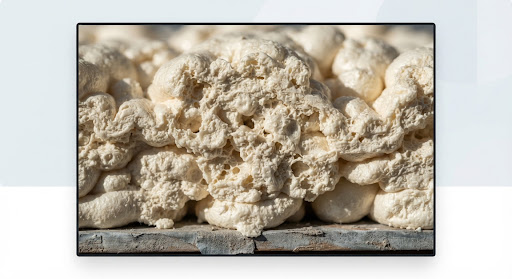
SPF roofs are famously repairable — that is one of the system's core virtues — but only when the repair respects the chemistry. Impact damage from dropped tools or hail, gouges from careless trades, blisters from moisture driven into an aging surface, and UV degradation on a coating that ran past its recoat window all have specific, correct fixes: cut out and dry the affected foam, re-foam the void, and re-coat to match the surrounding membrane. What kills foam roofs is the wrong repair — asphalt mastic smeared over a blister, incompatible caulks, patches that trap moisture in the foam. We repair SPF the way the foam roof repair discipline specifies, because a correct repair disappears into the roof and an incorrect one becomes next winter's bigger leak.
The asphalt-mastic patch deserves its own warning, because we cut them out of Kern County foam roofs constantly. Black mastic smeared over a foam blister looks like a repair and behaves like a trap: it is incompatible with the silicone the roof will eventually need, it absorbs heat in a market that already has too much, and it seals moisture into the foam, where summer sun vaporizes it and grows the blister it was supposed to fix. Every mastic patch is future demolition — it must be ground out before the roof can be recoated, at your expense, years after the handyman who applied it cashed the check. If your foam roof has been "repaired" this way before, tell us during the assessment; finding and pricing those removals up front is part of giving you a recoat bid that holds.
Water is a liar. It enters at a parapet crack on the north side, travels a purlin or a deck flute for forty feet, and drips over the server room — and the contractor who patches the ceiling stain's nearest seam has fixed nothing. Our repair calls start with diagnostics that beat the liar: a drone survey of the entire surface, moisture readings around the suspect zones, core samples where we need to see what the assembly is doing inside, and a walk of the interior evidence with your maintenance people. It takes a little longer than pointing at the obvious crack. It is also why our repairs hold. You get the findings in writing, with photos, and a bid within 48 hours of the assessment.
The inside of the building testifies if someone listens. Where the stains appear, how fast they respond to a storm, whether they track structural lines, whether they show in summer (condensation or HVAC, usually) or only in rain (the roof itself) — each answer cuts the search area down. We ask your maintenance people the questions a patch crew never asks: when did it start, what changed on the roof that year, who worked up there last. More than one "roof leak" in a Bakersfield warehouse has turned out to be a condensate line, a swamp cooler, or a wall breach masquerading as a roof problem, and finding that out during a free assessment is considerably cheaper than finding it out after three rounds of roof patches.
Surface evidence sometimes is not enough, especially on roofs with multiple layers of history. That is when core sampling earns its place in the process: a small plug cut to the deck tells us which layer is wet, how far the saturation spreads, and whether the assembly under the leak is still worth repairing over. Cores get moisture-tested on the spot and permanently sealed the same hour. On repairs, this is the step that separates fixing the roof from redecorating it — a beautiful patch over saturated insulation is a receipt, not a repair.
Six inches of annual rain sounds like a roofing vacation until you watch how Bakersfield actually receives it: months of nothing while dust and debris settle into drains and scuppers, then a storm that drops an inch in an afternoon onto a surface with nowhere to send it. Water stands for days, loaded with abrasive grit, working at every seam, blister, and hairline crack the summer UV opened. Repairing pond-related damage without addressing the pond is a subscription, not a fix — so our ponding repairs pair the membrane work with drainage correction: clearing and re-securing drains, resetting scupper flashing, and building foam crickets to move water where it refuses to move itself. It is the difference between fixing a leak and retiring one.
For owners who want to stay ahead of the cycle, we fold drainage into simple preventive rhythm: strainers and scuppers cleared in October before the first real storm, a drone pass every few years to catch new low spots as buildings settle and equipment gets added, and low-cost foam crickets installed during any other roof work while the crew is already mobilized. None of this is exotic. All of it is cheaper than the alternative, which in Bakersfield is a January phone call with water over the racking and every roofer in Kern County already booked.
Wind deserves a mention alongside water, because Kern County's storm damage is as often mechanical as it is wet. The gusts that funnel through the Tehachapi gap and across the valley floor lift loose edge metal, peel membranes back from corners where fasteners had already loosened, and turn unsecured rooftop debris into puncture hazards moving at highway speed. After any significant wind event we recommend a perimeter-and-penetrations walk even if nothing is leaking yet — lifted edges rarely leak on day one, and re-securing an edge is a fraction of the cost of replacing the membrane section that departs in the next gust. Our drone surveys after wind events document conditions across the whole roof plane in minutes, which is exactly the record you want in hand before an insurance conversation and before the damage compounds.
Bakersfield's roof-level environment is the harshest in our service area: surface temperatures far above ambient on dark membranes, day-night swings that flex every joint through thousands of cycles a year, and UV intensity that chalks coatings and embrittles single-ply years ahead of the same product's life in a coastal market. The repair consequences are predictable — splits at seams and stress points, alligatored coatings, cracked pipe boots, sealants that let go — and so is the honest prescription: repair the damage with materials rated for this exposure, then get ahead of the cycle with a reflective restoration coating before the next round of damage opens. A repair visit that ends with a coating plan is a repair visit that does not repeat every winter; our guide to how long spray foam roofing lasts shows what proactive recoating does to the damage curve.
Timing matters more here than owners realize. Bakersfield's damage season and its discovery season are offset by months: summer does the damage silently — nothing leaks at 105°F and zero rainfall — and the first November storm presents the bill all at once. The smart move is a fall assessment, after the heat has done its work and before the water arrives to find it. Repairs made in October are made on our schedule and yours, in good working weather, at normal pricing. The same repairs in January compete with every other leaking building in Kern County. We batch assessments weekly year-round, but if you take one thing from this page, take the calendar advice: the cheapest week to find your roof's problems is the week before the first storm, not the morning after it.
Across all of those categories, one discipline holds: material compatibility. Every patch we place is chosen to bond with what the roof is now and with what the roof will need next — silicone-compatible repairs on coated roofs, foam-compatible work on SPF, correctly primed details on metal. It costs nothing extra to repair this way and it saves real money later, because when the roof reaches its restoration point, none of our repair work has to be cut back out. We also photograph every repair before and after and leave the documentation with you — useful for your maintenance file, for insurance records after storm events, and for the day you sell or refinance the building and someone asks for the roof's history.
Not every roof should be repaired, and not every aging roof needs replacing. The core samples usually make the call obvious.
| Roof condition | Right answer | Cost signal |
|---|---|---|
| Localized damage; assembly dry and sound | Targeted repair | Job-priced; free assessment, bid in 48 hours |
| Widespread surface wear; structure and insulation sound | Repair + silicone restoration coating | $2–$4 / sq ft |
| Failing membrane; deck sound; owner wants insulation gains | New SPF roof over existing | $4–$8 / sq ft |
| Saturated insulation, rotted deck | Deeper remediation — coating or patching would waste money | Scoped case by case, with the evidence shown to you |
We put the same numbers and photos in front of every owner and let the roof argue its own case. If a $2,500 repair buys your roof five more years, that is what we will tell you — because the recoat or replacement we eventually do for an owner who trusts us is worth more than any oversold patch.
One more honesty note on that table: "repair plus coating" is the row most Bakersfield roofs actually land in, and it is also the row most owners never get offered — patch outfits do not sell restorations, and replacement contractors do not sell patches. Because we work the entire spectrum, from a single boot repair to a full SPF system, our incentive is simply to match the roof to the right row. That breadth is rarer than it should be in this market, and it is the practical reason an assessment from us reads differently than three competing bids that each happen to recommend exactly what the bidder sells.
Straight answer, because leaking buildings deserve one: our crews dispatch from our Tulare County shop, roughly ninety minutes north of Bakersfield on CA-99, and Kern County assessments batch weekly. Active-leak calls get triaged ahead of routine assessments, and because our rigs mobilize self-contained, a green-lit repair is not waiting on staging or suppliers. We will not invent a response-time guarantee we cannot keep every single time — contractors who promise the world at 2 a.m. tend to bill like it — but you will get an honest ETA when you call (559) 739-9519, and we keep the ETAs we give.
When a roof is actively taking on water and the schedule cannot get us there the same day, we talk you through honest interim measures over the phone: where to place containment inside, how to safely divert water away from electrical gear and inventory, and what your own maintenance crew can and should not attempt on a wet membrane. Temporary dry-in work — properly placed, properly weighted covering over a breach — buys days without damaging the roof, and unlike the mastic-bucket approach, it does not create demolition work for the permanent repair. It is not glamorous advice, but it is the advice that protects your building between the phone call and the crew, and it costs you nothing.
Repair work in Bakersfield means working around what is under the roof. In the big-box distribution corridor along Highways 99 and 58, that means containment discipline over racking and pick lines, and repairs sequenced with facility managers so receiving never stops. In the oil patch around Oildale and east Kern, it means metal-roof repairs — fastener replacement, seam sealing, rust remediation — on shops and field offices that cannot pause operations. In the citrus, carrot, and almond processing plants of Shafter, Wasco, Delano, and Arvin, it means food-safety awareness: clean containment, documented materials, and scheduling that respects pack season. Twenty-plus years of valley work means none of this is new to our crews.
Site compliance is part of the same professionalism. Energy-sector facilities run contractor orientations, hot-work permits, and strict access control, and a repair crew that treats those requirements as friction slows your job down and burns your safety record; ours arrive expecting them, with the paperwork, insurance certificates, and orientation compliance handled before mobilization day. Food facilities audit their contractors' materials and containment practices, and our documentation is ready before the auditor asks. Distribution sites want proof of insurance and a plan for working over active operations before anyone touches a ladder. This administrative readiness sounds boring right up until the moment a contractor without it is standing at your gate, unbadged, while your roof leaks behind him.
Delano, Shafter, Wasco, and Arvin sit squarely inside our Bakersfield service pattern — same weekly assessment batching, same self-contained mobilization, same crews. A packing-house leak in Delano or a shop roof split in Arvin is not a "we'll get to it" call; it rides the same triage as a job on Rosedale Highway, with the same crews, the same diagnostic standards, and the same 48-hour written bid at the end of it. If your building sits anywhere in the Bakersfield orbit, it is in our lane.
The satellite towns actually concentrate some of the county's most repair-critical roofs. Delano's cold storage and packing buildings cannot tolerate water over product, period — a small leak there carries food-safety consequences a dry-goods warehouse never faces. Shafter's new logistics stock is young, but young roofs still take forklift-mast punctures at the dock line and installer errors reveal themselves in year three. Wasco and Arvin carry older ag buildings where decades of patch-on-patch history make honest diagnostics matter most. We treat each of those contexts on its own terms, and the assessment paperwork reflects the building in front of us, not a generic checklist.
Because repair is where a roofing company's honesty shows. We are family-owned, twenty-plus years in the valley, fully licensed (CA Lic #C-2-1052735), BBB accredited, and SPFA members, and we back our work with industry-leading leak-proof guarantees. We diagnose with evidence, we repair to restoration-grade standards, and we tell you the truth about the repair-versus-replace line — our installation process guide shows exactly what the full-system path looks like when a roof is truly done. One call to (559) 739-9519 starts with a drone survey and ends with a written bid in 48 hours — findings, photos, and every viable path priced side by side, so the decision is yours and the evidence is on the table. The leak does not get a vote.
Also serving Bakersfield: Spray Foam Roofing in Bakersfield · Silicone Roof Coating in Bakersfield · Commercial Insulation in Bakersfield. See all Bakersfield services on the Bakersfield service hub, or read our full foam roof repair guide. Nearby: Foam Roof Repair in Merced.
Honestly: our crews dispatch from our Tulare County shop about 90 minutes north on CA-99, we batch Kern County assessments weekly, and active leaks get triaged ahead of routine work. We will give you a real ETA when you call rather than a marketing promise, and we keep the ETAs we give.
We are foam and flat roof specialists - SPF is our core system, but our crews repair the full range of low-slope commercial roofing found across Bakersfield: coatings, built-up, modified bitumen, single-ply, and metal. Every repair is done restoration-grade so it stays compatible with future coating or foam work.
UV degradation and thermal cycling do the slow damage - opened seams, cracked boots, chalked coatings - and then ponding water finds it. Kern County's dust-clogged drains make the ponding worse when the rare heavy rain arrives. Most of our repair calls trace back to that one-two punch.
Core samples usually settle it. If the assembly is dry and damage is localized, a targeted repair is the right money. Widespread surface wear over a sound structure points to repair plus a silicone coating at $2-$4 per square foot. A failing membrane over a sound deck points to new SPF at $4-$8. We show you the evidence and price each path.
Yes - all four towns ride the same weekly assessment batch and the same triage as Bakersfield proper. Our rigs mobilize self-contained, so a packing-house repair in Delano or a shop roof in Arvin gets the same response as a job inside the city.
It depends entirely on what the diagnostics find, so we do not quote blind numbers. The assessment is free - drone survey plus core sampling where needed - and you get a written bid within 48 hours. If repair plus a restoration coating is smarter than repair alone, the bid will show both paths priced.
Free assessment — drone survey, core sampling where needed, and a written bid within 48 hours, anywhere in Kern County.
Or Call Directly
(559) 739-9519