Closed-cell foam for metal buildings, warehouses, cold storage, and energy-sector facilities — R-6.5 per inch, air sealing, and condensation control in one pass.
Home / Bakersfield / Commercial Insulation
Commercial spray foam insulation in Bakersfield pays for itself faster than almost anywhere else in California, for one blunt reason: no city in our service area asks more of its cooling equipment. When the Kern County summer parks above 100°F for weeks, every uninsulated metal panel, every air leak at a ridge or an eave, and every thermally bridged bolt in a building envelope becomes a small open faucet of conditioned air pouring into the sky — and the compressor pays for all of it, hour after hour, May through October. Allstate applies closed-cell spray polyurethane foam — roughly R-6.5 per inch, air barrier and insulation in a single pass — to the metal buildings, warehouses, cold storage plants, and oil-patch facilities that make up Bakersfield's commercial stock. Commercial only: it is our lane, and we stay in it — residential work belongs to other crews, and our clients get a contractor built entirely around industrial and commercial constraints.
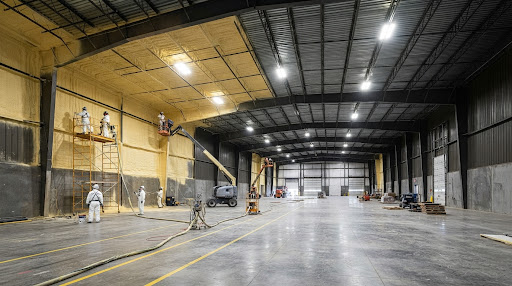
Drive Highway 58 east or wander the streets around Oildale and you will pass hundreds of pre-engineered metal buildings — shops, equipment barns, yards, small plants — whose entire thermal envelope is a single sheet of steel. Bare metal is a radiator: on a July afternoon the panels can be too hot to touch, and they re-radiate that heat straight down onto the shop floor until well after dark. Add the air leakage at panel laps, ridge vents, and framed openings, and conditioning the space is closer to conditioning the parking lot. Closed-cell spray foam applied to the underside of the roof panels and the wall girts transforms these buildings: the steel is isolated from the interior, the leaks are sealed in the same pass, and shops that were unbearable by 10 a.m. become workable all day. For crews doing precision work — machining, welding, electronics — the productivity change is not subtle.
High-bay geometry compounds the problem in ways single-story thinking misses. Heat stratifies: the air at the ridge of a thirty-foot building can run far hotter than at the floor, and an uninsulated roof feeds that hot layer continuously while every roll-up door cycle at the dock swaps expensively conditioned air for parking-lot air. Insulating the roof deck attacks the top of that stack directly — the ceiling stops radiating, the stratified layer stops being fed, and the HVAC (or the evaporative cooling many Kern County shops still run) finally gets to condition the space where people actually work instead of the volume where nobody does. Pair the envelope work with the door-discipline and destratification measures your operations team can implement for free, and buildings that were written off as unconditionable become ordinary.
Kern County processes a meaningful share of the produce America eats — citrus and carrots around Bakersfield, Arvin, and Edison, almonds through Shafter and Wasco — and all of it moves through refrigerated or conditioned space at some point between field and truck. Cold storage is where insulation stops being a comfort line-item and becomes core process equipment: the temperature difference between a 34°F cooler and a 105°F afternoon is enormous, it persists around the clock, and every weakness in the envelope is billed continuously at the compressor. Closed-cell SPF is the premier envelope material for this duty. It delivers the highest practical R-value per inch, and — just as important in refrigerated work — it is its own vapor retarder: warm, moist outside air cannot migrate through the foam to condense inside the assembly, the failure that quietly destroys fiberglass-insulated cold storage from within. We build insulation plans around each facility's operating temperatures and, critically for this county, around harvest and pack calendars.
Cold storage envelopes also live or die at their transitions — the dock walls where refrigerated space meets ambient, the ceilings over coolers that share structure with dry warehouse, the interior partitions between temperature zones. These junctions are where generic insulation jobs leak capacity, because batts and boards cannot seal the geometry where framing, panels, and penetrations collide. Spray foam can, and does, in the same pass that insulates the field. For processors weighing an envelope upgrade against another compressor, the envelope usually wins the arithmetic: refrigeration capacity you stop losing through the roof is capacity you do not have to buy, power, and maintain — and unlike machinery, foam does not wear out, cycle, or call for service on the hottest day of the year.
Bakersfield's energy sector runs on buildings that get used hard — pump and pipe shops, maintenance bays, warehouses of parts and downhole equipment, modular field offices baking on unshaded pads. These facilities share the metal-building problem and add their own wrinkles: big roll-up doors that dump conditioned air every cycle, high bays where heat stratifies, and duty cycles that cannot pause for a lengthy retrofit. Spray foam fits the constraints. Application is fast, it conforms to the ribbed panels and framing that defeat batt insulation, it adds stiffness and a measure of corrosion protection to the panel underside, and our self-contained rigs mean the work does not depend on site power or staging space. We sequence bays so operations continue while we work, and a typical shop is transformed in days, not weeks.
Energy-sector sites also bring compliance expectations that generalist insulation crews stumble over: contractor orientations, hot-work and confined-space awareness, strict housekeeping around ignition sources, and documentation for everything. Our crews arrive expecting that framework, not surprised by it. And where building codes require a thermal or ignition barrier over exposed foam plastic — as they do in many occupied assemblies — that requirement is scoped and priced in the bid up front, not discovered by your inspector afterward. The pattern repeats across everything we do in the oil patch: the technical part of the job is spraying foam; the professional part is doing it inside your rules without slowing your operation, and the second part is where twenty years of industrial work shows.
The distribution centers that have multiplied around the Highway 99/58 junction — and up the corridor through Shafter's logistics park toward Delano — compete on cost per pallet, and the building envelope is quietly one of the levers. High-bay warehouse space with thin or degraded roof insulation forces a choice between paying brutal cooling bills or letting summer interior temperatures drift into territory that OSHA heat rules, worker retention, and product specs all punish. Spray foam applied at the roof deck attacks the problem at its source, and pairing interior work with an insulated SPF roof system on the exterior — see our spray polyurethane foam roofing page — lets an owner fix waterproofing and thermal performance in one coordinated project instead of two separate capital fights.
California's workplace heat rules have moved this from a comfort conversation to a compliance one: the state's indoor heat-illness standard puts specific obligations on employers when indoor temperatures climb, and a Bakersfield warehouse with a thin envelope spends a lot of summer afternoons in that territory. Insulation is the structural fix — the one that lowers the indoor temperature curve itself rather than managing symptoms with break schedules and fans. For distribution operators staffing through valley summers, that has a second-order payoff that outlasts any single utility bill: buildings that hold reasonable temperatures keep their people, and in a logistics labor market as competitive as the 99 corridor, the building that is bearable in August has a hiring advantage over the one that is not.
Three properties make closed-cell SPF the default answer for Bakersfield commercial work. First, R-value density: at roughly R-6.5 per inch, foam reaches code-level and cold-storage-level R-values in a fraction of the thickness fibrous insulation needs — two to three inches does what batts cannot do at any practical depth on a metal panel. Second, air sealing: the foam is a continuous air barrier applied in the same pass, and in leaky metal buildings air movement is routinely as large a load as conduction; batts address one and ignore the other. Third, moisture behavior: closed-cell foam does not absorb water, does not sag away from panels over time, and functions as its own vapor retarder — the property that makes it the right material over cold storage and under metal roofs where condensation otherwise drips onto equipment and inventory every winter morning when the tule fog rolls through the valley floor.
Bakersfield's winters are mild but humid at ground level — tule fog can sit on the valley floor for days, saturating the air while clear nights drop steel panel temperatures below the dew point. In an uninsulated metal building, that combination manufactures indoor rain on a schedule: condensation forms on the panel underside overnight and releases onto whatever sits below as the morning warms. Rust on stock, water spots on finished product, corrosion tracking across electrical gear, wet insulation in any batts that were supposed to prevent this — all of it traces to one condensing surface. Closed-cell foam removes that surface from the equation entirely, because interior air never touches cold steel again. Owners buy foam for summer and then discover the winter benefit was worth the price by itself.
Open-cell foam is a legitimate material with a real niche — it is cheaper per inch and useful where sound control matters more than R-density. But its lower R-value per inch, air-permeable structure, and moisture absorption make it the wrong default for Kern County's metal buildings and refrigerated envelopes, where vapor drive and condensation control are half the job. When a Bakersfield project genuinely calls for open-cell, we will say so and price it; the rest of the time, closed-cell earns its premium by doing three jobs at once in the exact conditions this county serves up.
Most Bakersfield metal buildings that have any insulation at all have the vinyl-faced fiberglass blanket that came with the kit — and most owners already know how that story goes. The comparison, honestly told:
| Factor | Closed-cell spray foam | Fiberglass blanket / batts |
|---|---|---|
| R-value per inch | ~R-6.5 | ~R-3 range |
| Air sealing | Yes — insulation and air barrier in one pass | No — leaks continue at laps, ridges, openings |
| Fit on ribbed metal panels | Conforms completely, no gaps | Compressed at every girt and purlin, gapped at ribs |
| Moisture and condensation | Closed-cell; own vapor retarder; controls panel condensation | Absorbs moisture, sags, facing tears; condensation persists |
| Longevity in service | Decades; bonded to structure | Degrades, sags, and is often falling by year 15 |
| Installed cost | Higher up front | Cheaper up front, repaid in energy and replacement |
Fiberglass wins exactly one row of that table. In a mild climate that row can carry the argument; in Bakersfield's cooling season it cannot. There is also a replacement-cycle cost fiberglass owners rarely book: the blanket that came with the building sags, tears at its facing, slips off the purlins, and eventually hangs in strips that have to be pulled and landfilled before anything better can go in — a demolition line item foam never generates, because it is bonded to the structure for the life of the building. When we quote a retrofit over failed blanket insulation, removal is priced explicitly, and it is the last time that cost will ever appear in the building's books.
Insulation pricing is honest only when it is specific, because the per-square-foot number moves with thickness (a cold storage envelope wants far more R than a parts warehouse), substrate and prep, access and lift requirements, and project size — mobilization spreads thinner over 60,000 feet than over 6,000. That is why we price from a site visit rather than publishing a one-size number that would mislead half the people reading it. What we can promise about cost: the assessment is free, the bid is written and itemized within 48 hours, and thickness and R-value are specified explicitly so bids can be compared like-for-like against any competitor. For how we think about foam economics generally, our spray foam cost guide walks the same logic on the roofing side.
The return side of the ledger deserves equal specificity. An insulation project in this market repays through several channels at once: the cooling energy that stops escaping, the refrigeration capacity that stops being wasted, the condensation damage that stops occurring, the compliance exposure that shrinks, and — least measurable, most mentioned by owners afterward — the working conditions that stop costing people. Bakersfield's long, severe cooling season means each channel pays more per square foot here than the identical project would pay in a coastal market. When we present the bid, we will walk the payback logic against your actual utility spend and operating pattern, so the decision-maker who signs it can defend it with numbers rather than adjectives.
California's Title 24 energy code sets envelope requirements for new commercial construction and for alterations, and the state's indoor-heat workplace rules have added a second regulatory reason to care what your building envelope does in summer. Closed-cell spray foam is a straightforward compliance tool on both fronts: continuous insulation with no thermal bridging performs at its rated value — unlike bridged assemblies that quietly underperform their paper R — and the air-barrier function contributes to the envelope tightness the code increasingly rewards. For Bakersfield owners doing alterations or additions, getting the insulation strategy right at permit time is dramatically cheaper than bolting it on after; we are happy to work from your plans and give your designer real numbers.
Any insulation contractor can quote a thickness; the ones worth hiring can defend it. When you compare bids for spray foam insulation in Bakersfield, ask three things. Is the bidder licensed and insured for commercial work in California — ours is CA Lic #C-2-1052735, and we are BBB accredited and SPFA members. Do they specify the foam type, thickness, and target R-value in writing, so you are comparing real scopes instead of round numbers — our bids do, within 48 hours of the assessment. And do they understand your industry's constraints — wash-down requirements in food plants, hot-work rules on energy-sector sites, receiving schedules in distribution — or will your operations team be educating them on the fly? Twenty-plus years in the valley means our crews have already worked inside every one of those constraint sets.
There is a structural reason to prefer a specialist here, too. Spray foam quality is applicator-dependent in a way batts are not: correct substrate temperature and preparation, correct mix and pass thickness, correct cure conditions — each is a craft decision made in real time on your site, and each one done wrong hides inside a finished surface that looks fine. A contractor whose whole business is foam has crews who make those decisions correctly by habit and equipment maintained for exactly this work, and stands behind the result because foam is the reputation, not a sideline bolted onto a roofing or drywall operation. That is what SPFA membership signals and what twenty years of valley referrals verify: when the entire company is the craft, the craft does not get delegated to whoever was available that week.
It starts with the free assessment — we batch Bakersfield-area visits weekly, so the walk-through happens within days of your call. We measure the envelope, look at the equipment loads and the utility history you can share, and scope the foam plan: areas, thickness, R-targets, prep, and sequencing around your operations. The written bid lands within 48 hours. On execution, our rigs mobilize from our Tulare County shop ninety minutes up CA-99, fully self-contained — foam, compressors, generators on board — and we protect, mask, and ventilate properly, spray to specified thickness with depth checks as we go, and leave the space clean and ready for use on the schedule we agreed. No surprises is the whole method.
Preparation and re-occupancy get planned with the same care as the spraying itself. Foam application requires proper masking of everything that must stay clean — equipment, fixtures, sprinkler heads, lighting — and active ventilation during and after application, with re-entry timing agreed in advance so your people are never guessing about when a zone is back in service. In occupied facilities we typically work in contained zones, off-shift where the operation demands it, and we walk each completed area with your maintenance lead before the masking comes down. The finished work is inspected against the specified thickness with depth gauges, documented, and photographed — the same evidence-first habit that runs through our roofing installation process, applied indoors.
Our commercial insulation service covers Bakersfield and its satellite towns as one territory: almond facilities in Shafter and Wasco, packing and cold storage in Delano, ag-commercial buildings in Arvin, energy-sector facilities across Oildale and east Kern, and the warehouse corridor the length of Highway 99. The satellite towns are not an afterthought: our weekly assessment batching covers them on the same cadence as the metro, and our self-contained rigs make a Wasco hulling facility exactly as reachable as a shop on Rosedale Highway. One call to (559) 739-9519 puts your building on this week's assessment run — and puts real numbers, not guesses, in front of whoever signs off on the project. If the building also needs its roof addressed, say so on that first call: combining an interior foam project with an exterior SPF or coating project shares mobilization cost across both scopes, and solving the whole envelope in one coordinated effort is how Kern County's sharpest owners buy this work.
Also serving Bakersfield: Spray Foam Roofing in Bakersfield · Silicone Roof Coating in Bakersfield · Foam Roof Repair in Bakersfield. See all Bakersfield services on the Bakersfield service hub, or read our full commercial insulation guide. Nearby: Commercial Insulation in Fresno · Commercial Insulation in Merced.
No - our Bakersfield insulation work is commercial and industrial only: metal buildings, warehouses, cold storage, ag processing, and energy-sector facilities. That focus is deliberate, and it is why our crews are fluent in the constraints those buildings carry, from food-safety rules to hot-work permits.
Roughly R-6.5 per inch, plus air sealing and vapor control in the same pass. Two to three inches on a metal roof or wall panel reaches performance that fibrous insulation cannot match at any practical thickness in that assembly, which is why closed-cell is our default for Kern County metal buildings and cold storage.
Usually, yes. We sequence work bay by bay or zone by zone, our rigs are fully self-contained so we do not draw on your site power or staging space, and we coordinate scheduling around your operations - including harvest and pack calendars for the county's citrus, carrot, and almond facilities.
It depends on thickness, substrate, access, and project size, so we price from a free on-site assessment instead of publishing a misleading flat number. Your written bid arrives within 48 hours and specifies foam type, thickness, and target R-value explicitly so you can compare it like-for-like against any other insulation contractor's quote.
Fiberglass compresses at every girt, gaps at every rib, absorbs moisture, and does nothing about air leakage - which in metal buildings is often as big a load as conduction. Closed-cell foam conforms to the panels completely, seals the leaks in the same pass, controls condensation, and holds its performance for decades.
Yes. Closed-cell foam provides continuous insulation with no thermal bridging, so it performs at its rated value, and its air-barrier function supports the envelope tightness Title 24 increasingly rewards. For alterations and additions in Bakersfield, we can work from your plans and give your designer exact thickness and R-value numbers at permit time.
Free assessment — drone survey, core sampling where needed, and a written bid within 48 hours, anywhere in Kern County.
Or Call Directly
(559) 739-9519