Closed-cell foam for Fresno's metal buildings, warehouses, packing houses, and cold storage — R-6.5 per inch with air sealing and condensation control built in.
Commercial spray foam insulation in Fresno, CA turns the buildings that run this region's economy — metal shops, warehouses, packing houses, and cold storage — into envelopes that actually hold their conditioned air. Closed-cell spray polyurethane foam delivers roughly R-6.5 per inch, air-seals as it insulates, adds a vapor retarder in the same pass, and bonds structurally to metal panels and decking. In a county where summer highs sit above 100°F for weeks and PG&E demand charges punish every BTU of leakage, insulation is not a comfort upgrade; it is operating-cost equipment. Allstate Spray Foam has installed it across the Central Valley for more than twenty years — family-owned, Fully Licensed · Lic #C-2-1052735, BBB Accredited, SPFA member — and our rigs reach Fresno in about 45 minutes north on CA-99 from our Tulare County shop.
One boundary up front: our lane is commercial and agricultural work. Metal buildings, warehouses, processing plants, cold storage, shops, barns — not residential attics and crawlspaces. That focus is deliberate: commercial foam is rig-scale work with different chemistry choices, thickness specs, and code paths than house insulation, and it is what our crews do every week.
Spray polyurethane foam arrives as two liquids that react at the gun and expand into place. Closed-cell foam — the commercial workhorse — cures rigid and dense, with its gas-filled cells sealed shut. Three consequences matter to a Fresno building owner. First, thermal performance: about R-6.5 per inch, roughly double fiberglass per inch of depth, so real R-values fit inside shallow metal-building cavities. Second, air sealing: foam expands into every gap, seam, and fastener penetration, and in most commercial buildings air leakage moves as much energy as conduction does. Third, moisture control: at typical thickness, closed-cell foam functions as its own vapor retarder and cannot wick or hold water. No other single material does all three jobs in one application — which is why the same chemistry, in a different formulation, is also what we install on roofs as spray polyurethane foam roofing.
Spray foam comes in two families, and the distinction matters enough to spell out. Open-cell foam is soft, light, and cheaper per inch, with an R-value around R-3.5–R-3.8 — a fine product for interior sound control and certain wall assemblies, but it absorbs water and offers no vapor control. Closed-cell foam is rigid and dense, carries roughly R-6.5 per inch, rejects moisture outright, and adds genuine structural stiffness to whatever it bonds to. For the buildings we insulate around Fresno — steel skins subject to condensation, warehouses under punishing cooling loads, cold storage where vapor drive is the whole battle — closed-cell is the correct specification nearly every time, and it is what our commercial rigs run. When a scope genuinely suits open-cell (an interior partition wall, a sound-control ceiling), we say so and price it honestly; what you will not get from us is open-cell quoted where closed-cell physics is required, just to win on price.
Building code treats spray foam as a combustible plastic, which means foam in occupied spaces generally must be separated from the interior by a thermal barrier — half-inch drywall or an approved equivalent — or covered with an intumescent coating rated for the purpose, with specific allowances and exceptions depending on the building and occupancy. This is not fine print to discover at inspection time; it is a design input that belongs in the bid. Our proposals for Fresno projects state how ignition and thermal barrier requirements will be met for your specific occupancy — coating, board, or existing assembly — so the price you compare includes the code path, not just the foam. Any bidder who waves the topic off is quoting you a change order in advance.
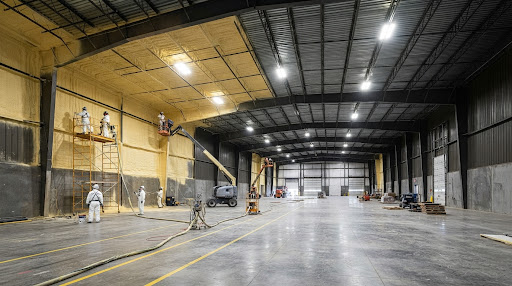
Drive any corridor out of the city — CA-180 west toward Kerman, CA-99 south through Fowler and Selma, Golden State Boulevard past the older industrial stock — and you pass thousands of steel buildings insulated with either sagging vinyl-faced blanket or nothing at all. Bare metal skins mean interiors that track the outdoors: 110°F-plus inside on July afternoons, dripping condensation during tule fog season as warm moist interior air hits cold panels. Closed-cell foam sprayed directly to the walls and roof deck fixes the whole failure pattern at once. It insulates at R-6.5 per inch, glues the panel system together (adding measurable rigidity), encapsulates every through-fastener, and — because the foam surface stays near room temperature — ends the condensation drip that rusts equipment and stains inventory. For shops, equipment barns, and packing sheds around Sanger, Selma, Kingsburg, and Kerman, a foam retrofit is routinely the difference between an unusable summer building and a workable one.
Retrofit details matter on these buildings, and twenty years of them has taught us the traps. Existing vinyl-faced blanket usually comes down before foam goes up — spraying over compressed, dust-laden batt buries a future problem. Panel seams and skylight curbs get inspected for active leaks first, because insulation should never be the thing hiding a roof problem; where the roof itself is the patient, a foam roof from above may be the smarter scope. Lighting and electrical runs get coordinated so conduit stays serviceable. None of this is exotic — it is the difference between an insulation contractor in Fresno who does metal buildings weekly and a crew improvising its first one on yours.
South Fresno, Calwa, and Malaga carry the metro's logistics load — tilt-up and steel distribution boxes feeding the CA-99 corridor. Most were built with minimal roof-deck insulation, and their owners pay for it every summer as rooftop units fight heat radiating off the deck all afternoon. Spraying closed-cell foam to the underside of the roof deck (or foaming the roof from above — often the smarter move; see below) transforms the load calculation. The same applies to dock walls, where seams and panel joints leak conditioned air around the clock. For tenants under triple-net leases and owners marketing space, insulation performance shows up directly in the operating-expense line that Fresno's industrial market increasingly quotes. Warehouse projects are also where staging matters most: our crews work in sections, coordinate around racking and inventory, and keep the facility receiving while we spray.
The metro's other commercial stock benefits just as directly, even if it calls us less often. Downtown Fresno's older masonry buildings being repositioned as offices, studios, and event space frequently have uninsulated roof structures that make conditioning economics impossible until foam changes them. Back-of-house areas in Blackstone and Shaw corridor retail — stockrooms, prep kitchens, mechanical mezzanines — are routinely the envelope holes through which a storefront's cooling budget escapes. Churches, gyms, and shop-with-office buildings across Clovis, Fowler, and Selma share the same profile: big simple volumes, thin envelopes, and owners staring at summer bills that insulation would cut permanently. If the building has a cooling load and a metal or under-insulated shell, the physics — and the fix — are the same.
Fresno County's packing and processing plants — fruit off the east-side orchards through Sanger and Selma, and the cold chain that moves it — run refrigeration as their dominant utility cost. In cold storage, insulation defects do not merely waste energy; they build ice, and ice on evaporators, ceilings, and door frames is a defrost, maintenance, and safety problem. Closed-cell foam is the standard answer because it insulates and vapor-seals simultaneously: warm, humid outside air (or fog-season air) never reaches a cold surface inside the assembly to condense and freeze. We foam cooler and freezer envelopes, dock transitions, processing-room ceilings, and the chronically troublesome penetrations where refrigeration lines pass through walls. On these projects thickness specs come from dew-point math, not rules of thumb — under-speccing a freezer wall by an inch shows up as frost within a season, so we engineer it right the first time.
Timing is the other cold-chain reality: packing houses live and die by the harvest calendar, and an insulation crew that wants your cooler offline in August does not understand the business. We plan these projects for the off-season windows the operation actually has, sequence work zone by zone so product keeps moving, and coordinate with your refrigeration contractor so defrost cycles and door schedules are not fighting the installation. It is unglamorous logistics, but it is why food-side operators keep our number.
Nearly every Fresno insulation bid we win was previously specced as fiberglass batt or blanket, so here is the honest head-to-head:
| Factor | Closed-Cell Spray Foam | Fiberglass Batt / Blanket |
|---|---|---|
| R-value per inch | ~R-6.5 | ~R-2.9–R-3.8 |
| Air sealing | Built in — expands into gaps | None — air moves through and around it |
| Vapor control | Own vapor retarder at thickness | Needs separate facing; fails at seams |
| Moisture behavior | Closed cells — will not absorb or sag | Absorbs, sags, loses R-value when damp |
| Fit to metal buildings | Bonds to panels, seals fasteners, adds rigidity | Compressed at every purlin, gaps at details |
| Upfront cost | Higher | Lower |
| Lifecycle in Valley conditions | Decades, stable | Degrades with dust, moisture, pests, sag |
Fiberglass wins exactly one line of that table. In a climate with 100°F-plus cooling seasons, fog-season condensation risk, and ag dust that infiltrates every unsealed assembly, the performance lines are the ones that compound year after year. Where a budget genuinely cannot reach foam everywhere, hybrid designs — foam at the roof deck and rim details, batt in easy wall bays — capture most of the benefit; we spec those honestly too.
Beyond R-value and air sealing, closed-cell foam earns its keep in Fresno buildings in quieter ways:
Commercial insulation is bid to the project, not off a rate card, because the honest drivers vary: total square footage and mobilization scale, specified thickness (an R-13 shop wall and an R-40 freezer ceiling are different animals), substrate prep, masking and overspray protection around equipment and inventory, and access height. As orientation, closed-cell foam is typically priced per board foot — one square foot at one inch thick — and multi-inch commercial assemblies land at a few dollars per square foot in most Valley projects, scaling with thickness. What we commit to is the process: a free assessment of your building, and a written, line-itemed bid within 48 hours, so the number you plan around is real. Cost-per-square-foot logic, and how thickness drives it, is explained further in our spray foam roofing cost guide — the same math governs insulation work.
Payback context matters more than the sticker: on a metal building going from bare skin to R-13+ walls and roof, summer cooling loads drop so sharply that many Fresno owners see the project pay for itself within a handful of PG&E summers — and Title 24 compliance on alterations comes along with it rather than as a separate fight.
Two budgeting habits make these projects go well. First, spec to the load, not to the minimum: the marginal cost of another inch of foam is mostly material, while the mobilization, masking, and labor are already paid for — so the cheapest R-value you will ever buy is the inch you add during the original project. Second, get the whole envelope assessed even if you only intend to insulate part of it; knowing that the roof deck is the dominant loss path (it usually is, in this climate) prevents spending the budget on walls that were never the problem. The free assessment covers both questions before any money moves.
California's Title 24 energy standards apply to most commercial construction and many alterations in Fresno County, setting minimum envelope performance for conditioned buildings. Closed-cell foam makes compliance straightforward rather than marginal: continuous insulation values are met in fewer inches, and the air-sealing performance foam delivers is exactly the direction the code keeps moving. For unconditioned ag-exempt buildings, code may not force insulation — but refrigeration economics and worker conditions usually argue louder than the code does. We handle the documentation on every bid where Title 24 applies, and we will tell you plainly when it does not.
Spray foam is unforgiving of bad installation — off-ratio chemistry, wrong substrate temperatures, or rushed passes produce foam that shrinks, smells, or delaminates, and no warranty paperwork fixes it afterward. So when you evaluate any insulation contractor in Fresno, including us, check four things. State licensing you can verify (ours: Lic #C-2-1052735). Track record in commercial foam specifically — ask how many metal buildings and cold storage envelopes the crew has done, not just houses. Industry affiliation (we are SPFA members; the Alliance publishes the standards good installers work to). And a written scope that names product, thickness, and prep — not a per-foot number scribbled on a card. Twenty-plus years, family ownership, and BBB accreditation are our answers to those questions; we encourage you to ask them of anyone who bids against us.
Proximity is the fifth factor Fresno owners underrate until they need it. Spray foam is equipment-intensive work — rigs, proportioners, generators, hose heat — and a contractor trucking in from the Bay Area or Southern California prices every mobilization and disappears after the last one. Our shop sits 45 minutes down CA-99, which changes the economics of everything after the sale: warranty visits, small additions when you expand the building, a quick look when your facilities manager notices something odd. Buying foam from the company that will still be nearby in year fifteen is cheaper than it looks on bid day.
Most of our Fresno insulation work happens in buildings that cannot shut down, so the process is built around it. Assessment first — we walk the facility, identify substrate and prep needs, and deliver the written bid within 48 hours. Scheduling gets planned around your operation: sections, shifts, or weekends as the facility requires. Prep is masking and protection — inventory, equipment, and finished surfaces get covered, and ventilation is set up per SPFA practice. Application runs in controlled lifts to the specified thickness, with depth checked as we go. Re-occupancy of sprayed zones follows the product's cure schedule — we state those windows up front so operations can plan, and the rest of the facility runs normally throughout. The mechanics are similar to our roof work, which is detailed on the spray foam roofing installation page; interior work adds the masking and ventilation discipline.
Quality is verified as we go, not assumed at the end: depth gauges confirm thickness against the spec in every zone, and pass thicknesses stay within the product's lift limits — foam installed in over-thick single passes can scorch or shrink, which is an installer-discipline failure no warranty paperwork repairs. At completion you receive documentation of what went on your walls and deck: product, thickness, and coverage — the paper trail that matters for Title 24 files, insurance questions, and the day you sell or refinance the building.
Here is advice that regularly saves Fresno owners money: if your roof is also near the end of its life, do not buy interior deck insulation and a re-roof separately. A spray foam roof installed from above is both — a seamless waterproof membrane and R-6.5 per inch of continuous insulation over the deck, with no interior disruption, no masking around racking, and no lost operating hours. For warehouses and processing plants whose roofs and energy bills are failing together, that single system is usually the best capital allocation on the table. Spray foam insulation in Fresno, in other words, sometimes belongs on top of the building rather than inside it — the assessment tells us which, and the two service pages together show the full picture.
The decision logic is straightforward. If the roof membrane has ten good years left and the pain is purely thermal, interior deck foam wins — it is cheaper per R and leaves the roof alone. If the roof is leaking or within a recoat-or-replace decision anyway, foam from above wins decisively, because you were about to spend roofing money regardless and the insulation arrives inside the same $4–$8 per square foot system. And if the building needs both wall insulation and a roof, bundling them into one mobilization saves real money over two separate projects a year apart. We quote the scopes separately and together so the comparison is yours to make with actual numbers.
Whether it is a Kerman equipment barn, a Malaga distribution box, a Selma packing line, or a downtown Fresno building being repositioned, the first step is identical: call (559) 739-9519. We assess the building free, spec the assembly honestly — foam where foam earns it, hybrid where that is smarter — and put a written bid in your hands within 48 hours. Family-owned, twenty-plus years in the Valley, Fully Licensed · Lic #C-2-1052735, BBB Accredited, SPFA member, and 45 minutes up CA-99 whenever your building needs us.
Also serving Fresno: Spray Foam Roofing in Fresno · Silicone Roof Coating in Fresno. See all Fresno services on the Fresno service hub, or read our full commercial insulation guide. Nearby: Commercial Insulation in Clovis · Commercial Insulation in Bakersfield.
Projects are bid to the building because thickness, square footage, prep, and access drive the number - closed-cell foam prices per board foot, and multi-inch commercial assemblies typically land at a few dollars per square foot. We assess your facility free and deliver a written, line-itemed bid within 48 hours.
No - our lane is commercial and agricultural work: metal buildings, warehouses, packing houses, cold storage, and shops. That focus is why our crews are rig-scale efficient on the projects we do take.
Yes - that drip is warm interior air condensing on cold metal panels, which is rampant during Fresno's tule fog season. Closed-cell foam bonded to the panels keeps interior air from ever touching cold steel, ending the condensation cycle and the rust and inventory damage that come with it.
Closed-cell foam delivers about R-6.5 per inch, roughly double fiberglass, so a 2-inch pass reaches R-13 and 3 inches exceeds R-19 - real numbers inside cavities where batt has to be compressed to fit. Foam also air-seals the assembly, which batt never does.
Yes - most of our Fresno projects run in occupied facilities. We work in sections, mask and protect inventory and equipment, follow SPFA ventilation practice, and state re-entry windows for sprayed zones up front so your operation can plan around us.
Title 24 sets envelope minimums for conditioned commercial buildings and many alterations; it does not mandate foam specifically, but closed-cell foam meets the requirements in fewer inches and adds the air sealing the code increasingly rewards. We handle the compliance documentation on every applicable bid.
Free assessment — drone survey, core sampling where needed, and a written bid within 48 hours, anywhere in Fresno County.
Or Call Directly
(559) 739-9519