Closed-cell foam for metal buildings, warehouses, and cold storage across Clovis — condensation control, R-6.5 per inch, and Title 24 performance in one application.
Commercial spray foam insulation solves a problem most Clovis building owners have simply learned to live with: steel and concrete shells that are brutal to occupy in July and clammy through the tule-fog months, with utility bills that reflect the fact the building has effectively no thermal envelope at all. A bare metal building on the Valley floor is a heat exchanger — the skin hits well over 140°F under summer sun and pours that load straight into the workspace, then reverses the trade on winter nights, sweating condensation onto everything below. Closed-cell spray polyurethane foam, applied directly to the interior of the roof deck and walls, converts that skin into an insulated, air-sealed, moisture-controlled envelope in a single application — roughly R-6.5 per inch, fully adhered, with no gaps, sags, or thermal bridges. Allstate Spray Foam Roofing has applied commercial foam across the Central Valley for more than twenty years as a family-owned, fully licensed contractor (Lic #C-2-1052735), BBB accredited and an SPFA member. Our crews reach Clovis from our Tulare County shop in about 55 minutes, and we work commercial exclusively — metal buildings, warehouses, cold storage, and shop space are the lane, and we stay in it.
The calls come from every corner of the commercial map. Owners of shop buildings who are tired of losing the afternoon to heat. General contractors closing out metal-building projects that need envelope numbers for the permit file. Property managers with a tilt-up whose tenants complain from both ends of the thermostat. Packing and processing operators whose refrigeration bills climb every summer. Warehouse operators discovering that the fiberglass blanket their building came with has been soaking, sagging, and feeding pests for a decade. The common denominator is a building that was never really finished — a structure without an envelope — and a single-application fix that finishes it. Because the same closed-cell chemistry is also our roofing product, we are often solving both sides of the same building's problem in one mobilization: foam above the deck as the roof, foam below it as the envelope.
Closed-cell SPF is the highest-performing insulation commonly available, and the number that headlines it — approximately R-6.5 per inch — understates the advantage. Fibrous insulation achieves its rated R-value only under laboratory conditions: perfectly installed, uncompressed, dry, and with zero air movement. Real buildings deliver none of those conditions, and air infiltration alone can cut fibrous performance dramatically. Closed-cell foam does not depend on stillness because it creates it: the foam is its own air barrier, bonded to the substrate across every square inch, so the rated R-value is the delivered R-value. The closed-cell structure also refuses to absorb moisture — decisive in a fog climate — and adds rigidity to metal panels, measurably stiffening a steel building's skin. Two inches on a warehouse roof deck delivers R-13 of continuous insulation plus a complete air seal; three inches reaches roughly R-19.5. For most Clovis metal buildings, the difference between before and after is not a percentage on a bill — it is whether the space is usable at 3 p.m. in August.
The air-sealing half of the story deserves equal billing in this county, because Valley air carries more than heat. Harvest season loads the atmosphere east of town with fine agricultural dust, and an unsealed metal building breathes that dust through every panel lap and fastener hole, filming inventory, equipment, and product with sediment that no janitorial budget defeats. Foam closes the envelope against it the same way it closes it against heat — by eliminating the pathways rather than filtering the flow. Shops that foam their buildings notice the change in weeks: less dust on the benches, fewer insects finding their way in, a building that holds its conditioned air instead of trading it with the outdoors several times an hour. For food-adjacent businesses and clean-sensitive operations, the sealed envelope is frequently worth more than the R-value that comes with it.
The Clovis Industrial Park east of Clovis Avenue, the contractor yards off Sunnyside and Fowler, and the steel buildings scattered from Sanger's packing districts to the shops out toward Friant share the same construction DNA: pre-engineered metal buildings with, at best, sagging vinyl-faced fiberglass blankets pinched between purlins and panels. That blanket system fails in every way that matters here. Compression at every purlin cuts its real R-value to a fraction of the label. The vinyl facing tears, and the exposed fiberglass drinks the condensation the panels produce. Birds and pests nest in it. And it does nothing to stop air exchange through the thousand fastener holes and panel laps of a steel skin. Spray foam replaces the whole failed assembly in one pass: applied to the underside of the roof panels and walls, it fills the purlin cavities, encapsulates the fasteners, air-seals the laps, and delivers continuous R-value with no compression points. The building gets quieter, stiffer, dryer, and dramatically cheaper to condition — and for owners running evaporative coolers or oversized package units to brute-force the heat problem, the equipment downsizing at replacement time is part of the payback.
Fresno County's economy moves perishables, and the cold chain runs on insulation. Sanger's fruit packing operations, processors across the metro, and the cold rooms behind Clovis's food businesses all fight the same physics: every BTU that leaks through the envelope is compressor runtime, and in a Valley summer the temperature differential across a cooler wall can exceed 65 degrees for weeks. Closed-cell foam is the standard answer in cold storage for reasons beyond raw R-value. Its air-sealing eliminates the infiltration that loads refrigeration hardest; its closed-cell structure is a vapor retarder in its own right, controlling the moisture drive that destroys lesser insulation at cold-wall interfaces; and it goes on seamlessly around the penetrations, hangers, and transitions where board insulation leaves joints. We insulate new cold rooms, upgrade existing ones, and — a Central Valley specialty — bring older packing and storage buildings up to the performance their refrigeration contractor wishes they had. Freezer and cooler work is scheduled around product and production; foam application is fast, and downtime is measured in shifts, not weeks.
The satellite towns in our Clovis service radius run on agricultural steel, and their buildings work harder than almost anything inside the city limits. Sanger's packing houses, equipment barns, and processing support buildings cycle between summer heat that punishes workers and product, and fog-season damp that corrodes everything a roof panel drips on. Friant's shops and facility buildings up toward Millerton Lake add wind exposure and the wider temperature swings of the foothill margin. For both, closed-cell foam is less an upgrade than a structural correction: it stiffens wind-worked panels, stops the condensation that rusts buildings from the inside out, and makes seasonal workspaces usable across more of the year without heroic HVAC.
Ag operations also bring scheduling realities that a commercial insulation contractor either respects or fails. Harvest and packing seasons are untouchable; the work happens in the shoulder months or not at all. Buildings often cannot be fully emptied, so we mask, phase, and stage around equipment that stays. And budgets answer to commodity years, which is why our bids itemize thickness options honestly — the two-inch condensation-and-comfort spec versus the three-inch conditioned-space spec — so an operator can buy the performance the year affords and add to it later. Foam is one of the few insulation systems that genuinely accepts a phased approach: a second lift bonds to the first without seams or waste.
The comparison every owner asks for deserves a straight table rather than adjectives. Both materials insulate; the difference is what else each one does, and fails to do, in a Valley steel building.
| Factor | Closed-cell spray foam | Fiberglass batts / blankets |
|---|---|---|
| R-value per inch | ~R-6.5, continuous, no compression loss | ~R-3 nominal; real-world value drops with compression and air movement |
| Air sealing | Complete — foam is its own air barrier | None; requires separate air barrier rarely installed in metal buildings |
| Moisture behavior | Closed cells reject water; controls condensation on steel | Absorbs condensation, sags, loses R-value, feeds corrosion |
| Fit to metal buildings | Fills purlin cavities, encapsulates fasteners and laps | Compressed at every purlin; facing tears; pest habitat |
| Structural effect | Stiffens panels, damps noise and oil-canning | None |
| Installed cost | Higher upfront; strongest lifetime economics in harsh climates | Cheapest upfront; frequent replacement and energy penalty |
Fiberglass keeps winning specifications on one axis only: first cost. In a mild climate with a framed, sheathed building, that can be a defensible trade. In an unconditioned steel box on the Fresno County valley floor — 100-degree summers, fog-season condensation, ag dust working through every unsealed lap — it is a purchase that keeps costing money every month it remains installed.
Owners sometimes ask about the middle options — rigid board, reflective bubble products, blown cellulose in framed sections — and each has a niche, none of it here. Board insulation on the underside of a metal roof fights the purlin geometry and leaves air paths at every joint; reflective barriers address radiant gain only and do nothing for air sealing or condensation; cellulose has no business near a fog-season steel skin. The reason closed-cell foam keeps winning Valley metal buildings is not marketing — it is that one material does all four jobs the building actually needs done: insulation, air barrier, vapor control, and panel stiffening. Any alternative requires assembling three or four products to match it, installed perfectly, in a building geometry that punishes assembly.
Commercial insulation pricing turns on three variables: foam thickness (driven by your target R-value and Title 24 requirements), substrate preparation (a new build sprays clean; a retrofit may need old blanket insulation stripped and panels prepped), and project geometry (open warehouse ceilings spray efficiently; cut-up spaces with racking, equipment, and lifts in place take staging). Because those variables swing widely, we quote from a site visit rather than publishing a misleading single number — but the structure of the bid is always transparent: square footage, specified thickness and resulting R-value, prep scope, and staging plan, in writing within 48 hours of the assessment. For context on how foam pricing behaves at commercial scale — and why thickness is the honest lever rather than the place bids quietly cut corners — our spray foam cost guide covers the economics in depth. The short version: foam costs more than fiberglass on day one and less than fiberglass every month after, and in this climate the crossover comes fast.
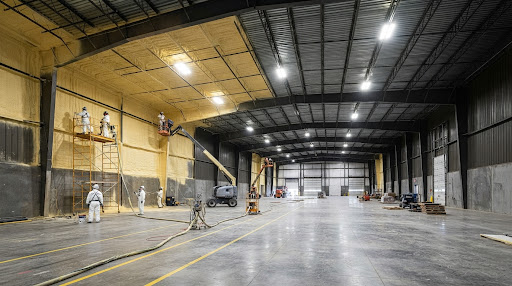
California's Title 24 energy code shapes commercial insulation decisions in two directions. New construction and major renovations in Clovis must meet prescriptive envelope requirements, and closed-cell foam's continuous insulation — no thermal bridging through framing, no compression losses — makes compliance straightforward to demonstrate and document. But the code also reaches existing buildings more often than owners expect: alterations, changes of occupancy, and significant HVAC replacements can trigger envelope requirements, and an uninsulated metal building that was grandfathered for decades suddenly needs a real thermal envelope before the project closes out. Foam is frequently the only practical retrofit path in those cases, because it installs against the existing skin without reframing, furring, or losing usable interior volume. We document installed thickness and R-value for your compliance file, and we coordinate with your design-build or mechanical contractor so the envelope numbers and the equipment sizing tell the same story to the plan checker.
The paperwork side is easy to underrate until a project stalls on it. Our bids state the foam product, the installed thickness, and the resulting R-value in writing, and our completion documentation records what actually went on the steel — measured, not assumed. For owner-builders and small GCs navigating a Fresno County permit on a metal building, that file is the difference between a smooth final and a re-inspection; for owners who never pull a permit at all, it is the record that travels with the building when it sells or refinances. Either way, an insulation project that cannot document itself is worth less than it cost, and we treat the documentation as part of the product.
Ask any Clovis shop owner about winter and you will hear about the drip. On clear nights the Valley floor radiates heat to the sky and metal roof panels drop below the dew point; when the tule fog settles in — as it does for days at a stretch between November and February — the entire building skin sits at saturation. Inside an uninsulated steel building, that means condensation raining off the purlins onto inventory, equipment, and stored materials, rusting the fasteners from the inside, and soaking whatever fiberglass was supposed to be insulating the roof. Closed-cell foam ends the cycle mechanically: with the interior surface of the envelope insulated to R-13 or better, the surface the indoor air touches never falls below dew point, so there is nothing to condense on. The foam itself cannot absorb moisture, so there is no wet-blanket failure mode. For warehouses storing paper goods, steel stock, packaged food, or anything else that hates water, condensation control alone has justified more Central Valley foam projects than energy savings ever did.
There is a corrosion dividend, too, that owners only appreciate in year ten. A metal building that sweats every winter is quietly rusting at its fastener points, panel laps, and purlin contacts — the exact locations that determine the building's lifespan. Encapsulating the interior skin in closed-cell foam takes those surfaces off the condensation cycle entirely, which is why insurers and lenders reviewing older steel buildings look kindly on the upgrade. The foam does not just make the building cheaper to run; it makes the building last longer, and in a market where replacing a pre-engineered structure costs multiples of insulating one, that is the quietest return on the whole project.
Not every commercial foam job is a warehouse. Clovis's growth has filled the Herndon corridor around Clovis Community Medical Center with medical office buildings and clinics, and the northeast retail pads keep adding conditioned commercial space. In these buildings foam earns its keep at the roofline and in specific assemblies: sealing and insulating roof decks under mechanical penthouses, quieting and conditioning the envelope of tilt-up shells before tenant improvement, and solving the comfort complaints that follow when a suite's perimeter was value-engineered a decade ago. Conditioned-space work rewards foam's precision — it goes exactly where sprayed, adheres overhead without fasteners, and air-seals as it insulates, which HVAC contractors notice at balancing time. Where the project is the roof itself rather than the interior, the same chemistry works from above as a roofing system; that path — foam as the roof, not under it — is covered in our spray polyurethane foam roofing overview, and many Clovis buildings ultimately do both.
Commercial foam succeeds or fails on preparation and scheduling discipline, so our process is built around both. It starts with the free assessment: we walk the building, measure, check existing insulation and moisture conditions, and deliver a written bid within 48 hours specifying thickness, R-value, prep, and staging. Before spray day, the areas to be foamed are cleared or masked — we plan around racking, equipment, and operations, and phase large buildings so work continues in occupied zones. Application itself is fast: a crew can foam thousands of square feet of deck per day, with thickness verified as passes build. Ventilation is managed during and after application per SPFA practice, with re-entry timing coordinated so your operation, not the foam, sets the schedule. We close with documented thicknesses for your Title 24 or project file and a walkthrough of the finished envelope. Most retrofits are measured in days, and the building works better the first week than it did the previous decade.
Fire and finish requirements get engineered in, not discovered later. Where code or occupancy requires a thermal or ignition barrier over exposed foam, we include the appropriate coating or covering in the specification from the first bid — it is a known line item, not a surprise, and pretending otherwise is how low bids stay low until permit inspection. Similarly, where a space will be washed down, take physical abuse from forklifts and product, or face food-facility surface requirements, we spec the protective finish that matches the use. A commercial insulation bid that is silent on barriers and finishes is not cheaper; it is incomplete.
Plenty of insulation outfits will quote a metal building; far fewer spray closed-cell foam every working day, and the difference shows up in millage discipline, substrate prep, and honest thickness specs — the exact places a low bid hides its cuts. Allstate brings twenty-plus years of Central Valley foam work, SPFA membership, BBB accreditation, and CA License #C-2-1052735 to every project, and we bring the specialist's honesty: commercial is our only insulation lane, so if your project is a residential attic, we are the wrong call and will say so. What we promise a Clovis business is simple — a free assessment with real measurements, a written bid in 48 hours with the thickness and R-value in ink, a crew that respects your operating schedule, and an envelope that performs in the two seasons the Valley uses to test buildings: the 100-degree stretch and the fog. Call (559) 739-9519 and we will put numbers to your building.
If you are still weighing whether the building justifies the project, apply the two-season test we use ourselves. Walk the space at 3 p.m. during a hundred-degree week and note what the heat is costing you in productivity, equipment stress, and cooling spend. Then walk it on a January fog morning and look up at the purlins for the condensation line. If either walk makes the case — and in an unfoamed Valley steel building, one of them almost always does — the assessment will tell you precisely what fixing it costs. Most owners who run that test wish they had run it five summers sooner.
Also serving Clovis: Spray Foam Roofing in Clovis · Silicone Roof Coating in Clovis · Foam Roof Repair in Clovis. See all Clovis services on the Clovis service hub, or read our full commercial insulation guide. Nearby: Commercial Insulation in Visalia · Commercial Insulation in Fresno.
It depends on thickness, prep, and building geometry, so we quote from a site visit rather than a phone estimate — but every bid is written, itemized, and delivered within 48 hours of the free assessment, with the specified thickness and R-value stated in ink. Foam costs more than fiberglass upfront and returns the difference in energy, condensation control, and not replacing failed batts.
Two inches of closed-cell foam (about R-13 continuous) is the working floor for most Valley metal buildings — enough to air-seal the skin and stop condensation. Three inches reaches roughly R-19.5 for conditioned or Title 24-driven projects. The right number depends on how the space is used, and the assessment settles it with your actual building, not a rule of thumb.
Yes — this is one of the most common reasons Clovis and Sanger building owners call us. Foam insulates the panels so the interior surface stays above dew point during tule-fog weather, and the closed-cell material cannot absorb moisture itself. The purlin drip that soaks inventory every winter ends when the deck is foamed.
No — and be wary of anyone who says yes. Compressed, moisture-laden blanket insulation has to come out so foam can bond directly to the panels and fill the purlin cavities properly. We include removal and prep in the written scope so there are no surprises on spray day.
Yes — cold rooms, coolers, freezers, and packing-house upgrades are a core part of our commercial work in Fresno County. Closed-cell foam delivers the R-value, air seal, and vapor control cold storage demands, and we schedule around product and production so downtime is measured in shifts.
No. Our insulation work is commercial only — metal buildings, warehouses, cold storage, shops, and commercial interiors. Keeping to that lane is why our crews are fast and our bids are accurate. For a Clovis business property, call (559) 739-9519 for the free assessment.
Free assessment — drone survey, core sampling where needed, and a written bid within 48 hours, anywhere in Fresno County.
Or Call Directly
(559) 739-9519