100% silicone restoration for foam, single-ply, modified bitumen, and metal roofs across Clovis — a fraction of replacement cost, without the tear-off.
Silicone roof coating gives Clovis building owners a third option between patching a tired roof forever and paying for a tear-off it may not need. Most flat roofs in eastern Fresno County do not fail structurally — they weather. The membrane surface chalks and craze-cracks under one of the highest UV loads in the country, seams and flashings open under summer heat cycling, and by year fifteen the roof leaks even though 90 percent of the assembly underneath is still sound. A 100% silicone coating system addresses exactly that situation: the existing roof is cleaned, repaired at its failure points, and sealed under a seamless, UV-immune, waterproof membrane at $2–$4 per square foot — typically a fraction of what replacement costs once demolition, disposal, and new material are counted. Allstate Spray Foam Roofing has been coating Central Valley roofs for more than twenty years as a family-owned, fully licensed contractor (Lic #C-2-1052735), BBB accredited and an SPFA member, with crews reaching Clovis from our Tulare County shop in about 55 minutes.
The timing question is the one that decides most coating projects, and it deserves plain language. A roof is a restoration candidate while its bones are still good — sound deck, mostly dry insulation, failures concentrated at seams, flashings, and the weathered surface. Wait too long and the window closes: water saturates the insulation field, the deck starts moving, and the only honest options left are sectional rebuilds or full replacement at several times the price. The frustrating part of this trade is meeting owners two winters after the coating window shut, holding repair invoices that add up to half a restoration and a roof that now needs the expensive answer anyway. The free assessment exists to put a date on your roof's window. A drone survey and a handful of core samples tell us — and you — whether this is a $2-per-foot year, a $4-per-foot year, or a year to budget for something bigger, and the written bid arrives within 48 hours either way.
Not all coatings are close cousins, and the distinction matters in this climate. Acrylic coatings are water-based; they re-emulsify under standing water and wear thin under UV, which makes them a poor match for Valley roofs that pond through the winter and bake through the summer. Asphaltic coatings dry out and crack on the same cycle that killed the original roof. High-solids 100% silicone is a different chemistry: it is moisture-cure, meaning humidity helps rather than hurts it; it is permanently UV-stable, so Fresno County's 260-plus sunny days cannot chalk it away; and it tolerates ponding water indefinitely — the single property that separates it from nearly everything else in the coating aisle. Applied at proper millage over a prepared surface, it forms a seamless rubber-like membrane that moves with the roof through 100-degree heat swings without splitting, and its bright white surface reflects the solar load that used to pour through the deck into your conditioned space.
Application quality is where identical materials produce opposite outcomes, so the specification matters as much as the chemistry. A proper system is applied in measured millage — typically two passes on a first-time restoration — with wet-film thickness checked during application rather than guessed afterward. Details are done first and by hand: seams get reinforcement where movement demands it, fasteners get individually capped on metal roofs, and flashings get brush-grade material worked into the transition before any field coating flows. Walk paths and equipment surrounds get granules embedded into the final coat, solving silicone's one genuine handling drawback — its slickness when wet — exactly where people actually walk. Every one of those line items appears in our written bid, because a coating quote that only states a price and a color is hiding the variables that determine whether the membrane lasts eight years or eighteen.
The buildings that benefit most from coating are the ones that can least afford replacement disruption, and Clovis is full of them. A tear-off means dumpsters in the parking lot, days of noise and debris, and sections of the building exposed to weather mid-project. A silicone restoration is quiet by comparison: cleaning, targeted repairs, and roller- or spray-applied coating, with the building open and operating underneath the entire time. That difference is decisive for the medical and dental offices clustered along Herndon Avenue near Clovis Community Medical Center, where patient schedules do not pause for roofing. It matters for the Old Town retail blocks along Pollasky and Clovis Avenue, where a shared roof spans several storefronts and no tenant wants to be the one closed during an event weekend. It matters for the schools, churches, and gyms scattered across the city, which need summer-window work that actually finishes inside the summer window. Coating projects compress the calendar in a way replacement never can.
Silicone's versatility across substrates is what makes it the workhorse of roof restoration. Over spray polyurethane foam, silicone is the standard protective layer — every SPF roof carries a coating, and recoating on schedule is what makes a foam roof effectively permanent (the full system story is in our spray polyurethane foam roofing guide). Over single-ply membranes like TPO and EPDM, silicone seals the seams and flashings that are the membrane's chronic weak points, buying a decade or more from a roof whose field material is still serviceable. Over modified bitumen and built-up roofs — the dominant stock on Clovis's older commercial buildings — silicone locks down alligatored, oxidized surfaces before they crack through. And over metal panels, covered in depth below, it solves the fastener-and-seam leak pattern that plagues every aging steel roof in the Valley. The free assessment tells us which situation your roof is in: drone survey of the field, core sampling where saturation is suspected, written bid within 48 hours.
One substrate note saves Clovis owners real money: mixed roofs. Older commercial buildings that have been added onto over the decades — common in Old Town and along the original arterials — often carry two or three different roof systems meeting at awkward transitions, and those transitions are reliably where the leaks live. Because silicone adheres across all of the common substrates, a single restoration can unify a mixed roof under one continuous membrane, eliminating the transition details that no patching program ever permanently solves. It is one of the quiet places where a coating outperforms even a partial replacement, which would simply create a new transition to leak.
We sell coatings nearly every week, and we still tell owners the whole truth about them, because a coating applied to the wrong roof fails and takes our name with it. The genuine advantages: silicone costs a fraction of replacement at $2–$4 per square foot; there is no tear-off, no landfill load, and minimal disruption; it handles ponding water and UV better than any competing chemistry; the white surface cuts summer cooling loads; and it is renewable — when it weathers thin in 10 to 20 years, you recoat again rather than replace. The honest limitations: silicone is slick when wet, so designated walk paths get granule embedment; it holds dirt and dulls over time, which affects looks more than performance but is worth knowing; once a roof is siliconed, future work must also be silicone, because almost nothing else adheres to it; and — most important — a coating is a restoration, not a resurrection. A roof with widespread saturated insulation, rotten decking, or structural issues needs those areas cut out and rebuilt, or needs a new roof entirely, and our core samples will say so before we quote a coating that should not happen.
Silicone roof coating price questions deserve real numbers, so here are the ranges Clovis projects actually land in and what pushes a roof up or down within them.
| Scenario | Typical price | Notes |
|---|---|---|
| Recoat of existing foam or coated roof | $2–$4 / sq ft | Cleaning, minor repairs, new silicone at spec millage |
| First-time silicone over BUR / mod-bit / single-ply | $2–$4 / sq ft, upper half of range with heavy prep | Seam and flashing repairs, primer where required, two-coat application |
| Full replacement (avoided) | Several times coating cost | Demolition, disposal, new insulation and membrane, days of disruption |
Within the range, three variables do most of the work: surface preparation (a chalked, dirty roof needs washing and priming; a recent foam roof needs little), repair scope (open seams, wet insulation cut-outs, flashing rebuilds), and millage specification (more coating thickness costs more and lasts longer — we quote the thickness, not just the price, so bids compare honestly). A cheap coating bid that is silent about millage is usually a thin coating, and a thin coating in Fresno County sun is a short one.
Metal roofs earn their own section because Clovis's satellite economy runs on them — the packing and processing buildings around Sanger, the shop buildings out toward Friant, the contractor yards and light-industrial steel of the Clovis Industrial Park. An aging metal roof leaks in a completely predictable pattern: thousands of fastener gaskets dry-rot on the same schedule, panel laps loosen as the steel oil-cans through daily heat cycles, and rust establishes at every scratch and low spot. Coating that roof is a system, not a paint job. We wash the panels, treat rust, detail every fastener head and lap seam with brush-grade silicone or seam tape, then flood-coat the field to specification. The result seals all several thousand penetrations at once, stops the leak chase for good, and drops the panel temperature dramatically in summer — steel that ran too hot to touch in July reflects most of that load instead. For an occupied shop or warehouse, it is the difference between a working roof and a re-roofing project the business cannot schedule.
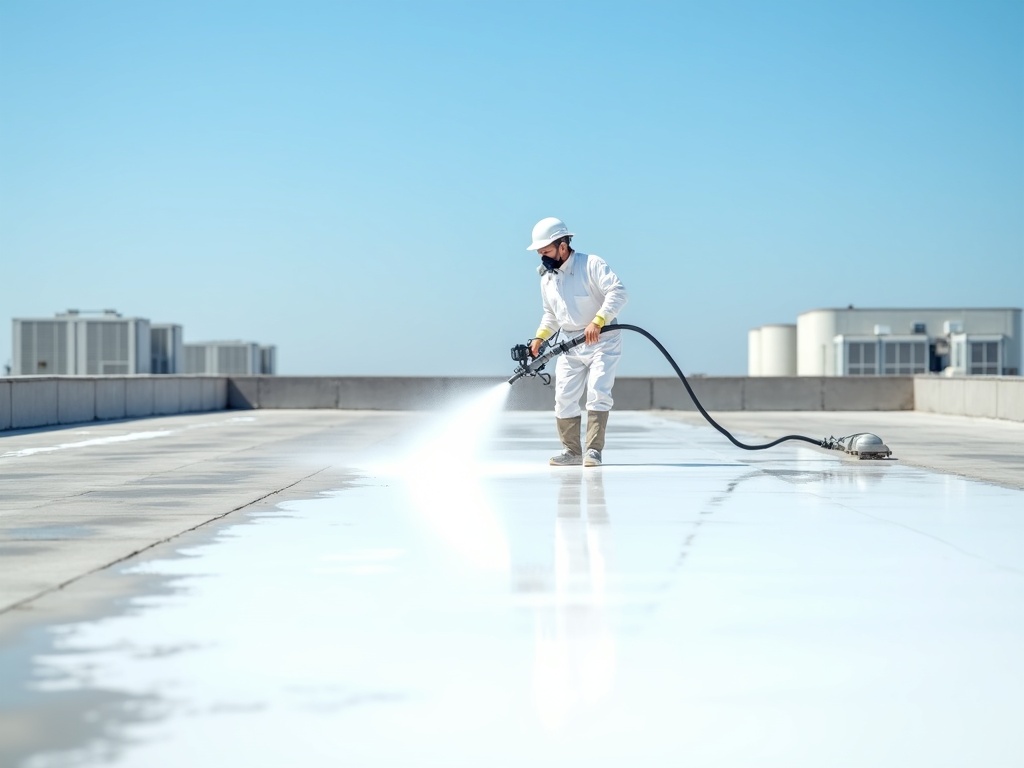
Two Clovis building categories deserve their own scheduling notes. Warehouses and distribution space — the industrial park's stock in trade — benefit from coating precisely because their roofs are huge: at 30,000 square feet, the per-foot difference between restoration and replacement is not a rounding error, it is a capital decision. Large fields also coat efficiently, which pushes big simple roofs toward the friendly end of the $2–$4 range. The operational note is dust and heat: we schedule around receiving hours and skip application during the worst of harvest-season particulate so the membrane cures clean.
Schools, churches, and institutional buildings run on the opposite constraint — the calendar. A campus roof project in one of the Valley's largest school communities has a hard window between June and August, and a coating project actually fits it: no tear-off phase, no exposed deck gambling on a surprise thunderstorm, no demolition debris where students return in weeks. Church campuses along the older avenues and gymnasium roofs across town follow the same logic on Sunday-to-Sunday and season-to-season rhythms. We build these schedules backward from the immovable date, stage the work in sections so any single day's weather risk is contained, and hand facilities staff the millage documentation their maintenance file — and their board — wants to see. It is unglamorous project management, and it is exactly why institutional roofs are some of our steadiest Clovis work.
Clovis gets nearly all of its ten-to-twelve inches of annual rain between November and March, often in concentrated storm systems coming up the Valley — which means a flat roof spends the wet season being tested precisely where it is weakest. Ponding is the classic failure accelerant: water collects in deflected bays and around clogged drains, and whatever coating or membrane sits under that pond degrades fastest. Two facts matter here. First, 100% silicone is the one mainstream coating chemistry that genuinely tolerates permanent ponding — it will not re-emulsify or blister under standing water the way acrylics do. Second, tolerance is not an excuse for bad drainage: during prep we clear and resettle drains, and where ponds are deep or structural, we quote foam build-up to restore slope rather than coating over a lake and calling it solved. Between storms, tule fog keeps roofs damp for days at a time; silicone's moisture-cure chemistry shrugs at that, but the prep windows matter, which is one more reason coating season in the Valley is best scheduled before the fog settles in.
Drainage stewardship continues after we leave, and we are direct with owners about their half of the bargain. A coated roof sheds water beautifully, but no membrane can drain through a scupper packed with cottonwood leaves or a drain basket buried in harvest dust. The maintenance ask is small — clear the drains before the first November system, glance at them after each big storm, keep rooftop trades from leaving debris — and it protects both the roof and the guarantee behind it. Where a building has a history of drain problems, we say so in the assessment and, where the structure allows, add overflow protection to the scope, because the cheapest insurance against a ceiling collapse is a second way off the roof for water.
The most misunderstood number in this business is coating life. A silicone membrane weathers gradually — it does not fail on a birthday. Depending on millage, sun exposure, and foot traffic, the coating serves 10 to 20 years before it thins to the point of needing renewal, and renewal is the whole point: clean the surface, repair any incidental damage, apply new silicone, and the clock resets at $2–$4 per square foot. On a foam roof, this cycle is what makes the system effectively permanent — the foam never sees daylight, so it never degrades, and only the sacrificial coating layer is ever replaced. Owners who internalize this stop thinking about their roof as a depreciating asset with a demolition date and start budgeting it like scheduled maintenance, which is exactly what it becomes. The long-run math is laid out in how long spray foam roofing lasts, and it is the strongest argument for getting a restorable roof under coating before it deteriorates past the restoration threshold.
Between recoats, the system asks very little, but a light inspection rhythm pays for itself. We recommend a roof check twice a year — once after the storm season ends in spring, once before it begins in fall — plus a look after any rooftop trade work, because HVAC and solar crews cause more coating damage in this Valley than weather does. Small punctures and cuts caught early are trivial silicone repairs; the same damage left through a winter becomes a wet-insulation cut-out. Owners who want it handled entirely can put the building on our inspection calendar, and either way the drone makes the survey fast, thorough, and documented.
Every coating project follows the same disciplined arc. It starts with the free assessment — drone survey of the entire field, moisture readings and core samples where the story is uncertain, and a written bid within 48 hours that specifies substrate condition, repair scope, and coating millage. Project day one is preparation: pressure washing, drain clearing, cutting out and drying any saturated sections found in the survey. Detail work follows — every seam, fastener, flashing, curb, and penetration gets hand-treatment before a drop of field coating goes down, because coatings fail at details, not in the field. Then the flood coat is applied to specification, with granule-embedded walk paths at rooftop equipment and access routes. We close with a final inspection, documented millage readings, and maintenance guidance — mostly keeping drains clear through the November-to-March storm season and calling us rather than a handyman if rooftop trades cut into the membrane. Buildings stay occupied throughout; silicone application is low-odor and staged around your operating hours where needed.
Season and weather get managed, not wished away. Silicone's moisture-cure chemistry gives it more scheduling tolerance than most coatings, but application still wants a clean, dry surface and a rain-free cure window — which in practice makes late spring through mid-fall the natural Clovis coating season and makes September the smartest month on the calendar: past the worst heat, ahead of the first storms, with the roof's summer damage fully visible to the survey. Fog-season work is possible on the right roof with the right windows, but we would rather tell you to wait ninety days than apply a membrane into conditions that shortchange its cure.
Coating is an unforgiving trade dressed up as an easy one — anyone can buy a drum of silicone, and every summer somebody in the Valley learns why millage specs, moisture readings, and detail work exist. Our advantage is that coatings are not a sideline: as an SPF contractor, protecting roofs with silicone is half of everything we have done for twenty-plus years, and our crews carry that repetition onto every Clovis roof. We quote from core-sample evidence, we specify thickness in writing, we stand behind the work with industry-leading leak-proof guarantees, and if your roof is past the point where a coating is honest, we say so and price the alternative. One call to (559) 739-9519 starts the free drone assessment for any building in Clovis, Fresno, Sanger, or Friant — and 48 hours later you will know exactly what your roof needs and what it costs.
And if the assessment finds a roof still years from needing us, we will tell you that too, with the photos to prove it. A contractor who quotes every roof he surveys is running a sales funnel, not an inspection. The drone imagery goes in your file either way, the baseline makes every future decision easier, and when your roof's restoration window does open, you will already know who measured it honestly.
Also serving Clovis: Spray Foam Roofing in Clovis · Foam Roof Repair in Clovis · Commercial Insulation in Clovis. See all Clovis services on the Clovis service hub, or read our full silicone roof coating guide. Nearby: Silicone Roof Coating in Visalia · Silicone Roof Coating in Fresno.
Silicone restoration in Clovis typically runs $2 to $4 per square foot, covering cleaning, repairs at seams and flashings, and coating applied to a written millage specification. Heavy prep or extensive repairs push toward the top of the range. Replacement, by comparison, usually costs several times as much once demolition and disposal are included.
Usually, yes — if the roof is fundamentally sound. Silicone restores built-up, modified bitumen, single-ply, foam, and metal roofs. The deciding factor is moisture: we pull core samples during the free assessment, and if insulation is saturated in places, those areas get cut out and rebuilt before coating. If saturation is widespread, we will tell you a coating is the wrong spend.
Better than any other mainstream coating. 100% silicone tolerates permanent ponding without re-emulsifying or blistering, which matters in Clovis where nearly all annual rain lands between November and March. We still fix the drainage problem during prep — clearing drains and building slope with foam where ponds are deep — rather than just coating over standing water.
In this climate, yes, measurably. A bright white silicone surface reflects most of the solar load that a dark, weathered roof absorbs, which lowers deck temperatures during Clovis's 100-degree stretches and reduces rooftop-unit runtime. Owners of low-slope buildings along Shaw and Herndon feel it in the first summer.
Ten to twenty years, depending on coating thickness, sun exposure, and foot traffic. When it weathers thin, you recoat at the same $2–$4 per square foot rather than replacing anything — the cycle repeats indefinitely, which is why coated foam roofs are effectively permanent assemblies.
All of it — Old Town, the Herndon medical corridor, the Clovis Industrial Park, and the newer commercial growth toward Shepherd — plus Fresno, Sanger, and Friant. Crews dispatch from our Tulare County shop, about 55 minutes out, and every project starts with a free drone survey and a written bid within 48 hours: (559) 739-9519.
Free assessment — drone survey, core sampling where needed, and a written bid within 48 hours, anywhere in Fresno County.
Or Call Directly
(559) 739-9519