Leak diagnosis, flat roof repair, and foam roof restoration across Clovis — assessed by drone, confirmed by core samples, bid in writing within 48 hours.
Roof repair in Clovis usually starts the same way: a stain spreads across a ceiling tile during the first real November storm, someone puts a bucket under it, and the search begins for a contractor who will fix the roof instead of selling a new one. That is the call we built this service around. Allstate Spray Foam Roofing repairs flat, low-slope, foam, and metal roofs across Clovis and the surrounding Fresno County communities — leaks, ponding, blisters, split seams, failed flashings, and storm damage — as a family-owned contractor with more than twenty years in Central Valley roofing, CA License #C-2-1052735, BBB accreditation, and SPFA membership. Our crews dispatch from our Tulare County shop and reach Clovis in about 55 minutes, and every repair starts the same disciplined way: a drone survey of the entire roof, core samples where the damage story is unclear, and a written scope and price within 48 hours. No mystery invoices, no repairs that are really down payments on a replacement pitch.
The people who call us are as varied as the roofs. Property managers running multi-tenant retail along Shaw and Willow need documentation and predictable scheduling as much as workmanship. Small business owners in Old Town need straight answers about whether the building they lease or own justifies another repair. Facilities staff at medical offices, churches, and schools need work performed around occupancy without surprises. And owners of flat-roofed and foam-roofed homes — a real population in the older Fresno-Clovis neighborhoods — need a contractor who treats a modest residential flat roof with the same diagnostic rigor as a warehouse. All of them get the identical process, because the process is the product: survey the whole roof, prove the diagnosis, put the fix and the price in writing, and stand behind the result with industry-leading leak-proof guarantees.
Flat and low-slope roofs dominate Clovis's commercial stock, and they fail differently than the pitched shingle roofs most repair advice is written for. On a pitched roof, water runs off; on a flat roof, water lingers, probes, and finds the one detail that summer heat opened up. The repair inventory we see most across the metro: seams and laps split by thermal cycling on built-up and modified bitumen roofs; flashings pulled away from parapets and curbs; punctures and tears from rooftop equipment service; drains and scuppers clogged by fall leaf-drop and harvest dust until water finds another way down; and coatings worn through at walk paths and equipment surrounds. Each of these has a right repair and several wrong ones. Mastic smeared over a wet seam is a wrong one — it holds until the next heat cycle, then fails in the same storm season it was meant to survive. Our repairs cut out the failure, dry the substrate, and rebuild the detail with materials matched to the roof, which is why they hold through the following winter rather than through the following month.
Material matching is the unglamorous half of a repair that lasts. A TPO roof wants heat-welded TPO details, not a smear of universal sealant; a modified bitumen roof wants compatible mod-bit or a properly primed liquid flashing; a coated roof wants the same coating chemistry it already carries, because almost nothing bonds to silicone except silicone. We stock our repair rigs accordingly, and it is a genuine difference between a flat-roof specialist and a general roofer whose truck is set up for shingles. The wrong material on the right spot is still the wrong repair — it just takes one more storm season to prove it.
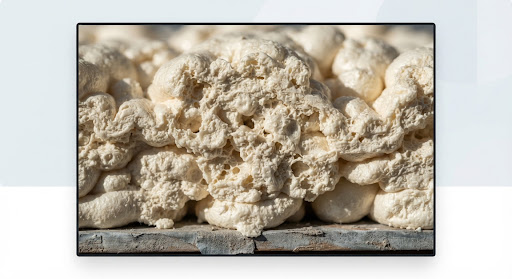
Clovis has a growing population of SPF roofs, and foam repair is its own discipline — one general roofers regularly get wrong. Foam roofs rarely leak in the field; they get damaged at specific points: a dropped tool or hail strike punching the coating, a trade cutting into the roof for a conduit run, birds pecking at an exposed edge, or simply a coating reaching the thin end of its 10-to-20-year cycle. The correct repair is straightforward for a foam contractor: cut out the damaged foam, dry the area, fill with new foam or a compatible sealant, and re-coat with silicone to spec. The incorrect repairs we get called to undo are depressingly consistent — asphalt products smeared onto foam (they attack it), incompatible coatings that never bond, or screwed-down metal patches that add the very penetrations foam exists to eliminate. As the Valley's foam specialists, we repair SPF with SPF-correct methods, and if your foam roof was installed by someone else and never maintained, our foam roof repair service covers the full restoration path from spot repairs to complete recoat.
The hardest part of flat roof repair is not the fix — it is the find. Water that enters at a parapet crack on the north side can travel laterally along the deck, under insulation, across a beam, and appear as a ceiling stain forty feet from the actual breach. This is why handyman patches so often fail: they seal the spot above the drip, not the hole in the roof. Our diagnostic sequence is built to beat that geometry. The drone survey maps the whole field first — ponding rings, coating wear, suspect seams, displaced flashings — so nothing is diagnosed through a keyhole. Moisture readings and core samples then confirm what is wet and what is dry, tracing the water back to its entry rather than its exit. On seamless foam roofs this lateral-travel problem barely exists, because the fully adhered foam gives water no path to wander — one of the quiet reasons owners who get tired of chronic leak-chasing eventually convert to SPF (the system is described in our spray polyurethane foam roofing guide).
Stand on almost any aging flat roof in Clovis a day after a winter storm and you will find the ponds — shallow lakes over deflected bays, around settled drains, behind equipment curbs. Ponding is not cosmetic. Standing water accelerates whatever weakness sits beneath it, multiplies the load on the structure, breeds the algae and debris that clog drains further, and in a hard freeze — which the Valley floor does get on clear winter nights — it becomes an ice lens working at every crack. Most repair contractors can only treat the symptom, because fixing ponding on a membrane roof means re-engineering slope. Foam gives us a better tool: because SPF is applied as an expanding liquid, we build up low areas and shape crickets around drains and curbs, restoring positive drainage as part of the repair itself. It is the single highest-leverage flat roof repair in this climate, because it removes the condition that was busy manufacturing your next three leaks.
When a Pacific storm system trains up the Valley and the wind comes down off the Sierra through the 168 corridor, the phones get busy, so here is our honest framing rather than an invented promise. We are 55 minutes away, we prioritize active leaks over scheduled maintenance, and we will tell you on the phone — truthfully — when a crew can be on your roof. What we will not do is advertise a response-time guarantee we cannot control the weather or the queue well enough to keep. What we can do fast is triage: temporary waterproofing to stop active water entry, drone documentation of the damage for your records and your insurer, and a written repair scope within 48 hours so the permanent fix is scheduled before the next system arrives. Wind-lifted edge metal, peeled flashings, equipment blown into membranes, and debris punctures are the standard post-storm inventory, and all of it repairs faster when the documentation is done right the first day.
On insurance itself, our role is evidence, not advocacy theater. The drone survey produces a dated, comprehensive visual record of the roof — before-and-after where we did the temporary work — and our written scope separates storm damage from pre-existing wear honestly, because inflated claims help nobody and accurate ones settle faster. Owners who had an assessment on file before the storm are in the strongest position of all: a documented baseline turns the damage conversation from opinion into comparison. It is one more argument for the free fall survey, and it costs nothing to have in the drawer.
A striking share of the repair calls we run in Clovis were preventable for less than the deductible. The killers are mundane: drains and scuppers that stopped draining, coating wear at walk paths that nobody walked in years, a satellite installer's lag bolts through the membrane, seams that telegraphed their failure a full season before they opened. A twice-a-year inspection rhythm — after the storms in spring, before them in fall — catches essentially all of it while it is still trivial to fix. For owners who want the discipline without the ladder, we put buildings on a scheduled drone-survey calendar: same flight pattern each visit, changes flagged against the prior imagery, small fixes quoted in writing before they become winter emergencies. Multi-building owners and property managers get the most leverage from this — one scheduled afternoon covers a portfolio — but even a single Old Town storefront benefits from having its roof's history documented instead of remembered. The economics are not subtle: the average preventive fix we quote is a fraction of the average emergency invoice, and it gets scheduled in September sunshine instead of performed in a January storm break.
Twenty years in the Valley teaches you that roof problems cluster by building stock. In Old Town Clovis, the brick retail blocks along Pollasky and Clovis Avenue carry flat roofs with decades of layered patches; the chronic issues are parapet flashings, dead-level drainage, and roofs where the honest question is whether one more patch is money well spent — we answer with core data, not a sales script. Along the Herndon medical corridor near Clovis Community Medical Center, the buildings are newer but the stakes are higher: single-ply roofs over occupied clinical space, where a small seam failure becomes a compliance problem, and where our low-disruption repair scheduling matters as much as the workmanship. In the Clovis Industrial Park and the metal-building yards off Fowler and Sunnyside, the pattern is fastener-gasket failure and panel-lap leaks by the thousand — spot-repairable early, coating-scale later. And in the newer northeast retail pads toward Loma Vista, we mostly see construction-era details failing early: pitch pockets, HVAC curbs, and penetrations that were flashed in a hurry during the building boom.
Schools, churches, and civic buildings form their own category across a city defined by its campuses. These roofs are usually large, usually flat or barely pitched, and usually maintained on public or congregation budgets that reward early, small repairs over deferred large ones. We work their calendars — summer windows for the big work, holiday breaks for the middle-sized, and quiet weekday scheduling for anything urgent — and we document everything, because facilities committees change and paper outlasts memory. The same applies to the mini-storage rows and small industrial condos multiplying along the growth corridors: modest roofs, absentee owners, and a repair model that runs on clear photos and written scopes rather than site meetings.
Every owner eventually faces the fork: keep repairing, or invest in a new system. We put the decision on paper with evidence. As a rule of thumb, a roof with localized damage, dry insulation, and a sound deck should be repaired; a roof with widespread saturation, repeated failures across the field, or a deck problem should be restored or replaced, because repairs on a failing field are rent, not equity.
| Roof condition | Right move | Typical economics |
|---|---|---|
| Localized damage, dry cores, sound field | Targeted repair | Lowest cost; restores full service life of existing roof |
| Sound structure, weathered surface, scattered failures | Silicone restoration or SPF overlay | Recoat $2–$4/sq ft; new foam system $4–$8/sq ft — no tear-off |
| Widespread saturation or deck failure | Replacement of affected areas or full system | Highest cost; repairs here only postpone and compound |
The core samples make this call honest. Saturated insulation does not dry out on its own, and it tells us — and you — exactly how far gone a roof is. If your roof lands in the middle row, the restoration path usually wins the math decisively; our spray foam roofing cost guide lays out what the overlay numbers look like at your square footage.
From the first call to the finished fix, the sequence is designed so you always know what is happening and why. First, the assessment — free, and the same rigor whether the job turns out to be a $900 flashing repair or a full restoration: drone survey of the complete roof field, moisture readings, core samples where needed. Second, the written scope within 48 hours: what failed, why, what we will do about it, and the price. Third, the repair itself — failure cut out rather than covered over, substrate dried, detail rebuilt with compatible materials, and the surrounding area inspected for the same failure mode, because defects that show in one curb are usually incubating in the others. Finally, documentation: photos of the completed work and any watch-items we found for your file. Buildings stay open throughout; we stage around business hours, patient schedules, and school calendars as the site requires, and we leave the roof cleaner than the leak left your ceiling.
One expectation worth setting: a right-sized repair sometimes reveals a bigger story, and we handle that moment with candor rather than escalation theater. If the cut-out shows saturation spreading beyond the visible failure, we photograph it, complete the contracted repair correctly, and give you the finding in writing with options — more exploratory cores, a monitored watch, or a restoration quote — rather than parking a change order on your desk mid-job. Owners keep working with contractors who tell them the truth at the awkward moment; that has been our experience for twenty years, and it is cheaper for everyone than discovering the same saturation through a collapsed ceiling tile two winters later.
It helps to understand the machine that is breaking your roof, because it runs on a calendar. Summer in Clovis delivers weeks above 100°F; a dark roof surface hits 160°F by afternoon and sheds forty-plus degrees overnight, and that daily expansion-contraction cycle works every seam, fastener, and flashing like a wire being bent back and forth. Autumn adds harvest dust from the ag country east toward Sanger — fine sediment that dams scuppers and holds moisture against the membrane. Then winter inverts the whole system: tule fog seals the Valley floor under a damp lid for days at a time, so the moisture summer let in never dries out, and the season's ten-to-twelve inches of rain arrive concentrated in exactly the months the roof is weakest. The practical takeaway is timing: the cheapest repair you will ever buy is the one done in September and October, after the heat has done its damage and before the storm season audits it. A fall drone survey costs you nothing and regularly saves Clovis owners the January emergency call.
Elevation adds a wrinkle on the east side of town. As Clovis climbs toward the Sierra foothills along the 168 corridor, buildings pick up more wind exposure than the sheltered valley floor, and the occasional cold snap bites harder — clear-night frosts that turn yesterday's pond into this morning's ice lens. Roofs out toward the foothill margins earn their fall inspection twice over, and anything mechanically fastened or loosely flashed up there should be checked after every significant wind event, not just annually. Meanwhile the older, lower parts of town fight the opposite micro-battle: mature street trees that fill scuppers with leaf-drop precisely when the first storms arrive. Same city, two different maintenance calendars — and one more reason a repair contractor should know the local map, not just the trade.
Our repair crews cover the whole northeast Fresno County market from the Tulare County shop — about 55 minutes to Clovis via Highway 99 and CA-168, with Fresno's commercial corridors, Sanger's packing and ag-industrial buildings, and Friant's facilities up by Millerton Lake inside the same service radius. We are straightforward about the geography: no Clovis storefront, no pretense of one — just a specialist crew that has been working Fresno County flat roofs for two decades and stands behind every repair with industry-leading leak-proof guarantees. If water is coming in now, call (559) 739-9519 and we will tell you honestly when we can be there. If the roof is merely worrying you, book the free assessment: drone survey, core samples where warranted, and a written answer in 48 hours about what your roof actually needs — repair, restoration, or nothing yet.
That last option is not a throwaway line. A meaningful share of the assessments we fly in Clovis end with us telling the owner their roof is fine — a drain to clear, a watch-item to photograph again next fall, nothing to invoice. We can afford that honesty because the specialty sustains itself: the owners whose roofs genuinely need work keep our crews busy year-round, and the owners whose roofs do not become the ones who call us first when that changes. Twenty years in the same Valley teaches a simple lesson about repair work — the diagnosis is the reputation, and the reputation is the business. Put ours to the test on your building.
Also serving Clovis: Spray Foam Roofing in Clovis · Silicone Roof Coating in Clovis · Commercial Insulation in Clovis. See all Clovis services on the Clovis service hub, or read our full foam roof repair guide. Nearby: Foam Roof Repair in Visalia.
It depends entirely on what failed, which is why we do not quote from the phone. A targeted repair — a split seam, a failed flashing, a puncture — is the cheapest work we do. If damage is widespread, restoration by silicone coating runs $2 to $4 per square foot and a foam overlay $4 to $8. The free drone assessment produces a written, itemized price within 48 hours.
Completely normal on flat roofs — water enters at one point and travels laterally along the deck before dripping, so the stain and the breach can be forty feet apart. That is why we survey the whole roof by drone and confirm with moisture readings and core samples instead of patching over the drip and hoping.
Yes. Foam repair is our core trade: we cut out damaged foam, dry the substrate, fill with new foam, and re-coat with compatible silicone. We also undo a lot of incorrect repairs — asphalt mastic and mismatched coatings damage SPF. If the roof's coating is simply at the end of its 10-to-20-year cycle, a full recoat restores the whole system.
We prioritize active leaks and respond as fast as the schedule and weather honestly allow — our crews are about 55 minutes out in Tulare County, and we will give you a truthful arrival window on the phone rather than an invented guarantee. First visits focus on stopping water entry and documenting damage, with the permanent repair scoped in writing within 48 hours.
The core samples decide. Localized damage over dry insulation is worth repairing. A structurally sound roof with a weathered surface is usually best restored — silicone coating or foam overlay — at a fraction of replacement cost. Widespread saturated insulation means repairs are throwing good money after bad, and we will show you the cores and say so.
The climate one-two punch: 100-degree summer heat cycling splits seams and flashings, then the November-through-March storm season and weeks of tule fog exploit every opening while the roof stays too damp to dry out. Clogged drains from fall debris and ag dust are the most preventable culprit — half the emergency calls we run trace back to drainage.
Free assessment — drone survey, core sampling where needed, and a written bid within 48 hours, anywhere in Fresno County.
Or Call Directly
(559) 739-9519