Seamless SPF systems for flat, low-slope, and metal-building roofs across Clovis — installed by a family-owned Central Valley crew with 20+ years in foam.
Spray foam roofing in Clovis solves the two problems that kill flat roofs in the eastern Fresno County basin: seams and heat. Every conventional low-slope system — built-up gravel, modified bitumen, TPO, PVC — is assembled from pieces, and every piece has an edge. Those edges are where thermal movement concentrates, and Clovis delivers extraordinary thermal movement: rooftop surface temperatures north of 160°F on a July afternoon along Shaw Avenue, followed by a 40-degree overnight drop, repeated a hundred times a summer. Then winter arrives and tule fog keeps the same roof damp for days at a time, working moisture into every fastener hole and lap seam that summer opened up. Spray polyurethane foam sidesteps the whole failure sequence because it has no seams to open. The foam is applied as a liquid that expands and bonds monolithically to the substrate, flowing around penetrations, up parapet walls, and over curbs as a single continuous membrane. There is no edge for the heat to work on and no lap for the fog to soak.
Allstate Spray Foam Roofing has installed SPF across the Central Valley for more than twenty years. We are family-owned, fully licensed (Lic #C-2-1052735), BBB accredited, and members of the Spray Polyurethane Foam Alliance. Our crews dispatch from our Tulare County shop and reach Clovis in roughly 55 minutes via Highway 99 and CA-168 — close enough for reliable scheduling, seasoned enough that a foam rig on your roof is running its thousandth job, not its tenth.
The low-slope inventory this page is written for is broader than most owners realize. If your building has a roof you cannot see from the street — a dead-flat deck behind a parapet, a barely-pitched membrane over a strip center, a standing-seam metal roof on a shop or warehouse, a gravel built-up roof that predates the freeway — spray foam roofing is a candidate system for it. That includes multi-tenant retail where one roof spans six businesses, single-owner industrial buildings, medical and professional offices, church halls and gymnasiums, mini-storage rows, and the flat-roofed mid-century commercial stock that lines the older arterials. It also includes buildings whose existing roof is already a patchwork: because foam is applied as a liquid over a prepared surface, it bridges transitions between old repairs, mismatched membranes, and odd additions in a way no rolled or sheet product can. The assessment is where we confirm the fit — and where, occasionally, we rule it out, because a deck holding trapped moisture has to be opened and dried before anyone should spray a permanent roof over it.
Most commercial roofing decisions in Clovis come down to a spreadsheet, so here is the honest math. A tear-off-and-replace on a conventional system means demolition labor, dumpster and landfill fees, days of disruption, and a brand-new roof that starts deteriorating the day it is finished — with another tear-off waiting at the end of its life. A sprayed foam system installs over the existing roof in most cases, which deletes the demolition line entirely. New SPF installations run $4–$8 per square foot depending on foam thickness, roof complexity, and prep. More importantly, SPF changes the shape of the lifetime cost curve: when the protective coating weathers thin after 10 to 20 years, the roof is cleaned and recoated at $2–$4 per square foot instead of being replaced. The foam itself stays. Run that cycle out over thirty years for a 20,000-square-foot tilt-up in the Clovis Industrial Park and the difference against repeated single-ply replacement is not subtle. For a full breakdown of what drives the number on your specific building, see our spray foam roofing cost guide.
The second budget item is energy, and this is where Clovis buildings feel SPF immediately. Closed-cell roofing foam delivers roughly R-6.5 per inch. A typical two-inch application adds R-13 directly on top of the deck — on the outside of the building envelope, where it stops heat before it ever enters the structure. Business owners along the Herndon corridor running rooftop package units through a Valley summer routinely see cooling loads drop after a foam roof goes on, because the roof deck that used to radiate heat into the conditioned space all evening simply stops doing it.
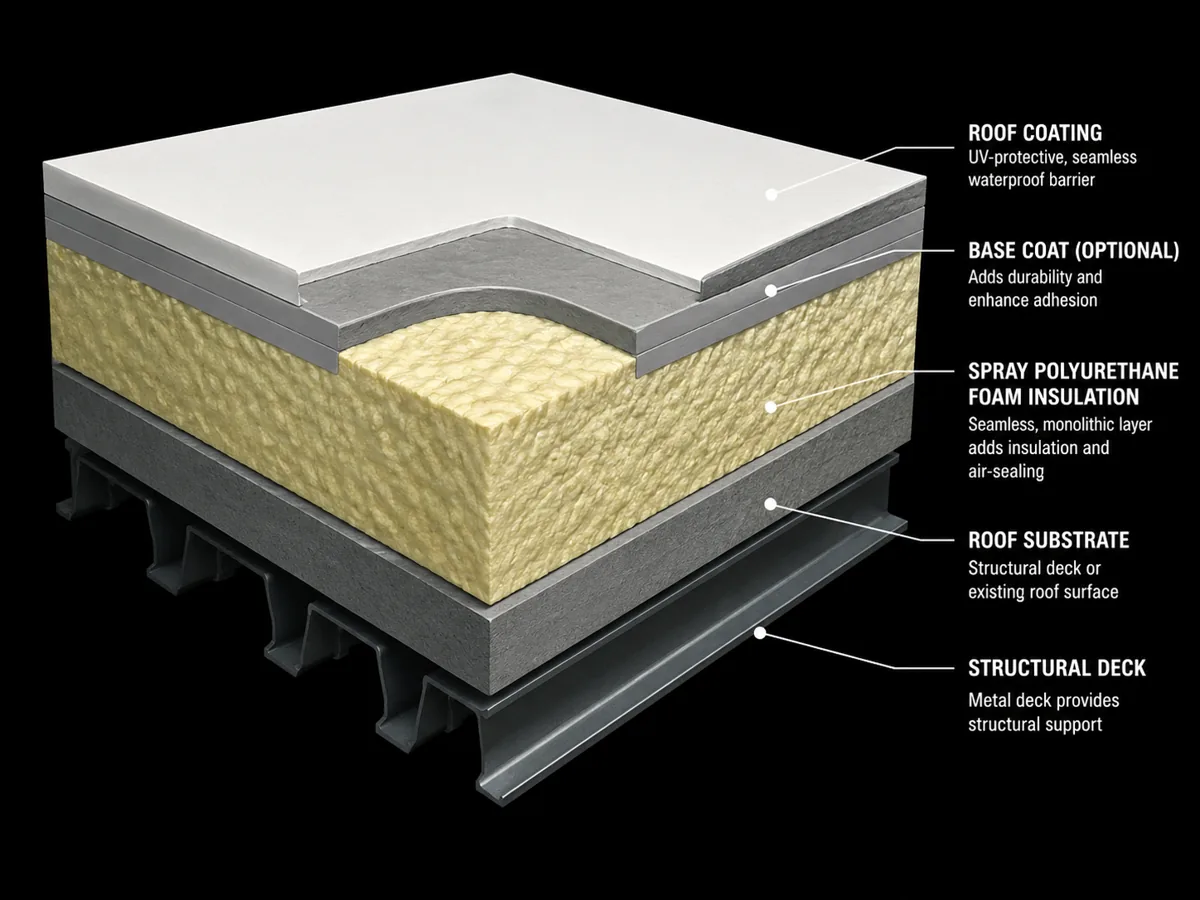
SPF is a two-component chemistry — an isocyanate and a polyol resin — combined at the spray gun under heat and pressure. The mixture reacts within seconds, expanding roughly thirtyfold and curing into rigid closed-cell foam that bonds tenaciously to concrete, metal, wood, and most existing roof membranes. Three properties make it a roof rather than just an insulation layer. First, the closed-cell structure is itself waterproof; the millions of sealed cells do not wick or absorb water the way fibrous insulation does. Second, the foam is fully adhered across every square inch, so there is no path for water to travel laterally beneath it — the failure mode that makes single-ply leaks so maddening to trace. Third, the foam is self-flashing: it expands around pipes, drains, HVAC curbs, skylights, and parapet transitions, which is exactly where 90 percent of conventional roof leaks originate.
Over the cured foam we apply a protective elastomeric coating — typically 100% silicone — with granules embedded where foot traffic warrants. The coating shields the foam from UV, takes the weathering hit, and is the renewable layer in the recoat cycle. The result is a roof assembly with no fasteners, no seams, no flashing details cut by hand, and no thermal bridges through the insulation. If you want the deeper engineering story, our spray polyurethane foam roofing overview covers the chemistry and assembly in detail.
Clovis has a more varied flat-roof inventory than people assume. Old Town's retail blocks along Pollasky, Clovis Avenue, and Fifth Street are some of the oldest commercial buildings in Fresno County — brick parapet construction with flat roofs that have been patched, tarred, and re-patched for generations. These roofs are ideal foam candidates: SPF bridges the accumulated patchwork, seals the parapet-to-deck transitions that leak during every winter storm, and adds insulation that vintage buildings never had. The industrial park east of Clovis Avenue carries the opposite building stock — tilt-up concrete and steel-frame warehouses with large, open roof fields where foam's seamless coverage and insulation value pay off at scale.
Between those extremes sits the Herndon Avenue medical corridor around Clovis Community Medical Center: medical office buildings, imaging centers, and clinics where roof failure is not an inconvenience but a compliance and continuity problem. Foam application is fast, comparatively quiet, and staged to keep buildings occupied throughout — a real advantage for practices that cannot relocate patients while a roof crew works overhead. Add the strip retail along Shaw and Willow, church and school-support buildings across the city, and the new commercial pads following the Loma Vista and Heritage Grove growth toward Shepherd Avenue, and nearly every commercial roof in Clovis has a foam answer.
Roofing systems get sold on lab specs, but they fail in the field, and the eastern Fresno County field is uniquely demanding. Consider what a Clovis roof endures in a single year. Summer brings 40-plus days at or above 100°F, rooftop membrane temperatures that can exceed 160°F, and one of the highest annual UV doses in the country. Fall drops ag dust from harvest across every horizontal surface — fine sediment that clogs drains and holds moisture against membranes. Winter parks tule fog over the Valley floor for days, keeping roofs continuously damp between the storms that deliver most of the year's ten-to-twelve inches of rain in a three-month window. Spring winds coming down the Sierra foothills through the CA-168 corridor pry at loose edges and lift anything mechanically fastened.
SPF answers each stress directly. The foam is fully adhered, so wind uplift has no purchase point — a genuine consideration for buildings in the open northeast growth corridors. The silicone topcoat is UV-stable and does not chalk away in the sun the way acrylics do, and it sheds the winter damp without absorbing it. Ponding water, the chronic disease of aging Valley flat roofs, is often engineered out during application: because foam is applied as an expanding liquid, our installers build slope and crickets into low areas, restoring positive drainage that the original roof lost decades ago. No membrane system can do that without a full tapered-insulation redesign.
Reflectivity carries the summer half of the equation. A weathered dark roof in Clovis absorbs solar energy all afternoon and re-radiates it into the building well into the evening — which is why rooftop units keep running at 9 p.m. in August. The white silicone surface over foam reflects the majority of that load, and the foam beneath blocks what the coating does not reflect. Maintenance in this climate is refreshingly modest, but it is not zero, and we say so: fall drain clearing before the storm season, a rinse when harvest dust builds up enough to dull the reflective surface, and a periodic inspection so small coating wear gets touched up years before it matters. Owners who give a foam roof that minimal attention get the full recoat interval out of it; owners who ignore every roof equally at least start from a system with no seams to neglect.
California's Title 24 energy code makes roof performance a regulatory matter, not just a utility-bill matter, and reroofing projects can trigger insulation and cool-roof requirements. SPF is one of the cleanest compliance paths available for low-slope commercial work: the foam adds continuous insulation at roughly R-6.5 per inch with zero thermal bridging, and the white silicone topcoat delivers the high solar reflectance that cool-roof provisions call for. Instead of engineering rigid-board insulation, cover boards, and a membrane as separate layers, a single applied system handles insulation, waterproofing, and reflectivity together. We document foam thickness and coating specifications so your project file supports the permit, and because the insulation is on the exterior of the deck, conditioned space gains the benefit without losing an inch of interior clearance — something warehouse operators in the industrial park care about more than any R-value table.
There is a planning angle worth flagging for owners weighing timing. Reroofing projects that trigger Title 24 provisions can turn a simple membrane swap into an insulation upgrade project, with the cost stacking accordingly. SPF collapses that stack: the same application that waterproofs the roof supplies the continuous insulation and the reflective surface in one specification. For buildings changing hands, changing tenants, or heading into HVAC replacement — all common moments when energy documentation gets scrutinized in a growing market like Clovis — a foam roof puts the envelope numbers on the right side of the file before anyone asks for them.
Clovis and its satellites — Sanger's packing sheds, Friant's shop buildings, the contractor yards off Fowler and Sunnyside — run on metal buildings, and metal roofs have a predictable end-game: the fastener gaskets dry out, the panel laps loosen, rust blooms at the scratches, and every one of several thousand screw penetrations becomes a potential leak. Replacing panels is expensive and disruptive; screwing down a second skin adds thousands of new holes. Foam takes a different route entirely. Applied directly over the cleaned and primed panels, SPF encapsulates every fastener and lap seam in one monolithic layer, stops the oil-canning movement that backs screws out, kills the condensation drip that plagues uninsulated steel, and converts an R-nothing metal skin into an insulated roof assembly. The building gets quieter in the rain and dramatically cooler in July at the same time. For metal building owners weighing panel replacement against foam, the drone survey and core-sample assessment settles the question with data rather than guesswork.
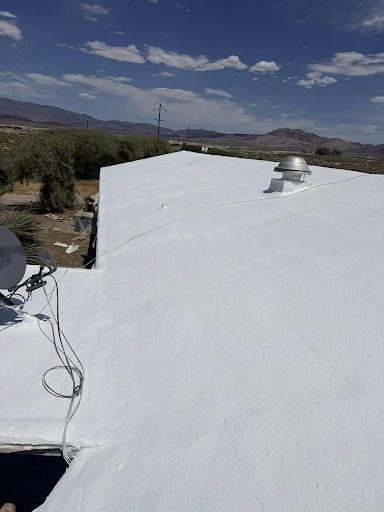
Every roof prices differently, but Clovis projects land in predictable ranges. The honest way to read this table is per-square-foot economics over the life of the building, because SPF's advantage compounds at every recoat cycle.
| System decision | Typical Clovis range | What drives the number |
|---|---|---|
| New SPF roof system (foam + silicone topcoat) | $4–$8 / sq ft | Foam thickness, roof complexity, prep and repairs, access |
| Recoat of existing foam roof | $2–$4 / sq ft | Coating condition, cleaning required, minor foam repairs |
| Conventional tear-off + single-ply replacement | Often well above SPF once demolition and landfill are counted | Demolition labor, disposal fees, new insulation, membrane, flashing |
Two notes on reading those ranges honestly. First, the low end belongs to large, open, uncomplicated roof fields — the industrial park profile — while cut-up roofs with heavy equipment, many penetrations, or parapet detail work price toward the top. Second, the recoat line is the one that matters most over time: a foam roof maintained on its 10-to-20-year recoat cycle never faces a tear-off again. Our written bid, delivered within 48 hours of the assessment, breaks out exactly where your building falls and why.
A foam project follows a disciplined sequence, and we keep owners informed at every stage. It begins with the free assessment: a drone survey of the full roof field, core sampling where deck saturation or hidden layers need confirming, and a written bid within 48 hours. On installation day the roof is cleaned and prepped — loose gravel removed, saturated areas cut out and dried, surfaces primed as the substrate requires. Foam application follows in controlled passes to the specified thickness, with our applicators building slope into ponding areas and flashing every penetration as they go. The silicone topcoat goes on once the foam has cured, with granule embedment at walk paths and around serviced equipment. We finish with a walkthrough, documentation of thicknesses and coatings for your records, and the maintenance guidance that keeps the system inside its warranty and recoat cycle. Most Clovis buildings stay open and operating for the duration; spray scheduling works around your hours where overspray control or odor-sensitive occupancies require it. The step-by-step detail is covered in our spray foam roofing installation guide.
Weather windows matter more in this trade than most, and we schedule around the Valley's calendar deliberately. Foam and coating application want dry substrates and workable temperatures, which makes late spring through fall the prime Clovis season — and makes the weeks before the November storm line the busiest. Owners who book assessments in late summer get first pick of the calendar; owners who call during the first atmospheric river of the season join a triage list. Neither gets a rushed application, because pass thickness and cure discipline are exactly the corners a schedule must never cut on a roof designed to outlast its coating cycle several times over.
Building owners comparing bids in the Fresno-Clovis market usually see SPF quoted against TPO, and the comparison deserves straight talk. TPO is a fine membrane installed by a fine crew — but it is a seamed, mechanically fastened system, and every seam is welded by hand on your roof, in Valley conditions, at whatever pace the schedule allows. Its insulation is a separate board layer bridged by thousands of fasteners, each one a small thermal short-circuit. SPF has no seams to weld and no fasteners to bridge; insulation and waterproofing are the same monolithic layer. TPO also cannot correct ponding without a tapered redesign, while foam builds drainage during application. Where TPO wins is a low upfront bid on a simple roof, and we say so when it is true. Our side-by-side spray foam vs TPO comparison walks through the trade-offs in detail, and our longevity data lives in how long spray foam roofing lasts.
Our crews cover the full northeast Fresno County market from the Tulare County shop — about 55 minutes to a Clovis rooftop, door to door. That radius takes in the whole Fresno-Clovis metro: Fresno's commercial corridors to the west, Sanger's ag-industrial buildings to the southeast, and Friant's shops and facilities up by Millerton Lake to the north. We are deliberate about what that means: we are not a Clovis storefront, and we never claim to be. We are a Central Valley foam specialist that has been driving these highways to Fresno County roofs for two decades, with the SPFA membership, the C-2-1052735 license, and the BBB accreditation to show for it. When a winter storm line is moving up the Valley or a July heat dome is cooking a failing roof, what matters is a crew that answers the phone, shows up when scheduled, and stands behind the work with industry-leading leak-proof guarantees.
The satellites each bring their own roof problems to the same phone number. Sanger's packing houses and ag-service buildings run hot, dusty, and hard, and their metal roofs age accordingly — foam-over-metal is the retrofit we quote there most. Friant's small commercial and facility buildings near Millerton Lake take more wind exposure than the valley floor, which favors a fully adhered system with nothing for a gust to peel. And Fresno proper simply multiplies the Clovis inventory — more tilt-ups, more strip retail, more mid-century flat roofs — across a bigger map. One assessment process covers all of it.
There are bigger roofing companies in the Fresno market and cheaper bids in every inbox. What we offer is narrower and, for flat-roof owners, more valuable: foam is not a sideline we quote occasionally — it is the business, and it has been for more than twenty years. That focus shows up in the details that decide whether an SPF roof performs for decades or fails in five years: substrate prep, moisture readings before spraying, pass thickness discipline, coating millage verified rather than estimated. It also shows up in how we bid. The drone survey and core sampling mean our number is built on what your roof actually is, not what it looks like from a ladder. If foam is the wrong answer for your building — and occasionally it is — the assessment will say so and we will tell you what the right answer costs instead. Call (559) 739-9519 for your free assessment, and have a written bid for your Clovis building within 48 hours.
Also serving Clovis: Silicone Roof Coating in Clovis · Foam Roof Repair in Clovis · Commercial Insulation in Clovis. See all Clovis services on the Clovis service hub, or read our full spray foam roofing guide. Nearby: Spray Foam Roofing in Visalia · Spray Foam Roofing in Fresno.
New spray foam roof systems in Clovis typically run $4 to $8 per square foot installed, including the foam and the protective silicone topcoat. Large open roofs like industrial park warehouses price toward the low end, while cut-up roofs with many penetrations price higher. Recoating an existing foam roof runs $2 to $4 per square foot. Every bid starts with a free drone survey and is delivered in writing within 48 hours.
In most cases, yes. SPF bonds directly to built-up roofing, modified bitumen, concrete, wood, and metal decks after cleaning and prep, which eliminates tear-off cost and disruption. We confirm suitability with core samples during the free assessment — if the existing roof is saturated, those areas are cut out and dried or removed first rather than sprayed over.
Very well — it is one of the main reasons Valley owners choose it. The foam adds roughly R-6.5 of insulation per inch on the outside of the roof deck, and the white silicone topcoat reflects rather than absorbs solar load. Buildings along Shaw and Herndon that switch to SPF typically feel the difference in rooftop-unit runtime during the first 100-degree stretch.
It is arguably the best retrofit available for aging metal roofs. The foam encapsulates every fastener and panel lap — the places metal roofs leak — in one seamless layer, stops condensation drip, and insulates a roof that previously had no R-value at all. Metal shops and warehouses around the Clovis Industrial Park, Sanger, and Friant are classic candidates.
The foam itself is effectively permanent when protected. The silicone coating weathers in the sun and is renewed on a 10-to-20-year recoat cycle at $2 to $4 per square foot. Maintained on that cycle, the roof renews indefinitely instead of facing another tear-off — which is the core economic argument for SPF in a high-UV climate like Fresno County.
No — and we are upfront about it. Allstate is a family-owned Tulare County company, and our crews reach Clovis in about 55 minutes via Highway 99 and CA-168. What you get is a specialist crew that installs foam every working day, a free drone-survey assessment, and a written bid within 48 hours, backed by CA License #C-2-1052735 and BBB accreditation.
Free assessment — drone survey, core sampling where needed, and a written bid within 48 hours, anywhere in Fresno County.
Or Call Directly
(559) 739-9519