Seamless, self-flashing SPF roofing from the family company that was founded in Visalia — insulation, waterproofing, and decades of Valley experience in a single system.
Spray foam roofing in Visalia is not a market we service — it is the work this company was founded on. Allstate Spray Foam Insulation started here in the Tulare County seat more than twenty years ago, and our shop still sits minutes from most Visalia roofs. When other contractors talk about “serving the Central Valley,” they mean a crew will drive in from somewhere else, do the job, and drive home. When we say it, we mean the foreman probably passed your building on his way to the shop this morning. That difference shapes everything about how we install, warranty, and maintain spray polyurethane foam roofs in this city.
Roofing is a trade with a trust problem, and flat-roof work has the worst of it. Storm chasers appear after every big weather event, out-of-area outfits bid jobs they will never revisit, and building owners end up holding warranties from companies whose phone numbers stop working. Our answer to that is boring and verifiable: family-owned for over twenty years, fully licensed under CA License #C-2-1052735, BBB accredited, and a member of the Spray Polyurethane Foam Alliance. The license and the accreditation are public records you can check before we ever set foot on your roof.
Being headquartered minutes away changes the economics of accountability. If a seam of coating needs attention two winters from now, sending a truck to a Visalia address costs us almost nothing — so we actually do it. A contractor dispatching from Bakersfield or the Bay Area has to weigh every callback against a half-day of windshield time. That is not a character flaw; it is geography. We simply have better geography, and for a roof system designed to be maintained on a 10–20 year recoat cycle rather than replaced, geography compounds over decades.
It also means we know this city's roofs specifically. We know which downtown blocks carry sixty-year-old built-up roofs over bowstring trusses, which industrial park panels were built with metal decks that sweat in January, and which strip centers along Mooney Boulevard have been patched with so many generations of mastic that the original membrane is archaeology. That local pattern recognition shows up in our bids: fewer surprises, fewer change orders, and core samples taken where experience says trouble hides.
The San Joaquin Valley punishes roofs from two directions. From June through September, Visalia regularly runs past 100°F, and a dark flat roof surface can hit 160°F or more. That thermal load does two things: it bakes membranes until plasticizers cook off and seams split, and it pours heat into the building below, driving cooling costs up through every ton of air conditioning. Then winter arrives with tule fog — days of near-100% humidity where a roof never fully dries. Water finds every fastener back-out, every alligatored crack, every failed pitch pan, and sits there working on it.
Spray polyurethane foam answers both seasons in a single application. The foam itself insulates at roughly R-6.5 per inch, so the summer heat that used to pour through the deck now largely stays outside; many owners notice the difference in the first billing cycle. The protective coating over the foam is highly reflective, dropping surface temperatures dramatically compared to a dark cap sheet. And because the system is applied as a liquid that expands and bonds to the substrate, it is seamless — there are no laps, no seams, and no fasteners for fog-season moisture to exploit. Every penetration, curb, and parapet gets self-flashed in foam as the roof goes on.
One more Valley-specific factor: ag dust. Visalia sits in a working agricultural county, and fine dust from harvests, dairies, and field work settles on every roof. On single-ply membranes, dust plus ponded water becomes an abrasive slurry that grinds at the surface; on gravel built-up roofs it clogs drains. A smooth, coated foam roof sheds dust with the first rain and keeps drains findable, and the sacrificial coating layer — not the waterproofing itself — takes the abrasion, then gets renewed at the next recoat.
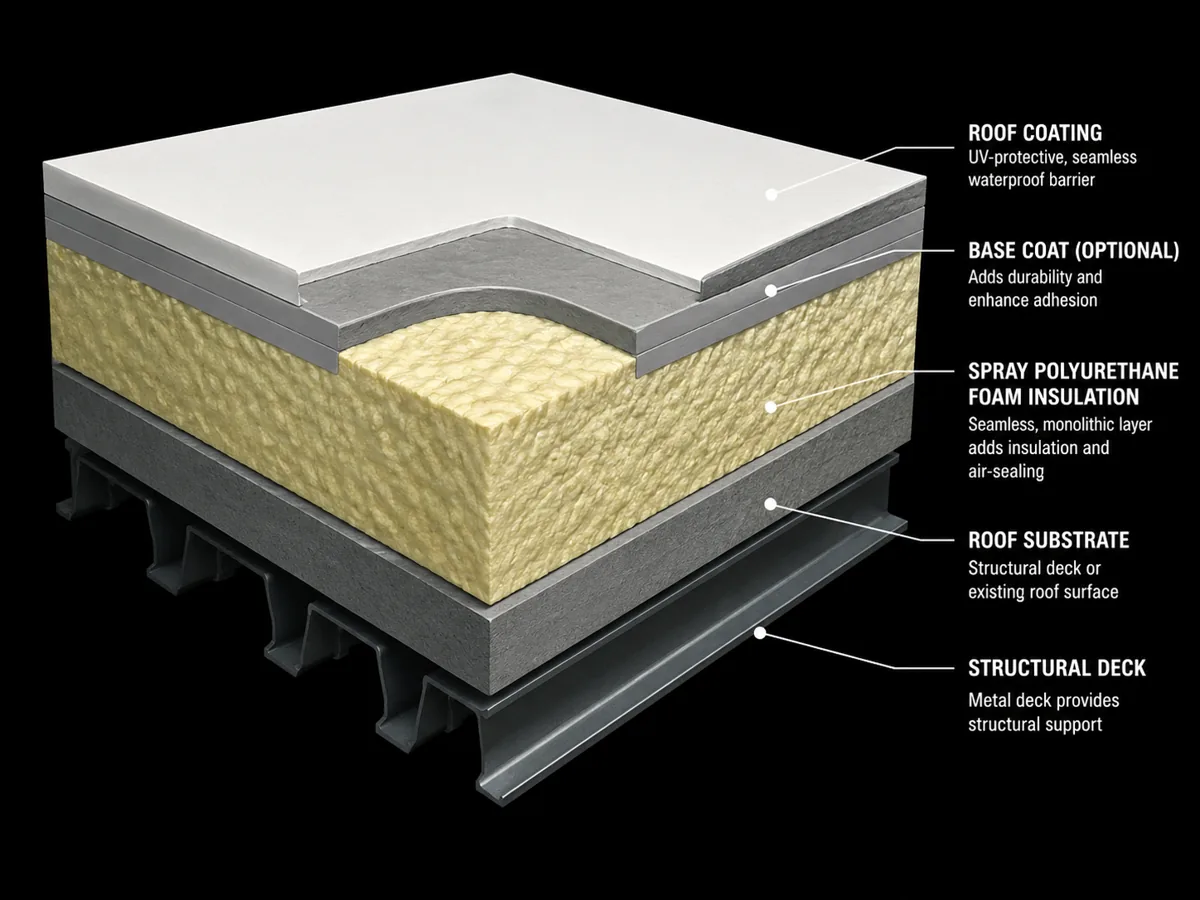
SPF is a two-component liquid applied on site through heated hoses. The components react within seconds, expanding roughly thirty times and curing into a rigid, closed-cell foam that is fully adhered to the roof deck or the existing roof surface. Because it goes down as a liquid, the applicator can build thickness where the roof needs it — adding slope toward drains, filling low spots that pond, and building crickets behind curbs — which is something no factory-made membrane can do without extra layers of tapered insulation.
Over the cured foam we apply a protective elastomeric coating, typically silicone in this climate, with embedded granules where extra traffic resistance makes sense. The coating shields the foam from UV, which is the only thing foam genuinely fears. The result is a monolithic assembly: insulation, waterproofing, and slope correction as one bonded layer that typically adds less than a pound per square foot — a fraction of the weight of a gravel built-up roof.
Owners reasonably ask about wind, hail, and fire. Fully adhered foam has no edge for wind to catch — there is no membrane to peel, which is why SPF roofs have such a strong record in uplift events; the assembly is bonded to the deck across every square inch rather than held at fasteners and perimeter bars. Hail resistance comes from the foam's crushable-but-closed structure: severe hail can dent a foam roof without breaching it, and dents are cosmetic repairs, not leaks. Fire performance is a ratings question we answer with documentation — the coated systems we install carry the classifications commercial work requires, and the specific listing for your assembly is part of the written bid rather than a verbal assurance.
Longevity is where the system earns its keep. The foam itself does not meaningfully degrade when kept coated. Industry studies and our own two decades in this valley show the same pattern: recoat on a 10–20 year cycle and the roof functionally renews itself indefinitely. If you want the deeper dive on service life, we've written up the evidence at how long spray foam roofing lasts — the short version is that SPF is the last roof most buildings ever need.
Most of our Visalia work is commercial roofing, and the city's commercial footprint is bigger than outsiders realize. The Visalia Industrial Park is one of the largest industrial districts in the Central Valley — a grid of distribution centers, manufacturers, and cold-storage operations northwest of town with quick access to Highway 99 via 198. Those buildings live and die by their roofs: a leak over racked inventory or a hot roof over refrigerated space is a direct hit to the operating statement.
SPF is close to purpose-built for this stock. Distribution centers get a seamless roof that ends the leak-chasing cycle across acres of deck. Cold storage gets insulation and vapor control on the warm side of the assembly, cutting refrigeration load and stopping the condensation drips that ice up docks. Manufacturers get a roof that installs in sections around their operating schedule, because foam application is staged and each day's area is watertight by the end of the day. We have foamed and coated roofs through the industrial park's growth spurts, and we bid them with the drainage, gas-line, and unit-curb details already anticipated.
Closer to the center of town, the calculus shifts from square footage to protection of older structures. Downtown Visalia's building stock includes masonry buildings that predate most codes, with roofs that have been layered and patched for generations. Foam's light weight matters there — you renew the roof without loading a vintage structure — and its self-flashing nature matters even more on roofs crowded with decades of abandoned penetrations.
Ring Visalia and its satellite towns and you will find thousands of metal buildings: shops, barns, packing sheds, gyms, church multipurpose buildings, mini-storage. Metal roofs in this climate fail predictably — fastener gaskets cook and back out under thermal cycling, lap seams open as panels expand and contract through 100-degree summer swings, and rust blooms wherever fog-season condensation lingers. The standard fixes are miserable: re-screwing buys a couple of years; panel replacement is expensive and shuts the building down.
Foam over metal is the better path, and it is a large share of what we do. SPF applied directly over a prepared metal roof encapsulates every fastener and lap seam in a monolithic layer, kills the rattle and oil-canning, stiffens the whole diaphragm, and — critically for metal buildings that were built with little or no insulation — wraps the roof in R-6.5 per inch of closed-cell foam. Condensation stops because the metal is no longer the cold surface meeting humid interior air. The building gets quieter, cooler, and dry, usually in a matter of days and without disturbing the operation inside.
We evaluate metal roofs honestly: heavily rusted panels get treated or replaced before foaming, and roofs that are structurally shot are not candidates for burial under foam. That is what the core-sample-and-drone assessment is for. When a metal roof is a candidate — and most are — the economics beat replacement by a wide margin.
Between the metal buildings and the downtown masonry sits the broad middle of Visalia's commercial roofscape: flat and low-slope roofs on strip retail, offices, schools, medical buildings, and light industrial — built-up roofs, modified bitumen, and a generation of TPO that is now aging out. Each has its own failure signature. BUR alligators and loses gravel into the drains. Mod-bit opens at the end laps. TPO's seams and flashings outlive their welds while the sheet itself gets brittle under Valley UV; we wrote a full comparison at spray foam vs. TPO roofing for owners weighing the two.
In most cases, SPF goes directly over the existing roof after cleaning, repairs, and a moisture survey — no tear-off, no dumpsters of old roofing to the landfill, no days where the building stands open to the sky. The existing roof becomes the substrate, the foam becomes the new insulation and waterproofing, and low areas that have ponded for years finally get sloped to drain because foam thickness is variable by design. For occupied buildings — and in Visalia that includes everything from dental offices to packing-line offices — the ability to renew the roof from above, in sections, without breaching the envelope, is frequently the deciding factor.
Every job starts with the free assessment: a drone survey of the whole roof surface, core sampling where the assembly or moisture picture is unclear, and a written bid within 48 hours. The bid is a document, not a pitch — photos, findings, scope, and numbers you can compare line-for-line against anyone else's.
Installation itself follows a sequence we've refined over two decades. First, preparation: the existing surface is cleaned of dust and debris (a real task in an ag county), wet or damaged sections found by the survey are cut out and replaced, drains and penetrations are prepped, and anything not being foamed is masked. Overspray control matters in town — we monitor wind and stage work accordingly, which is easier when the shop and its equipment are minutes away rather than three counties over.
Then the foam goes down in passes to the specified thickness, typically an inch and a half or more, with extra thickness built where slope needs correcting. Each day's foam is coated or covered before the crew leaves, so the roof is never exposed overnight. The protective coating goes on in two contrasting-colored coats — the color contrast is our own quality check for full coverage — with granules embedded in walkway and high-traffic areas. Final walk-through includes thickness verification and coating millage checks, and you get the documentation. For a fuller walkthrough of the sequence, see our spray foam roofing installation guide.
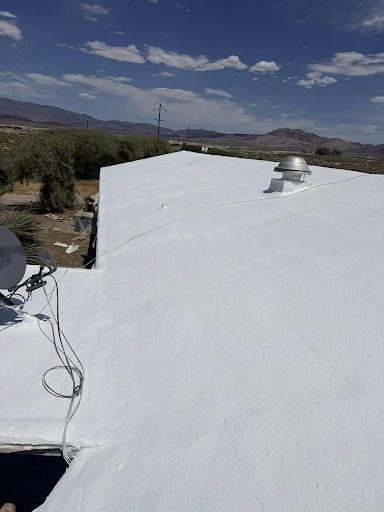
A Visalia roof is an energy appliance whether you treat it as one or not. Cooling dominates utility spending here for eight months of the year, and the roof is the biggest solar collector on the property. Closed-cell SPF at roughly R-6.5 per inch means even a modest two-inch application adds around R-13 of continuous insulation — continuous being the operative word, because unlike batts between joists, foam has no gaps, no compression, and no thermal bridging through framing.
California's Title 24 energy code pushes commercial roofs toward exactly this combination — cool roof surfaces and continuous insulation — on replacements and major alterations, not just new construction. An SPF system with a reflective coating typically satisfies both requirements in one application, which simplifies permitting conversations considerably. We handle the documentation side routinely, and because we work under the same Tulare County and City of Visalia permitting environment year-round, there is no learning curve billed to your job.
Owners ask what the savings are worth. We do not invent numbers: the honest answer is that it depends on the building's insulation starting point, and buildings that start from little or none — most metal buildings and much of the older stock — see the most dramatic change. What we can say flatly is that no other roofing option adds meaningful R-value while it waterproofs. Everything else is a membrane; this is a membrane plus an envelope upgrade.
A word on the buildings this serves, because Visalia's variety is the point: we foam and coat distribution roofs measured in acres and shop roofs measured in squares, and the system scales honestly in both directions. Typical Visalia candidates include:
New SPF roof systems in Visalia typically run $4–$8 per square foot installed, depending on foam thickness, the condition and preparation needs of the existing roof, the number of penetrations and details, and access. Recoating an existing foam roof runs $2–$4 per square foot. Those ranges are real bid ranges, not teaser numbers, and the written bid you receive breaks out exactly where your building lands and why. For the full economics — including how SPF's lifecycle cost compares to repeated single-ply replacements — see the spray foam roofing cost breakdown.
| System path | Typical Visalia cost | What you get | Next cost event |
|---|---|---|---|
| New SPF roof over existing | $4–$8 / sq ft | Seamless foam + coating, ~R-6.5/inch, slope correction, no tear-off | Recoat in 10–20 yrs |
| Silicone recoat of existing foam | $2–$4 / sq ft | Renewed UV protection, resets service cycle | Recoat in 10–20 yrs |
| TPO replacement (typical market) | Comparable or higher with tear-off | New membrane, minimal added insulation | Full replacement at end of life |
| Built-up roof replacement | Highest with tear-off + disposal | Heavy conventional assembly | Full replacement at end of life |
The structural comparison in that table is the part most owners have never had explained: conventional roofs end in tear-offs, forever. Foam ends in recoats. Over thirty years, a foam roof's second and third cost events are $2–$4 per square foot, while a membrane roof's are full replacements. That is the arithmetic that has kept our original Visalia customers on the same roofs for twenty years.
An SPF roof asks little, but it should not be ignored. We recommend the same regimen to every Visalia owner: keep drains clear (especially after harvest dust and winter leaf drop), have the roof looked at after any hail or unusually violent storm, and plan on a professional inspection every few years. Because we are minutes away, inspection visits are easy to schedule and cheap to perform — another place where local geography quietly saves money.
The recoat itself, due every 10 to 20 years depending on coating thickness and traffic, is the entire long-term maintenance story: clean the roof, repair any incidental damage, and apply fresh coating over the existing system at $2–$4 per square foot. No tear-off, no interruption to the building below, no landfill load. Foam roofs we installed in Visalia early in the company's life are now on their renewal cycles, performing on exactly the schedule we promised their owners at the start — which is the kind of claim a company can only make in its hometown, where the evidence is still standing.
Visalia's orbit is part of the territory. Exeter's citrus packing sheds and Main Street masonry, Farmersville's shops and ag buildings, the warehouses and truck-serving businesses clustered at Goshen where Highway 99 meets 198, and Woodlake's packing and civic buildings up toward the foothills — all of it sits within a short dispatch of our shop. These satellite towns share Visalia's climate exposure and its building stock: metal ag buildings, low-slope commercial, and roofs that have been patched more often than assessed.
We treat the satellites exactly like the city: same free drone-and-core assessment, same 48-hour written bid, same crews. For packing houses in particular, timing matters — we routinely schedule foam and coating work around harvest windows so the roof is renewed in the off-season and watertight before the fruit comes in.
If you own a flat, low-slope, or metal-roofed building in Visalia, the next step costs nothing and commits you to nothing: a free assessment with a drone survey, core sampling where the roof's history warrants it, and a written bid in your hands within 48 hours. You will know what your roof actually is, what condition it is actually in, and what each path forward actually costs — from a fully licensed (CA #C-2-1052735), BBB-accredited, SPFA-member contractor whose shop is minutes away and whose reputation lives in this zip code.
Call (559) 739-9519. Twenty-plus years into this, the hometown pitch hasn't changed: we foam roofs like we're going to drive past them for the rest of our lives — because we are.
Also serving Visalia: Silicone Roof Coating in Visalia · Foam Roof Repair in Visalia · Commercial Insulation in Visalia. See all Visalia services on the Visalia service hub, or read our full spray foam roofing guide. Nearby: Spray Foam Roofing in Tulare · Spray Foam Roofing in Clovis.
Yes — this is our home turf, not an expansion market. The company was founded in Visalia over twenty years ago and our shop is minutes away in Tulare County. Crews dispatch from here daily, which is why callbacks and inspections in Visalia are fast and cheap for us to honor.
New SPF roof systems typically run $4–$8 per square foot installed, depending on thickness, prep, and detail work. Recoating an existing foam roof runs $2–$4 per square foot. Every price we quote comes as a written bid within 48 hours of a free drone-and-core assessment.
Usually, yes. SPF is applied directly over prepared built-up, modified bitumen, TPO, and metal roofs after cleaning, repairs, and a moisture survey — no tear-off in most cases. Roofs with widespread saturated insulation or structural damage get that diagnosed honestly in the assessment before anyone talks price.
It's the climate the system is best at. The foam insulates at about R-6.5 per inch, so roof heat stays out of the building, and the reflective coating keeps surface temperatures far below a dark membrane's. The coating takes the UV punishment and gets renewed on a 10–20 year cycle while the foam underneath stays protected.
Both. We work across the Visalia Industrial Park — distribution, cold storage, and manufacturing roofs — as well as downtown commercial buildings, strip retail, churches, and metal shops in Exeter, Farmersville, Goshen, and Woodlake. Foam installs in staged sections, so operating facilities don't shut down for the work.
Generally, yes. California's Title 24 pushes commercial roof work toward cool surfaces and continuous insulation, and a coated SPF system delivers both in one application. We handle the local permitting paperwork routinely since we work under Visalia and Tulare County jurisdictions year-round.
Free assessment — drone survey, core sampling where needed, and a written bid within 48 hours, anywhere in Tulare County.
Or Call Directly
(559) 739-9519