100% silicone restoration for foam, metal, and flat roofs — applied by the Tulare County company whose shop is minutes from your building.
Silicone roof coating in Visalia is the closest thing commercial roofing has to a reset button: for roughly $2–$4 per square foot, an aging flat, foam, or metal roof gets a seamless, UV-immune, waterproof surface and a fresh 10–20 year service cycle — with no tear-off, no dumpsters, and no days when your building stands open to the weather. We have been applying these systems from our Tulare County shop, minutes from Visalia, for more than twenty years, and in this climate we regard 100% silicone as the default answer for most roof restorations. This page explains why, where it fits, where it honestly doesn't, and what it costs on real Visalia buildings.
Coating work rewards proximity even more than new roofing does. A coating project is weather-sensitive — surfaces must be dry, temperatures right, wind manageable — and in a valley that swings from tule fog to 105°F, the contractor who can mobilize the moment a window opens beats the one scheduling around a two-hour drive. Our rigs stage out of the shop minutes away, which means Visalia coating jobs get the good weather windows instead of waiting for a crew to free up three counties over.
It also means the relationship survives the job. A silicone-coated roof should be inspected periodically and recoated in 10–20 years; the company that applied it should still exist and still answer. Family-owned for twenty-plus years, licensed under CA #C-2-1052735, BBB accredited, and SPFA members — that is the paper trail. The practical version is simpler: the roofs we coated in Visalia at the start of the company are still our customers, because we kept showing up.
Silicone earns its place here for three reasons that map directly onto Visalia's weather. First, UV: silicone is essentially unaffected by ultraviolet exposure — it does not chalk away meaningfully, embrittle, or degrade under the Valley sun the way acrylics and asphalt products do. In a place with 260-plus days of sun and summer roof temperatures north of 150°F, that is the headline property.
Second, ponding water. Flat roofs around Visalia pond — decades of settling, added equipment, and clogged drains guarantee it — and most coatings fail under standing water. Acrylics are water-based and will soften and re-emulsify in a pond. Silicone is a moisture-cure chemistry that is unbothered by permanent ponding; it is the coating category insurers and manufacturers accept over ponded areas. Given tule fog season, when a roof can stay wet for a week, that tolerance is not a luxury.
Third, reflectivity. A white silicone surface reflects the majority of solar radiation, dropping rooftop temperatures dramatically. That cuts cooling load in the building below, extends the life of rooftop HVAC equipment that no longer breathes 150°F air, and helps roof-surface requirements under California's Title 24 cool-roof provisions when work rises to the level of an alteration.
There is also a quieter benefit that Visalia building owners feel at budget season: predictability. A coated roof's future is a known quantity — periodic inspections, drain housekeeping, and a recoat at $2–$4 per square foot somewhere in the 10–20 year window. Compare that to the membrane-roof future of escalating repairs followed by a six-figure tear-off, and the coating is as much a financial instrument as a waterproofing one. Facilities managers who have to defend capital plans tend to become coating advocates quickly.
These are not abstract properties; they map to line items. The reflectivity shows up on summer power bills and in HVAC service intervals. The ponding tolerance shows up as warranty coverage that doesn't carve out the middle of your roof. The UV stability shows up as a coating still doing its job in year twelve instead of chalking away in year six. When we say silicone is the default chemistry for this valley, that is the ledger we are reading from — twenty years of watching coatings age on roofs we drive past weekly.
Owners deserve the whole ledger, so here it is — both columns.
If a roof is not a good silicone candidate — too far gone, too wet, structurally compromised — the honest answer is a different scope, sometimes a new spray polyurethane foam roof over the top, and occasionally a replacement. The free assessment exists so that determination is made with data instead of a sales quota.
Timing the decision is its own small art. The cheapest moment to coat a roof is a year or two before it obviously needs it — while the substrate is still dry and the repair line in the bid is still small. Owners who wait for the first interior leak often pay for wet-insulation replacement that a proactive recoat would have prevented entirely. If your roof is past its tenth year and nobody has assessed it since installation, that is the trigger: get the free survey done this season, even if the coating waits for next season's budget.
The candidacy test is condition, not age. A twenty-five-year-old built-up roof that is dry and adhered is a better coating candidate than a ten-year-old TPO roof holding water in its insulation. Our assessment answers the question empirically: the drone survey maps the whole surface — ponding, patches, blisters, seam conditions, rusted panels — and core samples tell us what is happening inside the assembly where it matters. Within 48 hours you get a written bid stating what the roof is, what percentage of it needs repair before coating, and what the finished system costs.
As broad guidance from twenty years of Visalia roofs: metal roofs are almost always candidates unless rust has perforated panels. Foam roofs are nearly always candidates — recoating is their designed maintenance path. Built-up and mod-bit roofs are usually candidates once wet sections are replaced. Single-ply membranes are case-by-case, hinging on how the seams and the insulation below have fared. Roofs with chronic structural deflection or widespread saturation are not candidates, and we will say so in writing.
One more candidacy note specific to this market: buildings change hands in Visalia's commercial corridors, and buyers routinely inherit roofs with no history at all. A pre-purchase roof assessment is one of the cheapest pieces of due diligence available — the drone survey and cores tell you within 48 hours whether you are buying a roof with a $3-per-foot future or a $12-per-foot one, and that difference has renegotiated more than one escrow. We run these for buyers, sellers, and lenders on the same free-assessment footing.
A large share of our coating work is the scheduled renewal of SPF roofs — many of them roofs we installed. Foam roofing is designed around this exact maintenance model: the foam provides insulation and waterproofing and essentially does not age while protected; the silicone coating takes the UV, the ag dust abrasion, and the foot traffic, then gets renewed every 10–20 years at $2–$4 per square foot. The building never experiences a tear-off again.
A recoat visit is straightforward: wash the roof, cut out and re-foam any incidental damage (a gouge from a dropped tool, a hail bruise, a spot where a trade cut in carelessly), re-detail anything questionable, and spray fresh silicone to the specified millage. A day or three of work for most buildings, no interruption below, and the clock resets. Owners who inherit a foam roof and are unsure where it sits in its cycle can start with the same free assessment — coating thickness and condition tell us everything, and the economics are laid out plainly in our spray foam roofing cost guide.
Tulare County may have more metal roofing per capita than anywhere else we could operate, and Visalia's ring of packing houses, equipment sheds, mini-storage, and light industrial buildings supplies a steady stream of the same complaint: fastener leaks. Thermal cycling through 100-degree summers backs screws out and cooks their gaskets; lap seams open; rust follows the fog. Re-screwing and caulking buys seasons, not solutions.
A silicone metal-roof system solves the failure points categorically. Every fastener head gets encapsulated — brushed or sprayed individually with mastic-grade silicone — every lap seam gets reinforced, rust gets converted or treated, and the whole roof is then coated monolithically. The panels stay, the leaks stop, and the white surface drops the summer heat load on buildings that usually have minimal insulation. For packing operations in Exeter and Woodlake, we schedule this work in the off-season so the roof is tight before harvest; for occupied shops along the 99 corridor in Goshen, the work proceeds without the tenants stopping.
Where a metal building needs insulation as well as waterproofing, the better system is often foam over the metal with silicone over the foam — the full assembly described on our installation page. The assessment tells us which building you have.
Metal-roof owners also ask about color and heat. The standard answer for this valley is white or near-white: the reflectivity gain against a weathered galvanized or dark-painted panel is enormous, and on an uninsulated shop the difference is felt on the floor within a day of completion. Where a business wants a brand color or a planning context calls for something quieter than bright white, tinted silicones exist and we spray them — with the honest note that darker tints give back some of the cooling benefit, a trade-off we quantify rather than hand-wave.
It bears repeating as its own subject, because it is the core of the Visalia case for silicone: this valley alternates between the two conditions that kill roof coatings, and silicone is the chemistry indifferent to both. Summer delivers four-plus months of extreme UV and rooftop temperatures that turn lesser coatings chalky and brittle. Winter delivers tule fog — day after day of saturated, non-drying dampness — plus the ponding that follows every rain on a low-slope roof with imperfect drainage.
Acrylic coatings, the budget alternative, are respectable products in dry-fast climates and the wrong products here: water-based, they erode measurably every year under UV and cannot tolerate ponding without softening. Asphalt-based coatings age even faster in the sun. Silicone's moisture-cure chemistry actually uses ambient humidity to cure, shrugs at ponds, and holds its properties under UV for its full cycle. We stock and spray other chemistries when a substrate demands it, but in twenty years of Visalia weather, 100% silicone has been the default for a reason.
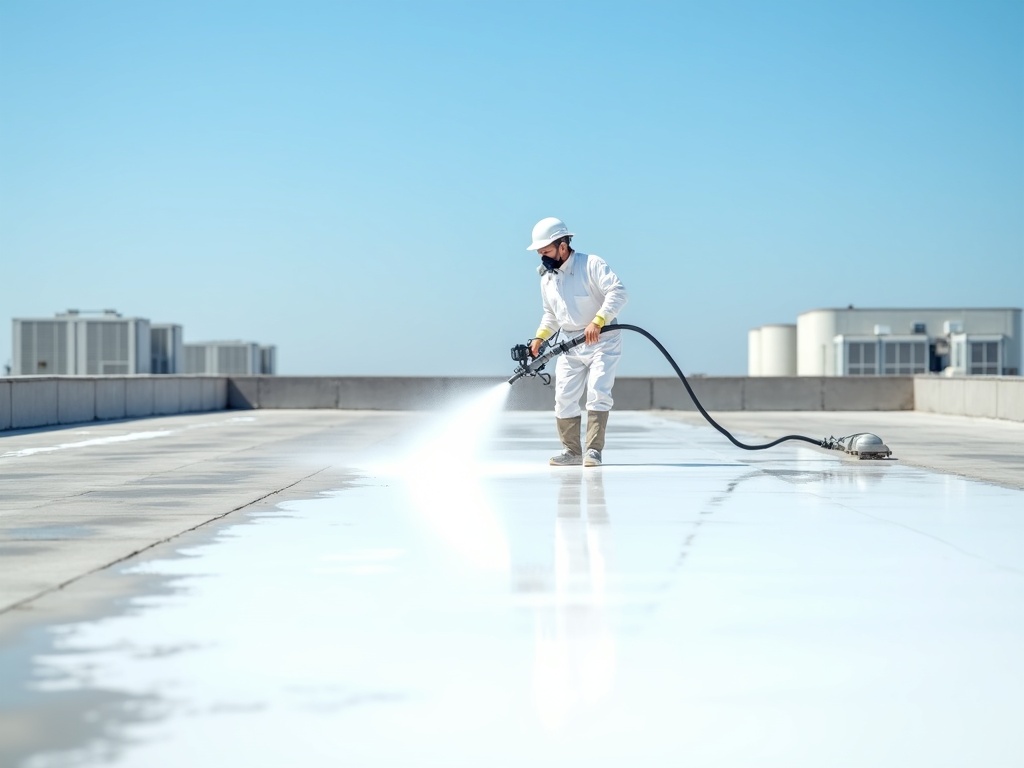
A restoration project in Visalia follows a sequence that rarely surprises anyone by the time it starts, because the written bid already described it. Day one is almost always washing — a pressure wash that pulls off the season's ag dust, the winter's organic debris, and the chalk of whatever the old surface has been shedding. On a Valley roof this step is genuinely substantial; skipping or rushing it is the single most common cause of coating failure industry-wide, which is why we treat wash day as seriously as spray day.
Repairs come next: wet insulation found by the core samples is cut out and replaced, open seams get reinforced with mastic and fabric, fastener heads on metal roofs are individually encapsulated, blisters are cut and healed, and questionable flashings are re-detailed. This is the stage where the roof's real condition — already documented in your assessment — gets corrected rather than buried. Only a dry, sound, clean surface gets coated; that rule has no exceptions on our crews.
Then the silicone goes on, typically in two coats of contrasting colors. The contrast is our built-in quality control: any spot where the finish color shows thin reveals the base coat beneath it, so full coverage is verifiable by eye and by wet-millage gauge as the work proceeds. Granules are broadcast into designated walkways and around rooftop equipment while the final coat is wet, giving service techs traction for the decade ahead.
The final walk happens with you or your facilities contact on the roof if you want to be there — thickness readings, detail checks, photos, and the paperwork for your records. Most Visalia projects run from a few days to a week or two depending on size and repair scope, and because the work is staged from a shop minutes away, weather interruptions cost days, not mobilization fees.
Restoration coating systems in Visalia run $2–$4 per square foot in almost all cases. Where a specific building lands in that range is driven by a short list of variables, and the written bid itemizes them: how much washing and prep the surface needs (ag dust is real work), how much repair — wet-material replacement, seam reinforcement, fastener encapsulation — precedes the coating, the specified coating thickness, and access and staging logistics.
| Scenario | Typical range | Drivers |
|---|---|---|
| Foam roof recoat (maintenance cycle) | $2–$3 / sq ft | Mostly clean-and-spray; minimal repair |
| Metal roof silicone system | $2–$4 / sq ft | Fastener count, rust treatment, seam detail |
| BUR / mod-bit restoration | $2.50–$4 / sq ft | Wet-section replacement, surface prep, millage |
| Full roof replacement (comparison) | Several times higher | Tear-off, disposal, new assembly, downtime |
The comparison row is the point. Against a tear-off and replacement, restoration typically saves well over half the cost while deferring the largest capital event a building faces — and because the cycle is repeatable, “deferring” usually means “retiring.”
Owners comparing bids will meet all three words, so here is the honest taxonomy. Silicone: best UV stability, only mainstream chemistry rated for permanent ponding, moisture-cure (fog doesn't frighten it), premium price within the coating world, slick when wet (granules fix this). Acrylic: cheapest, easy to apply, genuinely fine on steep metal in mild climates; erodes under Valley UV and fails under ponding — we rarely specify it here. Urethane: toughest against physical abrasion and foot traffic, common as a base coat in high-traffic details or under silicone topcoats; less UV-stable alone. Many of our systems use urethane where gear gets serviced and silicone everywhere else — chemistry by zone, not by slogan.
What matters more than the chemistry argument is millage and prep: a properly washed roof with wet material replaced and coating applied at spec thickness will outperform a premium product slapped thin over dust every single time. That is why our bids state thickness, and why our two-coat contrasting-color method exists — the second coat visibly reveals any spot the first missed.
Millage — the applied thickness of the coating — deserves its own sentence in any comparison, because it is where low bids hide. Two contractors quoting “a silicone roof coating” can be describing systems that differ by half the material: one specifying finished thickness verified by gauge, the other spraying until the color looks even. Thickness is what gets consumed over the service life; thin systems simply run out of coating early. Every Allstate bid states the specified millage in writing, and the two-coat contrasting-color method plus wet-film gauging during application is how we prove the roof got it. When you compare our number against another, compare that line first.
The satellite towns around Visalia carry exactly the roof stock coatings serve best. Exeter's citrus packing sheds and its older Main Street masonry buildings; Farmersville's shops and ag-service buildings; Goshen's warehouses and truck-stop-adjacent commercial at the 99/198 junction; Woodlake's packing and civic buildings toward the foothills — metal and low-slope, sun-beaten, and mostly patched rather than assessed for years. All of it is a short dispatch from our shop, all of it gets the same drone-and-core assessment and 48-hour written bid, and packing facilities get scheduling built around harvest.
The economics for the satellites are identical to Visalia proper because the dispatch is: no travel premium, no minimum-size threshold that quietly excludes a small Exeter shop roof, and the same 10–20 year relationship afterward. If your building sits anywhere in this cluster — on Highway 198 toward the foothills or along the 99 corridor — the roof is in our normal daily radius, not at the end of a route.
Allstate started in Visalia more than twenty years ago; the crews that coat these roofs live under this same sun and drive these same highways. If your flat, foam, or metal roof is aging, leaking, or simply due, start with the free assessment — drone survey, core samples where the story needs them, written bid within 48 hours, backed by industry-leading leak-proof guarantees from a licensed (CA #C-2-1052735), BBB-accredited, SPFA-member contractor. Call (559) 739-9519 and get the reset button priced before another Valley summer takes its cut of your roof.
Also serving Visalia: Spray Foam Roofing in Visalia · Foam Roof Repair in Visalia · Commercial Insulation in Visalia. See all Visalia services on the Visalia service hub, or read our full silicone roof coating guide. Nearby: Silicone Roof Coating in Tulare · Silicone Roof Coating in Clovis.
Almost all restoration coating work in Visalia lands between $2 and $4 per square foot, driven by prep, repair scope, and specified thickness. That's typically less than half the cost of replacing the roof. You get exact numbers in a written bid within 48 hours of the free assessment.
Yes — that's silicone's signature advantage. It's the mainstream coating chemistry rated for permanent ponding, and its moisture-cure formulation is untroubled by tule fog season. Acrylic coatings, by contrast, soften and fail under ponded water, which is why we rarely specify them on Visalia flat roofs.
Usually. Surface rust gets treated or converted, every fastener head is individually encapsulated, lap seams are reinforced, and then the whole roof is coated monolithically. Panels rusted through are replaced first. The free drone survey and inspection tell us which category your roof is in before we quote it.
Foam roofs run a 10–20 year recoat cycle depending on coating thickness and traffic. Coating condition, not age, is the real test: if foam is starting to show through or the surface is thinning, it's due. We check thickness and condition as part of the free assessment, including on foam roofs other companies installed.
Minimal. There's no tear-off, so the building envelope is never opened — work happens entirely on top of the existing roof, staged in sections. Odor and noise are modest compared to roofing work generally. For packing houses in Exeter or Woodlake we schedule around harvest; offices and retail generally operate normally throughout.
Coatings are weather-window work — surfaces must be dry and conditions right. Our crews stage from a shop minutes away, so Visalia jobs catch good windows quickly instead of waiting on travel. And since silicone systems run 10–20 year cycles, you want the applicator still local, still licensed (CA #C-2-1052735), and still answering the phone at recoat time.
Free assessment — drone survey, core sampling where needed, and a written bid within 48 hours, anywhere in Tulare County.
Or Call Directly
(559) 739-9519