A 100% silicone restoration system that turns an aging flat or metal roof into a seamless, ponding-proof, reflective surface — for a fraction of replacement cost.
Silicone roof coating gives Tulare building owners a way out of the replacement trap. If your flat, foam, or metal roof is aging but structurally sound — some leaks, chalking surface, tired seams, ponding stains — you generally don't need a new roof. You need a new weathering surface. A fluid-applied 100% silicone system delivers exactly that: a seamless, waterproof, reflective membrane installed directly over the existing roof at $2 to $4 per square foot, versus the far larger check (and the tear-off, and the disruption) a replacement demands.
The economics hit differently in a town like Tulare, where so much of the commercial square footage is big: processing plants, commodity warehouses, equipment dealerships, distribution buildings along Highway 99. On a 40,000-square-foot roof, the spread between a coating restoration and a full replacement isn't a rounding error — it's capital that stays in the operation. That's why roof coating work has become one of the most-requested services we run out of our Tulare County shop, which sits under 20 minutes from any roof in town.
Allstate Spray Foam is family-owned with 20+ years in the trade, fully licensed (CA Lic #C-2-1052735), BBB accredited, and an SPFA member. This page explains how silicone restoration works, which Tulare roofs qualify, what it honestly costs, and where silicone's limits are — because a coating quoted onto the wrong roof is money wasted, and we'd rather tell you that at the free assessment than after.
A silicone restoration is a process, not a paint job, and the difference between the two is why some coating projects last two decades and others peel in three years. Ours starts with the free assessment: a drone survey of the entire roof plane and core sampling wherever we suspect trapped moisture in the existing assembly. Coating over a wet roof seals the water in — it's the cardinal sin of this trade — so we verify what's underneath before we quote, and you get the written bid within 48 hours.
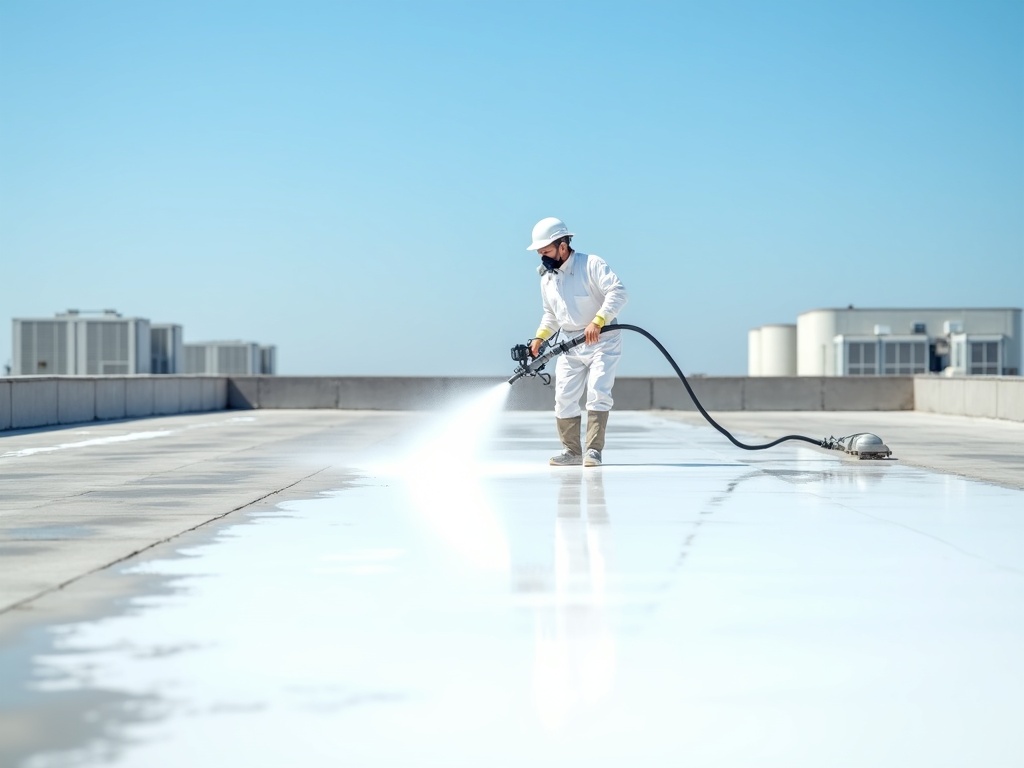
Installation begins with cleaning, usually a controlled pressure wash to strip the Valley's accumulated ag dust, chalking, and biological growth so the silicone can bond. Then comes repair: wet insulation is cut out and replaced, open seams and flashings are treated, fastener heads on metal roofs get individually sealed, and ponding areas are addressed. Only then does the silicone go down, spray- or roller-applied at the specified millage — thickness is measured, not eyeballed — flowing into every seam, lap, and penetration to cure as one continuous rubber-like membrane.
We install high-solids 100% silicone rather than acrylic for one Tulare-specific reason above all: water. Acrylics are water-based and re-emulsify under ponding — a real problem on dead-flat roofs that hold water through a foggy Valley winter. Silicone is moisture-cure; it doesn't soften, bubble, or break down under standing water. On roofs that pond, it isn't a preference, it's the only responsible spec.
Silicone flat roof coating systems adhere to nearly every substrate common in Tulare County, and the town's building stock reads like the compatibility chart:
The disqualifiers matter just as much. A roof with widespread saturated insulation, structural deck damage, or a membrane that's detaching isn't a coating candidate — sealing over those problems just postpones and inflates the bill. That's precisely what the core sampling in our assessment is for. Roughly speaking, if more than a quarter of the roof assembly is wet, restoration math stops working and we'll tell you so, usually with a spray foam re-cover as the honest alternative since it also avoids tear-off. The decision tree — coat, foam over, or replace — is something we walk through with you using the drone imagery and core results, not a sales script.
One more Tulare-specific candidate worth naming: buildings around the International Agri-Center that take a beating from event traffic, temporary equipment, and year-round sun. A silicone restoration before the February World Ag Expo is a common, sensible pre-show project — weather permitting, it's days on the roof, not weeks.
Silicone roof coating price is the number one question we get, so here it is plainly: complete restorations run $2 to $4 per square foot in Tulare, driven by roof condition (how much repair before coating), required coating thickness, penetration density, and access. Compare that against a new SPF system at $4–$8 per square foot — itself usually cheaper than membrane replacement once tear-off and disposal are counted — and the restoration case makes itself when the roof qualifies.
| Scenario | Typical Range | Best For |
|---|---|---|
| Silicone recoat of existing foam roof | $2–$4 / sq ft | SPF roofs at the 10–20 year mark; renews the system indefinitely |
| Silicone restoration over metal, mod-bit, BUR, or aged single-ply | $2–$4 / sq ft | Sound roofs with surface-level aging, seam leaks, minor ponding |
| New SPF roof system | $4–$8 / sq ft | Roofs needing slope correction, added insulation, or too far gone to coat alone |
Two honest footnotes to those numbers. First, repairs are part of the price conversation: a metal roof needing five hundred fastener seals and two panel replacements prices differently than one needing a wash and two coats — that's why the bid follows the drone survey, not a phone call. Second, coatings carry a tax angle worth asking your accountant about: restoration is often treated as maintenance expense rather than capital improvement, which changes the after-tax cost meaningfully for commercial owners. The broader lifecycle economics — coating cycles versus replacement cycles over 30 years — are laid out in our roofing cost guide.
Every roofing product has trade-offs, and you should hear silicone's from the contractor who installs it. The pros are substantial. Silicone is the most ponding-water-tolerant coating chemistry available — it simply doesn't degrade under standing water. Its UV stability is exceptional, which in the South Valley's sun is the difference between a surface that chalks gracefully over decades and one that cracks in five years. It stays flexible across our temperature swings, from 25°F fog mornings to 160°F roof-surface afternoons. It's seamless, it's reflective (cutting summer cooling load and helping with Title 24 cool-roof compliance), and it's renewable — when it eventually wears, you clean and recoat, not tear off.
Now the cons. Cured silicone is slick when wet, so walkway pads are a must around rooftop equipment that gets serviced — we install them as part of the system. Once a roof is siliconed, only silicone sticks to it afterward; you're committing to the chemistry for future work (given its performance, that's a commitment we're comfortable recommending, but you should know it). It picks up the Valley's dust, which dulls reflectivity between rains — an occasional wash restores it. And it is not a structural fix: silicone waterproofs and protects, but it adds no meaningful insulation and no slope. If your roof's real problems are thermal or drainage-related, the answer is foam (with silicone on top), not coating alone.
That last distinction is where an honest assessment earns its keep. We install both systems, so we have no incentive to force your roof into the wrong one. The drone-and-core-sample assessment tells us which conversation to have, and the 48-hour written bid reflects it.
Dead-flat roofs pond, and Tulare's winter makes it worse. Our rain arrives concentrated between November and March, often onto roofs whose drains are already contending with months of accumulated ag dust and debris, and then the tule fog settles in — days of saturated air where nothing evaporates. A birdbath that would dry in an afternoon in Phoenix sits for weeks in a Tulare January. Under that standing water, asphalt products leach and alligator, acrylic coatings re-emulsify, and membrane seams get tested exactly where they're weakest.
Silicone's moisture-cure chemistry is indifferent to all of it. It's the coating category that carries ponding-water warranties for a reason, and it's why we spec 100% silicone rather than cheaper acrylic on every low-slope roof that holds water. On roofs where ponding is severe, we go further: foam can be sprayed to build slope in the low areas before the silicone goes down, converting a chronic pond into a draining plane — a repair no sheet product can replicate.
If your roof shows the telltale rings — concentric dirt stains, algae shadows, rust blooms around low-lying fasteners — that's ponding history writing itself on the surface. It's worth a free assessment before this winter's rain, not after. Standing water accelerates every other failure mode a roof has, and each wet season the repair scope grows.
Metal roof coating deserves its own discussion in a county with this much steel overhead. The failure pattern on Tulare's metal buildings is consistent: UV cooks the fastener washers, thermal cycling backs the screws out, end-laps and ridge details open, and rust establishes wherever dust and condensation linger. Owners patch with tubes of sealant, the patches fail, and the cycle repeats every couple of winters.
A silicone metal-roof restoration breaks the cycle in one project. Every fastener head gets encapsulated, every seam and lap gets reinforced and sealed, rust is treated and primed, and the entire panel field is coated into a single continuous membrane. The white surface drops summer panel temperatures dramatically, which slows the thermal cycling that caused the fastener problem in the first place — the restoration doesn't just seal the symptoms, it calms the mechanism.
The buildings this fits are everywhere here: equipment dealerships and their service shops along the highway frontage, trucking and distribution terminals working the 99 corridor, commodity barns and shop buildings on dairies from Tipton to Pixley, packinghouse structures out toward Lindsay. For terminals and dealerships specifically, the no-tear-off nature of coating work matters operationally — docks keep working, inventory stays dry, and the project doesn't shut down the yard. Where a metal roof also has an interior condensation or heat problem, we'll talk about foam over the metal with silicone on top; where it's watertightness alone, coating is the efficient answer.
Tulare is the dairy capital of America, and its processing facilities present rooftop conditions most coating contractors never see: steam and washdown exhaust venting through the roof, cleaning-chemical residues settling on the surface, dense penetration fields around refrigeration equipment, and hygiene-critical operations below that cannot tolerate contamination or debris. We work these roofs regularly, and the protocols are second nature — sectioned scheduling around production and sanitation windows, absolute overspray and debris control, staging clear of air intakes, and documentation suitable for the facility's audit files.
Silicone itself is well suited to the environment. It's chemically stable against the wash-chemical fallout that degrades asphaltic surfaces, tolerant of the constant humidity plume around processing vents, and seamless around the pipe and curb penetrations that concentrate on these roofs. The reflective surface trims heat gain over refrigerated and conditioned space — compressor load nobody has to pay for — and the renewable recoat cycle means the plant never faces a tear-off over live production lines.
For facility managers, the practical takeaway: a coating restoration is one of the few roofing projects that can be executed over an operating food plant with essentially zero production impact, and it converts an unpredictable leak-risk roof into a documented, warrantied system. We're under 20 minutes away when something on the roof does need attention — the response-time math of a local contractor is part of the system too.
A silicone-coated roof isn't a product with an expiration date; it's a system with a maintenance rhythm. The coating is the sacrificial, renewable layer. Depending on millage, exposure, and foot traffic, it weathers gradually for 10 to 20 years, and then you clean it and apply a fresh coat at the $2–$4 recoat price — no tear-off, ever, as long as the cycle is honored. Over a 30-year horizon, that rhythm typically beats one-and-a-half membrane replacements by a wide margin, both in dollars and in disruption.
On spray foam roofs, this rhythm is the entire longevity story: foam protected by maintained silicone effectively doesn't age out. We've detailed the cycle, the inspection cadence, and what actually determines wear rates in our spray foam roof lifespan guide, and the same logic governs coated metal and membrane roofs. The variables that matter in Tulare are sun (high UV budget spends coating faster on south-facing exposure), dust (abrasive underfoot — service paths need walkway pads), and trades traffic (HVAC techs' dropped screws puncture more coatings than weather does).
We set every coating client up with the simple regimen that protects the investment: an annual visual check, debris cleared from drains before the November rains, and a call to us — not a tube of hardware-store sealant — when something looks off. Small silicone repairs are fast and cheap for a local crew; deferred ones are neither.
Three paths exist for an aging Tulare roof, and honest contracting means matching the roof to the right one. Coating alone fits roofs that are dry, attached, and structurally sound — the problems are at the surface, so the fix can be too. Spray foam over the existing roof fits when there are also insulation, slope, or severe ponding problems, or when the surface is too far gone for coating but the deck is good; you get the seamless silicone surface plus R-6.5-per-inch thermal performance underneath, detailed in our SPF roofing overview. Full replacement is the last resort, reserved for roofs with widespread saturation or structural failure — real, but rarer than the replacement-minded bids circulating this market suggest.
The diagnostic sequence is the same free assessment in every case: drone survey, core samples where the history is unclear, written bid within 48 hours. The drone imagery goes to you either way — it's your roof, and you should see it.
What we won't do is coat a roof that shouldn't be coated. Trapped moisture doesn't negotiate; it blisters coatings, rots decks, and turns a $3-per-foot project into a $8-per-foot apology. If your roof isn't a candidate, you'll hear it from us at the assessment, with photographs and core results, alongside what we'd do instead and what that path costs.
A silicone restoration changes more than the waterproofing — it changes the roof's color, and in the South Valley that changes the utility bill. An aged dark cap sheet or weathered metal roof absorbs the summer sun and runs extremely hot for hours a day; a fresh white silicone surface reflects the bulk of that solar energy and keeps the roof dramatically cooler through the same afternoon. Everything under the deck feels the difference: air conditioning cycles instead of running flat-out, refrigerated spaces buy back compressor hours, and the rooftop HVAC units themselves breathe cooler air, which measurably improves their efficiency and lifespan.
The reflective surface also does regulatory work. California's Title 24 pushes low-slope commercial roofs toward cool-roof performance, and a white silicone system is one of the simplest ways an existing building meets that bar when alteration work triggers compliance — no assembly rebuild, no added structure, just the coating the roof needed anyway. For buildings with conditioned or refrigerated space below, we'll walk the energy logic at the assessment: roof area, what's under the deck, and what the current surface temperature is costing you every summer afternoon between June and September.
One caveat we give every owner honestly: reflectivity is a bonus on top of the waterproofing case, not a substitute for insulation. A coating keeps heat from soaking in at the surface; it doesn't add R-value to a building that lacks it. When the assessment shows the real problem is thermal — an uninsulated metal roof over conditioned space, say — the right answer is foam under the silicone, and we'll price both paths side by side so the decision is yours with the numbers visible.
Roof coating in Tulare County doesn't stop at the Tulare city limits, and neither do we. The dairy corridor down Highway 99 through Tipton and Pixley is metal-roof restoration territory — shop buildings, commodity storage, and processing-support structures whose fastener systems have been cycling through Valley summers for decades. Lindsay, out Highway 137 in the citrus belt, carries packinghouse and cold-storage stock where reflective coating over conditioned space pays for itself in compressor hours. Porterville anchors the southeast on Highway 190 with retail centers, industrial parks, and civic buildings on flat roofs that pond every winter.
All of it is inside an easy dispatch radius from our Tulare County yard — under 20 minutes to Tulare proper, not much more to the satellites. That proximity shapes the service, not just the sales pitch: assessments happen within days, weather windows get used instead of missed, and when a coated roof needs attention years later, the crew that installed it is still local. Call (559) 739-9519, tell us where the building is and what the roof is doing, and we'll take it from there — drone survey, straight answers, written bid in 48 hours, and industry-leading leak-proof guarantees on the finished work. The best time to coat a Tulare roof is the dry season before the November rains; the second-best time is a free assessment this week to find out exactly where your roof stands.
Also serving Tulare: Spray Foam Roofing in Tulare · Foam Roof Repair in Tulare · Commercial Insulation in Tulare. See all Tulare services on the Tulare service hub, or read our full silicone roof coating guide. Nearby: Silicone Roof Coating in Hanford · Silicone Roof Coating in Visalia.
Complete silicone restorations run $2 to $4 per square foot in the Tulare area, depending on roof condition, required repairs, coating thickness, and access. That's typically a fraction of replacement cost, and it avoids tear-off entirely. We confirm the exact number with a free drone survey and a written bid within 48 hours.
Silicone is the one coating chemistry rated for continuous standing water, so it waterproofs ponding areas that destroy acrylics and asphalt products. Where ponding is severe, we can spray foam to build slope in the low spots before coating, so the water drains instead of sitting through the tule-fog season. The right combination gets determined at the assessment.
Yes — metal is one of the best substrates for silicone restoration. We seal every fastener head, reinforce seams and laps, treat rust, and coat the entire panel field into one seamless membrane. It's a fraction of replacement cost and the building stays in operation throughout.
Yes, and we do it routinely in Tulare. Work is sectioned around production and sanitation schedules, overspray and debris are strictly controlled, staging stays clear of air intakes, and the work is documented for your audit files. There's no tear-off, so the building envelope is never opened over live operations.
A properly applied 100% silicone system weathers for 10 to 20 years depending on thickness, exposure, and rooftop traffic, then gets cleaned and recoated at the same $2–$4 range — no tear-off. Maintained on that cycle, the roof effectively stops having a replacement date.
Usually not, but sooner is better. Coating needs dry substrate and workable weather, and Tulare's rain and fog concentrate from November through March, so fall is the ideal window. If leaks are active, we repair those areas first, verify the insulation is dry with core samples, and coat when conditions allow.
Free assessment — drone survey, core sampling where needed, and a written bid within 48 hours, anywhere in Tulare County.
Or Call Directly
(559) 739-9519