100% silicone restoration for Hanford's flat, foam, single-ply, and metal roofs — a fraction of replacement cost, engineered for 150°F roof surfaces and tule fog winters.
Silicone roof coating gives Hanford building owners a way out of the most expensive sentence in commercial property ownership: "the roof needs to be replaced." In most cases, it doesn't. If the deck is sound and the existing roof — foam, built-up, modified bitumen, single-ply, or metal — is aging rather than structurally failed, a fluid-applied 100% silicone system restores it to watertight, reflective, warrantable condition for $2–$4 per square foot instead of the $5–$12 that tear-off and re-roofing runs. For the packing houses, warehouses, county buildings, and Highway 198 corridor businesses that make up Hanford's commercial stock, that difference is frequently six figures.
The logic is simple: most "failed" roofs in Kings County aren't failed structures, they're failed surfaces. Twenty summers of Valley sun cooks the top layer — asphalt alligators, membranes chalk, coatings thin out — while the assembly underneath is still doing its job. Silicone replaces that spent surface with a seamless, UV-immune, ponding-proof skin that bonds to what's there and weathers in its place. It's the same chemistry we use as the protective topcoat on our spray foam roofs, applied here as a restoration system in its own right. Family-owned, licensed (Lic #C-2-1052735), BBB accredited, SPFA member, and 35 minutes from Hanford via CA-198 — we've been coating South Valley roofs for more than twenty years.
Coatings are not interchangeable, and the label matters. We install high-solids, 100% silicone coatings — meaning the wet film you pay for cures into nearly the same thickness of dry rubber, rather than losing a third of its volume to evaporating carriers. Compare that with economy acrylics, which are water-based: they lose significant film build as they dry, they re-soften under standing water, and they wear measurably every year under UV and dust scour.
Silicone's chemistry is inorganic at its backbone, which is why the San Joaquin Valley's most punishing input — ultraviolet radiation — essentially doesn't age it. It stays flexible from freezing fog mornings to 150°F afternoon decks. It is moisture-cure, meaning humidity helps rather than hinders curing. And critically for Kings County's dead-flat roofs, it is unaffected by ponding water: where acrylics blister and re-emulsify under a week-long winter pond, silicone simply doesn't care. When we say the words "100% silicone" in a Hanford bid, that's the entire performance story in three words.
Millage is where coating bids quietly diverge, so ask every contractor the same two questions: what solids content, and what finished dry-film thickness? A high-solids silicone applied at the specified gallons per square delivers the film the warranty math assumes. A thinned product, or the right product spread too far, looks identical the day it's done and fails years early. We state target wet and dry millage in the bid, apply with calibrated equipment, verify with thickness gauges as we go, and record the readings in your closeout documents — so the number you paid for is the number that's actually on the roof.
Roof coating in Hanford earns its keep on three local realities. First, the economics of big simple roofs: ag processing plants, cold storage, gins, and distribution buildings carry enormous square footage, so the per-foot spread between coating and replacing multiplies fast. A 40,000-square-foot warehouse roof coated at $3 per square foot versus replaced at $8 is a $200,000 decision.
Second, business continuity. Coating is a low-disruption process — no tear-off, no exposed deck, no dumpster convoys, minimal noise. Packing lines keep running, county offices stay open, clinic waiting rooms stay quiet. On food-adjacent facilities where an open roof is a contamination risk, restoration versus replacement isn't just cheaper; it's operationally safer.
Hanford's downtown adds a wrinkle worth naming: age. The blocks around Courthouse Square and China Alley carry some of the oldest commercial buildings in the south Valley, and their roofs are frequently archaeological — built-up over built-up, patched by five decades of different hands. Coating candidacy there depends entirely on what the cores reveal, and staging matters on tight blocks where a lift and a spray rig share an alley with open businesses. We've worked those constraints across the Valley's older downtowns; protecting the neighbor's storefront awning is part of the job, not an afterthought.
Third, the energy math. A fresh white silicone surface reflects the large majority of solar energy that a gray, weathered roof was absorbing. In a town with a hundred-plus days of cooling load, dropping the roof surface temperature by 50 degrees or more shows up on the PG&E bill the very first summer, and it helps alteration projects pencil under California's Title 24 cool-roof provisions without redesigning the assembly.
Hanford was laid out on some of the flattest ground in California, and its roofs match the terrain. Dead-flat decks plus winter rain plus tule fog that slows evaporation for days equals ponding — the standing water that kills more Valley flat roofs than any other single cause. Water sitting on a seamed membrane finds the laps. Water sitting on aged asphalt soaks into the alligatoring. Water sitting on a clogged drain field freezes on fog-season nights and pries surfaces apart.
Silicone flat roof coating is the only major coating chemistry that's flatly warrantable under permanent ponding. It doesn't re-emulsify, doesn't blister from moisture drive, and doesn't lose adhesion under standing water. On chronic-pond roofs we go further: because we're also a spray foam company, we can build foam crickets and slope corrections in the low spots before coating, converting a birdbath deck into one that drains. That combination — spray polyurethane foam for geometry, silicone for surface — is a fix that a coatings-only contractor simply can't offer.
Wind-blown ag dust makes ponding worse than the rainfall numbers suggest. Grit washes to the low spots and drains, forms dams, and deepens the ponds year over year. Our maintenance schedules for Hanford roofs include drain-field checks timed to the post-harvest dust season, because a coating system is only as good as the drainage it sits on.
One more Hanford-specific note on drainage: check your scuppers after harvest. The same weeks that fill the air with dust fill parapet scuppers with it, and the first November storm meets a dammed outlet. Ten minutes with a shop broom in late October has saved more Valley flat roofs than any product anyone sells.
Silicone roof coating costs in Hanford run $2–$4 per square foot for a typical restoration, with position inside that range driven by the variables below:
| Cost Driver | Pushes Toward $2/sq ft | Pushes Toward $4/sq ft |
|---|---|---|
| Existing surface | Sound SPF or smooth single-ply needing standard prep | Granulated mod-bit or rusted metal needing heavy prep/primer |
| Moisture in assembly | Dry cores, clean infrared scan | Saturated areas requiring cut-out and foam repair first |
| Roof complexity | Open field, few penetrations | Equipment-crowded processing roof, many details to flash |
| Specified millage | Standard restoration build | High-build system for maximum warranty term |
| Access & staging | Single-story, open yard | Tight downtown block near Courthouse Square, limited staging |
Compare any number in that range against replacement and the argument usually ends there — but the honest comparison includes the roof's condition. Coating a roof that's too far gone wastes money, which is why every Hanford project starts with a free assessment: drone survey of the whole field, core samples where the assembly's story needs verifying, and a written bid within 48 hours. If what your roof actually needs is repair first, or full SPF, the bid says so — with numbers from our spray foam roofing cost guide so you can weigh both paths.
When you're comparing our number against others, normalize three things: dry-film millage (thicker specs cost more and last proportionally longer), prep scope (a bid that skips the moisture cut-outs isn't cheaper, it's incomplete), and warranty term against the millage that actually supports it. A $2.25 bid at half the film of a $3.25 bid is the expensive one. We'll walk you through any competitor's scope line by line without drama — educated buyers choose better roofs, and better roofs are what we sell.
Every material has trade-offs, and you should hear silicone's from the people who install it. The pros, concentrated:
And the cons, stated plainly:
Metal roof coating may be the highest-return version of this entire service in Kings County, because the county is carpeted in steel: pre-engineered shops and warehouses in Hanford's industrial blocks, gin and processing structures down Highway 43 toward Corcoran, equipment barns on every section of farmland, and the commercial steel that serves Lemoore and Avenal. Metal roofs here fail at their details — fastener gaskets baked dead by decade two, panel laps opened by thermal cycling, rust tracking along seams where fog condensation sits — long before the panels themselves are done.
Our metal restoration sequence attacks exactly those details: pressure wash and prep, rust conversion on oxidized areas, seam and fastener treatment — every screw head individually encapsulated or brush-sealed — then a full-field 100% silicone application at specified millage. The result is a monolithic waterproof skin over the entire panel system, reflective white instead of heat-soaking galvanized or faded paint, with every one of the ten thousand fasteners that used to be a future leak sealed under rubber.
Two Hanford-specific notes. First, condensation: coating the exterior doesn't stop interior-side panel sweating in fog season — that's an insulation problem, and our commercial spray foam service handles it from the underside; the two treatments together fully rehabilitate a steel building envelope. Second, heat: an un-coated metal roof radiates brutal heat into shop space all summer, and owners consistently report the workspace itself feels different the first week after a white silicone coat goes on.
Gin and grain structures down the 43 corridor bring their own texture: tall corrugated surfaces, decades of galvanic wear, and dust loads heavier than anything in town. The math still favors coating — a gin roof's enormous, simple area is exactly where per-square-foot savings multiply — but prep is the project. Expect more washing, more rust conversion, and honest talk about any panels past saving. Steel that's structurally sound but cosmetically rough is silicone's ideal patient; steel that's perforated needs repair first, and the assessment will say so plainly.
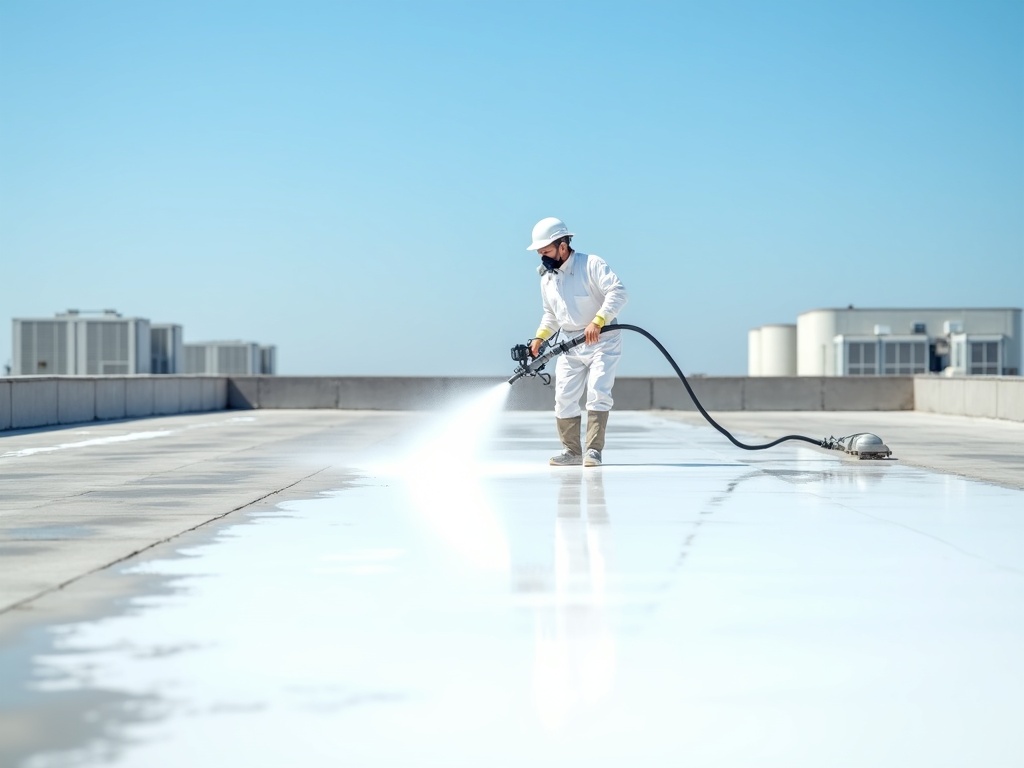
If your building already has a foam roof — and plenty of Kings County ag facilities do — silicone recoating is the maintenance act that makes it permanent. SPF roofs age from the topcoat down: the silicone weathers slowly, thinning over 10–20 years, while the foam beneath stays protected. Recoat before the foam is ever exposed and the cycle resets; the system's documented lifespan then extends past four decades, as covered in how long does spray foam roofing last.
Our recoat process on foam: clean, inspect the entire field, repair any impact damage or blisters — the fix procedures live on our foam roof repair page — then re-apply silicone to full specified thickness. At $2–$4 per square foot on a 10-to-20-year interval, it's among the cheapest per-year roofing costs any commercial building can achieve. We put every Hanford foam roof we touch on a documented recoat schedule so the interval is tracked by us, not by whoever notices a leak first.
Between recoats, the system wants an occasional look. We recommend a walk-through after the first storms and again after the summer dust season — checking drains, walkway granules, and any spot where equipment trades have been working. Coating damage from a careless HVAC repair is the most common thing we find up there, and it's a twenty-minute fix when caught the same season it happened.
Material selection is climate-driven, and Kings County's climate makes the choice unusually clear-cut. Summer delivers months of extreme UV and roof surfaces at 150°F — conditions that age organic coatings fast and favor silicone's inorganic backbone. Winter delivers tule fog: near-permanent surface moisture for days at a stretch, which punishes water-sensitive acrylics during both application windows and service life, while moisture-cure silicone is unbothered. The dust load off surrounding fields scours all surfaces, favoring high-build systems with granule reinforcement in traffic areas. And the daily thermal swing — a fog-chilled morning to a blistering afternoon — demands the elasticity silicone keeps across that whole range.
This is also why application timing is a local skill. We schedule Hanford coating work around fog-season dew points and afternoon wind events, verify substrate moisture before spraying, and adjust cure windows to the season. A coating spec written for San Diego fails in the basin; ours are written for the basin.
Foot-traffic planning is part of the spec, not a change order. Roofs with monthly filter-change routes get granulated walkway paths from the hatch to every serviced unit; roofs with rare access can run smooth. Getting this right on day one is cheaper than retrofitting paths after a maintenance tech discovers wet silicone's slickness the hard way.
Every silicone project in Hanford follows the same documented arc. The free assessment comes first: drone survey of the full roof field, core sampling where saturation is suspected, and a written bid within 48 hours that states plainly whether your roof is a coating candidate, a repair-then-coat candidate, or past restoring. Preparation follows — wash-down, moisture cut-outs and foam repairs, rust conversion on metal, primer where the substrate chemistry requires it. Application is measured, not eyeballed: silicone goes down at specified wet millage, verified with gauges, with details and penetrations brush-flashed before the field coat ties everything together. Granules are embedded in walkways and around serviced equipment. Final documentation includes drone imagery, thickness records, and the maintenance schedule that keeps our industry-leading leak-proof guarantees in force.
That paper trail matters more than it sounds. Kings County buildings change hands, managers rotate, and ten years from now somebody will want to know what's on this roof and when it's due. Our documentation answers that question — and because we're 35 minutes away, the company that installed it is still the company that services it.
Owners picture roofing projects as weeks of disruption; a coating restoration rarely is. A typical 20,000-square-foot Hanford roof runs about a week end to end. Day one is wash-down — pressure washing the field, flushing drains, and letting the Valley's dry air do what it does best. Day two is surgery: cutting out the wet spots the cores flagged, re-foaming or patching them, treating rust on metal, and priming where the substrate chemistry asks for it. Days three through five are application — details and penetrations brush-flashed first, then the field coat sprayed in measured passes, then granules embedded in the walkway routes while the final coat is still wet.
Site logistics stay light. The crew stages from a corner of your yard or an agreed lane of the parking lot; there's no dumpster train because there's no tear-off, and no days-long roar of demolition. Overspray control is a discipline we take as seriously downtown as beside a neighbor's equipment yard — wind screens, masking, and a spray plan that respects the day's forecast. Your operation keeps running underneath the entire time; most tenants notice the smell of a freshly washed roof more than anything else.
Closeout is paper, and it's the part most contractors skip. You receive drone imagery of the finished field, millage readings by area, the products and batch records used, the warranty terms, and the maintenance schedule with its two seasonal check-ins marked. File it with the building documents: when the property refinances, sells, or hits its recoat window in the 2040s, that folder answers every question anyone will ask about this roof.
The crews that coat Hanford roofs cover all of Kings County on the same terms. Lemoore's commercial corridor — the retail, dining, medical, and service businesses sustained by the naval air station community — plus its dairy and processing operations sit ten minutes west on 198. Corcoran's gins, grain structures, and institutional buildings are a straight run down Highway 43. Avenal anchors the county's west side out toward Interstate 5, with institutional and commercial stock that bakes under the same sun. Armona, Home Garden, Stratford, and Kettleman City all fall inside the normal dispatch radius from our Tulare County shop.
We also coordinate multi-building portfolios — a packing operation with roofs in both Hanford and Corcoran, or a landlord with three downtown buildings — under a single mobilization, which moves each individual roof toward the low end of the price range.
If your flat, foam, or metal roof anywhere in that footprint is showing its age — chalking, alligatoring, rust tracks, ponding rings, or the first interior stains — the assessment that tells you whether $3 a foot can save it is free. Call (559) 739-9519 and we'll schedule the drone.
Also serving Hanford: Spray Foam Roofing in Hanford · Foam Roof Repair in Hanford · Commercial Insulation in Hanford. See all Hanford services on the Hanford service hub, or read our full silicone roof coating guide. Nearby: Silicone Roof Coating in Madera · Silicone Roof Coating in Tulare.
Typical restorations run $2–$4 per square foot, depending on the existing surface, prep needs, moisture found in the assembly, and roof complexity. That's usually a fraction of the $5–$12 per square foot that tear-off and replacement costs. Every bid starts with a free drone assessment and is in writing within 48 hours.
Yes — 100% silicone is the one major coating chemistry that's warrantable under permanent ponding water. It doesn't blister, re-emulsify, or lose adhesion under standing water the way acrylics do. On chronic-pond roofs we can also build spray foam slope corrections in the low spots before coating so the deck actually drains.
In most cases, yes. Our metal restoration process includes rust conversion, individual sealing of every fastener head, seam treatment, and then a full-field silicone application. If panels are rusted through or structurally gone, the honest answer is repair or replacement first — and our free assessment will tell you which side of that line your roof is on.
Measurably. A weathered gray roof in Hanford can hit 150°F on summer afternoons; a fresh white silicone surface reflects most of that solar energy, dropping surface temperatures dramatically. Over a hundred-plus cooling days, that shows up on the PG&E bill the first summer — and it supports Title 24 cool-roof requirements on alteration projects.
Plan on a 10–20 year recoat cycle depending on millage, dust exposure, and foot traffic. The key advantage is that the system never goes back to zero: when the coating thins, we clean and re-apply at $2–$4 per square foot, and the cycle resets. We put every Hanford roof we coat on a documented maintenance schedule.
Yes. Coating is a low-disruption restoration: no tear-off, no exposed deck, minimal noise. We stage work in sections around production schedules, including weekend windows, which matters on Kings County packing and processing facilities where an open roof is a contamination risk, not just an inconvenience.
Free assessment — drone survey, core sampling where needed, and a written bid within 48 hours, anywhere in Kings County.
Or Call Directly
(559) 739-9519