Closed-cell spray foam for Kings County's metal buildings, warehouses, shops, and processing facilities — real R-value on steel skin, condensation control in fog season, one installed layer.
Commercial spray foam insulation in Hanford exists because Kings County built its economy inside metal buildings — and metal buildings, left un-insulated, are thermally honest to a fault. The pre-engineered steel shops, warehouses, gins, packing structures, and equipment barns that line Hanford's industrial blocks and run down Highway 43 toward Corcoran are essentially single-wall steel enclosures: whatever the weather is doing outside, the steel delivers inside within minutes. In a county where summer means months over 100°F and winter means weeks of tule fog, that honesty gets expensive — in cooling bills, in condensation damage, in product loss, and in workspaces that are genuinely brutal by 2 p.m. in July.
Closed-cell spray polyurethane foam is the definitive fix for steel-skinned commercial buildings, and it's worth being precise about why. Applied directly to the interior of roof panels and walls, it delivers roughly R-6.5 per inch, adheres permanently to the steel, seals every lap and fastener penetration as it goes, adds rigidity to the panel system, and — decisive in Kings County — keeps the steel's interior surface warm enough in fog season that condensation never forms. One installed layer does the job of insulation, air barrier, vapor retarder, and acoustic damping. We've been installing it across the South Valley for more than twenty years: family-owned, fully licensed (Lic #C-2-1052735), BBB accredited, SPFA member, and about 35 minutes from Hanford via CA-198. To be clear about our lane: this service is commercial and agricultural buildings only — metal buildings, warehouses, shops, and processing facilities, not houses.
A bare or minimally insulated steel building in Hanford loses money four ways at once. The first is radiant heat: a metal roof panel at 150°F on a July afternoon becomes a broiler element aimed at everything below it — inventory, equipment, and people. Buildings with thin vinyl-faced batt sagging between purlins barely blunt this; the steel framing itself bridges heat straight past the batts.
The second is air leakage. Pre-engineered buildings assemble from hundreds of panels and thousands of fasteners, and every lap and screw hole is a small air path. Multiply by a 40-mile-per-hour dust-storm gust and the building breathes hot, dusty outside air all summer — which matters doubly in ag settings where wind-blown grit settles on product, equipment, and anything freshly washed.
The third is condensation, covered fully below. The fourth is comfort-driven behavior: shops that can't be cooled don't run afternoon shifts efficiently, and warehouse pickers slow down measurably in 95°F interiors. Owners tend to discover that the payback calculation on insulation was never really about the PG&E bill alone — it was about the building finally working as designed.
Not all spray foam is the same product, and for metal buildings the specification matters. We install closed-cell polyurethane foam on steel: roughly R-6.5 per inch, a density near two pounds per cubic foot, and a closed-cell structure that refuses to absorb moisture. Two inches delivers about R-13; three inches about R-19.5 — real, continuous R-value with no gaps, no sag, and no thermal bridging, because the foam covers the purlins and girts as well as the panels.
The properties that matter on Kings County steel, in order: Adhesion — closed-cell foam bonds tenaciously to prepared metal, becoming part of the panel rather than a blanket hung near it; it cannot slump, shift, or be pulled down by vibration, forklifts brushing walls, or decades of thermal cycling. Air sealing — the foam floods every lap, closure, and fastener penetration during application, converting a leaky panel assembly into a sealed envelope in one pass. Vapor control — at two-plus inches, closed-cell foam is its own vapor retarder, which is the technical heart of the condensation fix. Rigidity — foamed panels stiffen noticeably; the oil-canning flex and wind-drumming of big bare panels largely disappears. Open-cell foam, by contrast, is a fine product for the wrong application here — it absorbs moisture and offers half the R-value per inch, and we don't put it on Valley steel.
Code compliance inside the building is part of the spec, and we say so up front: exposed foam plastics in occupied spaces generally require a thermal or ignition barrier under California's building code, depending on occupancy and exposure. Where your use case calls for it, we quote the appropriate intumescent or barrier coating over the foam as part of the bid rather than leaving it for the fire marshal to discover. It's a line item, not a surprise — and it's the difference between an installation and a liability.
The acoustic change surprises people too. Foam-damped panels stop drumming in wind and stop amplifying rain into a roar — which matters in offices attached to shops, in clinics and civic buildings with metal roof sections, and in any workspace where conversation currently competes with the building itself.
Ask any Hanford shop owner about winter and you'll hear about the drip. On fog-season nights, bare steel roof panels cool to the fog temperature — often within a few degrees of freezing — while the air inside the building holds moisture from washdowns, stored crops, propane heat, vehicles, or simple occupancy. Where warm moist air meets cold steel, the panel's underside hits dew point and the building rains on itself. Equipment rusts, packaged product gets water-spotted, hay molds, stored paper and cardboard wick, and the slab grows slick patches that are a genuine safety issue.
Closed-cell foam ends this by attacking the physics, not the symptom. With foam bonded to the panel, the steel's interior surface is no longer the cold side of the assembly — the foam face stays near room temperature, safely above dew point, and condensation simply has no cold surface to form on. Because the foam is itself a vapor retarder and air seal, moist interior air can't migrate through to find the cold steel either. This is the single most requested fix we install in Kings County agricultural buildings, and it's binary: buildings that dripped for twenty winters stop dripping the first fog night after application.
What's under the drip determines what it costs. Hay and feed mold. Nuts in bins take moisture damage that grades out at the processor. Cardboard-packed product wicks from the top of the pallet down. Steel equipment rusts along every horizontal surface. The insulation that stops the drip usually gets priced against energy savings, but around here it's just as often priced against one winter's commodity losses — and on that math it pays for itself before the first PG&E bill even arrives.
Hanford's position — county seat, junction of CA-198 and CA-43, rail-served, midway between the 99 corridor and I-5 — has made it a working distribution node, and distribution buildings have a specific insulation profile. The spaces are tall, the roof area is enormous relative to the walls, and the cooling problem is dominated by the roof deck broiling the top of the racking. Closed-cell foam on the roof panels attacks the problem at its source, cutting radiant load before it enters the space and letting existing HVAC — or big fans alone, in many warehouses — actually hold a workable temperature.
For owners weighing options, the roof question has two good answers and we install both: foam applied to the panel undersides from inside, or an exterior SPF roof system over the panels that insulates and waterproofs simultaneously — the full case for that approach lives on our spray polyurethane foam roofing page. Which one wins depends on the roof's condition, interior access around racking, and whether the panels are due for waterproofing anyway. The free assessment settles it with data rather than preference: drone survey outside, inspection inside, written bid within 48 hours covering the options honestly.
We'll also tell you what foam can't fix: dock doors. A warehouse that runs with doors open all day trades air with Hanford no matter what's on the walls, and in that scenario the insulation dollars go to the roof first, where the radiant load lives. Envelope advice that ignores how the building actually operates is how owners end up disappointed in good products.
Kings County's ag processing sector — dairy and cheese operations, tomato and vegetable packing, nut handling, and the cold rooms that serve them — runs on refrigeration, and refrigeration economics are insulation economics. Every point of R-value missing from a cold-storage envelope is compressor runtime, purchased daily, forever. Closed-cell foam is the standard envelope upgrade in these facilities for reasons beyond raw R-value: it's seamless (no batt joints for warm moist air to reach the cold side and condense), it's moisture-immune (washdown humidity doesn't degrade it), and it air-seals the thousand penetrations that refrigeration lines, conduit, and equipment mounts punch through processing-building walls.
Processing spaces add their own demands: washdown moisture loads, USDA-adjacent surface expectations in some rooms (foam takes protective coatings where wash-rated surfaces are required), and harvest-calendar scheduling that doesn't pause for contractors. We stage insulation work around production shifts and seasonal windows the same way we stage our roofing work — section by section, coordinated with your operation, no long equipment-down stretches. It's the kind of scheduling fluency that comes from twenty-plus years working ag facilities across the South Valley.
Refrigeration contractors are allies on these projects, and we coordinate with yours: pull-down loads, defrost cycles, and coil sizing all change when the envelope tightens, and the best results come from doing the insulation and the refrigeration service in the same season. More than once, envelope work has let a facility defer a compressor upgrade it had assumed was inevitable.
The incumbent comparison is fiberglass — the vinyl-faced batts that came with the building or got draped between purlins later. Here's the honest side-by-side for Kings County steel:
| Factor | Closed-Cell Spray Foam | Vinyl-Faced Fiberglass Batts |
|---|---|---|
| R-value per inch | ~R-6.5 | ~R-3 to R-3.5, degraded by compression at framing |
| Air sealing | Total — floods laps, fasteners, closures | None — building still breathes dust and heat |
| Condensation control | Built-in vapor retarder; ends panel drip | Facing tears leak vapor; batts soak, sag, grow mold |
| Durability | Bonded to steel; decades, no sag | Sags, tears at fasteners, degrades in 10–15 years |
| Moisture behavior | Closed cells absorb essentially none | Absorbs washdown/fog moisture, loses R-value wet |
| Structural effect | Stiffens panels, damps wind drumming | None |
| Installed cost | Higher upfront per square foot | Cheaper upfront, replaced repeatedly |
Fiberglass wins exactly one row of that table — first cost — and loses the rest, most decisively in the rows Kings County cares about: air sealing against dust, condensation control against fog, and moisture behavior in washdown environments. The wet-batt problem deserves emphasis: fiberglass that has absorbed a few fog seasons of condensation isn't insulation anymore, it's a damp blanket holding moisture against your steel. A significant share of our commercial insulation projects in Hanford begin by removing exactly that.
When we remove failed batts, the job includes disposal and a bare-panel inspection — the first honest look at fastener corrosion and panel condition the building has had in years. Owners are sometimes startled by what the batts were hiding; better to be startled during a planned project than during a February leak.
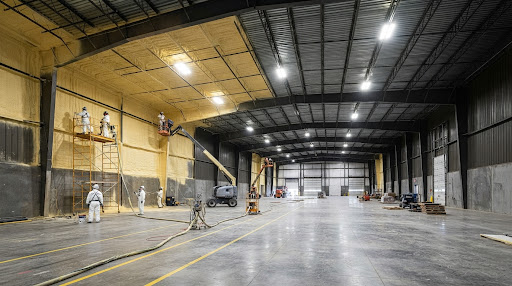
Spray foam insulation cost per square foot for commercial metal-building work depends on thickness, prep, and access, and honest context beats a teaser number. The variables: specified depth (two inches of closed-cell costs less than three; R-targets drive depth), substrate condition (clean newer panels spray fast; older buildings may need washing, rust treatment, or old batt removal first), interior access (open shell versus working around racking, lines, and equipment), and total area (mobilization spreads thinner across bigger jobs — and Kings County buildings tend to be big, which works in your favor).
Rather than publish a number that's wrong in both directions, we do it the accurate way: free on-site assessment, measured areas, verified substrate condition, and a written bid within 48 hours with the R-value math shown. If the smarter money for your building is an exterior SPF roof system instead of interior insulation, the bid will say that too, with the roofing economics laid out the same way they are on our spray foam roofing cost page. What we can promise up front: the energy delta on an un-insulated steel building in this climate is large enough that insulation is one of the few building upgrades with a genuine, calculable payback period.
Phasing is a legitimate cost tool, not a compromise. Foaming the roof panels this year and the walls next fiscal year captures most of the energy benefit immediately — the roof dominates the load in this climate — while spreading the spend. The bid prices each phase separately so the decision stays yours, not bundled to suit our invoice.
California's Title 24 energy code applies to commercial alterations and additions, not just new construction, and insulation levels are core to it. Closed-cell foam's arithmetic makes compliance straightforward: R-13 at two inches, R-19.5 at three, installed continuously — and "continuously" is the word that matters, because code-referenced performance assumes insulation actually covering the assembly rather than batts compressed to nothing at every purlin. On alteration projects in Hanford, foam frequently lets an existing steel building meet envelope requirements without framing modifications.
The operating math is more persuasive than the code math. Take a 20,000-square-foot bare-steel warehouse in Hanford: summer roof panels at 150°F radiating downward, cooling equipment fighting a losing battle, PG&E commercial rates doing the scoring. Three inches of closed-cell foam changes the roof from a broiler element into an R-19.5 barrier and simultaneously seals the air leakage that was importing 105°F outside air. Owners see it in the first summer bill; facility managers see it in equipment runtime; crews feel it by the first week of July. Fog-season heating tells the same story in reverse — the foam that stops condensation also stops the steel from stripping heat out of the space on 35°F mornings.
Comfort compounds the savings in ways spreadsheets miss. Shops that were unbearable by early afternoon keep full schedules; welders stop fighting sweat inside their hoods in August; morning crews in January start in a building that held yesterday's heat instead of one that shed it by midnight. Kings County owners rarely cite the utility bill first when they call us back about a second building — they cite the first building finally being usable.
Because we're a roofing company and an insulation company in one shop, we can treat a steel building as a single envelope instead of two trades' territories. The strongest configuration for many Kings County buildings pairs an exterior SPF roof — waterproofing and R-value over the panels, installed per our spray foam roofing installation process — with interior closed-cell foam on the walls. Roof-side application solves waterproofing, fastener leaks, and the radiant load in one system; wall-side application seals the remaining air paths and finishes the thermal boundary. Buildings that get both stop being metal boxes with weather inside them and start behaving like conditioned space.
Sequencing is flexible and budget-respecting: plenty of Hanford owners do the roof one year and the walls the next, or foam the cold-storage rooms first and the shop later. The assessment maps the whole envelope and prices the phases separately, so the plan matches your capital cycle rather than a contractor's ideal invoice.
For owners planning new metal buildings rather than retrofitting old ones, the same logic applies at the design stage: spec the foam before the interior liner goes on and the installation is faster, cleaner, and cheaper than any retrofit will ever be. We're glad to talk with your building erector before the panels are even ordered.
Commercial insulation installs happen in working buildings, and our process is built around that reality. Preparation comes first: surfaces cleaned, old failed batts removed where present (their disposal handled properly), rust treated, and everything that shouldn't get foam on it — equipment, lines, product, finished surfaces — masked and protected with the same discipline we bring to spraying near neighboring property on downtown roofs. Application proceeds in controlled passes to the specified depth, area by area, with your operation's schedule dictating the sequence; overnight and weekend windows are routine for us in processing facilities. Ventilation is managed during and after application per the material's re-occupancy specifications, and we verify installed depth as we go rather than estimating it afterward.
You get documentation at the end — areas covered, depths installed, R-values achieved — because insulation you can't prove might as well not exist when the building sells, the Title 24 paperwork comes due, or the refrigeration contractor asks what the envelope is doing. It's the same documentation habit that runs through everything we install, backed by industry-leading leak-proof guarantees on the roofing side of the house.
The insulation crews cover Kings County the way the roofing crews do: Hanford's industrial blocks and civic stock at the center; Lemoore's processing operations and the commercial businesses serving the naval air station community, ten minutes west; Corcoran's gins, grain structures, and equipment buildings down Highway 43; Avenal and the west-county I-5 corridor; plus Armona, Home Garden, Stratford, and the unincorporated dairies and packing operations between the towns. Dispatch is from our Tulare County shop, 35 minutes east of Hanford on CA-198.
If your metal building broils in July, rains on itself in January, or runs refrigeration against an envelope that was never really finished, the assessment that quantifies the fix is free: drone survey, interior inspection, and a written bid with the R-value math inside 48 hours. Call (559) 739-9519.
Also serving Hanford: Spray Foam Roofing in Hanford · Silicone Roof Coating in Hanford · Foam Roof Repair in Hanford. See all Hanford services on the Hanford service hub, or read our full commercial insulation guide. Nearby: Commercial Insulation in Madera · Commercial Insulation in Tulare.
Commercial and agricultural buildings only — metal buildings, warehouses, shops, cold storage, and processing facilities. That's our lane and we stay in it. For those building types, we handle the full envelope: closed-cell foam on roof panels and walls, plus exterior SPF roofing when the roof needs waterproofing too.
Yes — and it's the most common reason Kings County owners call us. Fog-season drip is condensation: warm moist interior air meeting steel panels chilled to fog temperature. Closed-cell foam bonded to the panels keeps the interior surface above dew point and acts as its own vapor retarder, so the condensation physically can't form. Buildings that dripped for twenty winters stop the first fog night after application.
Closed-cell foam delivers roughly R-6.5 per inch, installed continuously over panels, purlins, and girts — so about R-13 at two inches and R-19.5 at three, with none of the compression losses that gut fiberglass batts at every framing member. The written bid shows the R-value math for the depths we quote.
Yes. We stage application area by area around production shifts, harvest calendars, and racking layouts — overnight and weekend windows are routine on Kings County processing facilities. Masking and ventilation are managed to the material's re-occupancy specs, and your operation dictates the sequence, not our convenience.
For Valley steel, decisively. Fiberglass wins on first cost and loses everywhere else: half the R-value per inch, zero air sealing against dust and heat, and it soaks up fog-season condensation until it's a damp blanket rusting your panels. A meaningful share of our Hanford jobs start by pulling down exactly those wet, sagging batts.
It depends on the roof's condition and your interior access — and we install both, so you'll get a straight answer. If the panels leak or are due for waterproofing, an exterior SPF roof solves waterproofing and insulation in one system. If the roof is sound and the problem is heat and condensation, interior closed-cell foam is usually the better dollar. The free assessment prices both paths in writing within 48 hours.
Free assessment — drone survey, core sampling where needed, and a written bid within 48 hours, anywhere in Kings County.
Or Call Directly
(559) 739-9519