Closed-cell spray foam for the buildings that run Tulare's economy — metal shops, warehouses, cold storage, and dairy processing facilities that fight heat, humidity, and condensation year-round.
Commercial spray foam insulation in Tulare solves problems that this county's buildings face harder than almost anywhere in California. The dairy capital of America runs on metal buildings, processing plants, refrigerated warehouses, and Highway 99 distribution space — structures that bake past 100°F all summer, drip with condensation through the tule-fog winter, and carry refrigeration loads that never switch off. Closed-cell spray polyurethane foam attacks all three problems with one material: roughly R-6.5 per inch of thermal resistance, a built-in air barrier, and a moisture-blocking skin, applied as a continuous layer with no gaps, no sagging batts, and no thermal bridging.
Allstate Spray Foam is a family-owned Tulare County company with more than 20 years in the foam trade — CA License #C-2-1052735, BBB accredited, SPFA member — and our insulation crews dispatch from our county shop, under 20 minutes from any building in Tulare. We work the commercial and agricultural-industrial side of the market exclusively: shops, warehouses, packing and processing facilities, cold storage, equipment dealerships, terminal buildings. If it has a loading dock, a wash bay, or a compressor room, it's our kind of building.
This page covers how closed-cell foam performs, why metal buildings and food facilities benefit most, what the cost picture looks like per square foot, how foam compares with fiberglass and rigid board, and how Title 24 fits in. If you'd rather skip to a number for your building: (559) 739-9519, free assessment, written bid within 48 hours.
Closed-cell SPF is applied as a liquid that expands and cures in seconds into a rigid foam bonded directly to the substrate — metal panels, wood framing, concrete tilt-up, roof deck underside, whatever the building presents. Its cell structure is what makes it different from every fluffy or board product: millions of sealed gas-filled cells that resist heat flow at about R-6.5 per inch, stop air movement outright, and refuse to absorb or pass liquid water.
That means one installed layer does three jobs the conventional approach splits across three products and three failure points. It's the insulation (R-value), the air barrier (no infiltration through gaps, laps, or fastener penetrations), and a vapor retarder (critical in washdown and high-humidity buildings). Building scientists estimate that air leakage drives a large share of a commercial building's heating and cooling loss; batts in a metal building's purlin cavities do nothing about it, while foam eliminates it in the same pass as the R-value.
Closed-cell foam also adds measurable racking strength and stiffness to metal panel assemblies, bonds so completely that it can't slump or fall away from the substrate the way aged batts do, and won't feed mold — there's no organic food source and no absorbed moisture to grow it in. For the physics-minded, our spray polyurethane foam guide goes deeper on the material science; the same chemistry that waterproofs our roofs insulates these walls and ceilings.
Tulare County's commercial landscape is built from steel, and uninsulated steel is a thermal disaster in this climate. A bare metal shop or warehouse in Tulare hits brutal interior temperatures on a July afternoon — the panels themselves can exceed 140°F and radiate downward like a broiler — and the same building rains indoors in January, when fog-season humidity condenses on cold panels and drips onto inventory, equipment, and stored commodities. Every equipment dealer, shop owner, and barn operator in the county knows both halves of that cycle.
Spray foam applied to the panel interior ends it. Two inches of closed-cell delivers about R-13 bonded continuously across panels and purlins alike; three inches reaches roughly R-19 to R-20. Because the foam is continuous, the steel framing stops acting as a thermal bridge — a detail that quietly cripples batt systems in metal buildings, where the purlins conduct heat right past the insulation. And because the foam surface stays near room temperature rather than tracking the outdoor steel, wintertime condensation has no cold surface to form on. The drip stops, the rust stops, and the fiberglass-falling-from-the-ceiling era ends, because there's nothing left to sag.
The felt difference is immediate: shops that were unworkable from noon to six become usable all day; swamp coolers and shop ACs stop losing the fight; and the building's steel skeleton stops sweating onto everything below it. For dealerships and parts operations, protecting inventory from condensation alone frequently justifies the project before a single kilowatt-hour of savings is counted.
Tulare's position on Highway 99, roughly midway along the Valley's spine, has filled its industrial parks with distribution, trucking, and storage buildings — big-envelope structures where conditioning costs scale with every square foot of under-insulated roof and wall. For these buildings, spray foam applied at the roof deck underside or to wall panels changes the operating math: cooling systems sized for a leaky, radiant-oven envelope suddenly find themselves oversized for the improved one, peak-demand charges flatten, and temperature-sensitive goods stop riding the daily thermal rollercoaster.
Foam earns its keep in these buildings even when they're only partially conditioned. An unconditioned but insulated warehouse in Tulare tracks dramatically closer to livable — and closer to product-safe — than bare steel, cutting peak interior temperatures substantially in summer, which matters for everything from packaged food staging to electronics to tires. Air-sealing matters too: dock-adjacent spaces in foamed buildings hold their conditioning instead of exhaling it through every panel lap each time the wind shifts.
There's a durability dividend as well. Buildings along the 99 corridor breathe the Valley's ag dust and diesel particulate; foam's air-sealing shuts down the infiltration paths that pull that dust indoors through panel laps and gaps, keeping stored product, racking, and HVAC filters cleaner. Owners rarely buy foam for the dust control, but they notice it within a season.
Refrigeration is where insulation stops being a comfort item and becomes a profit line. Tulare County moves and stores enormous volumes of milk, cheese, produce, and frozen product, and every refrigerated cubic foot fights the Valley's heat 24 hours a day. The load a compressor must remove is set by the envelope: every R-value the envelope lacks is compressor runtime purchased at commercial electric rates, forever. Closed-cell foam, at R-6.5 per inch with an integral vapor barrier, is the standard of care for insulated cold-side envelopes for exactly this reason.
The vapor barrier point is not a footnote in refrigerated work — it's the whole game. Warm, humid outside air driving toward a cold interior will condense inside any permeable insulation it can penetrate; wet insulation loses R-value, feeds corrosion, and in freezer applications builds ice inside the assembly. Closed-cell foam is its own vapor retarder, applied seamlessly, with no joints or staple-torn facings to fail. That's why fiberglass has essentially no place on cold-side envelopes and why foam dominates them.
We insulate coolers, freezer additions, dock staging areas, blast-chill rooms, and the conditioned processing spaces that surround them. On existing buildings, foam retrofits over the current envelope often let an operator add refrigerated capacity without replacing walls — and on every project, the energy math is straightforward enough to estimate before you commit: envelope area, current assembly, target R-value, local rates. We'll run it with you at the free assessment, and the payback period on refrigerated foam work is routinely the shortest we see anywhere in our book.
The dairy capital of America runs processing environments that destroy ordinary insulation. Washdown sanitation cycles fill these buildings with hot-water spray, steam, and chemical mist; interior humidity runs high around the clock; and hygiene standards mean every surface and assembly gets scrutinized in audits. Fiberglass in this environment is a liability — it absorbs the humidity, sags in its cavities, loses R-value, and once wet becomes exactly the kind of concealed moisture reservoir food-safety auditors exist to flag.
Closed-cell foam is the opposite animal. It absorbs essentially no water, provides no organic food source for mold, bonds seamlessly with no cavities to harbor anything, and keeps its R-value through decades of humid service. Applied to processing-area ceilings, wall panels, and the envelopes around wash bays and CIP rooms, it does double duty: thermal control for the conditioned and refrigerated spaces, and condensation control everywhere humid interior air meets a surface that winter would otherwise chill below dew point. Condensation dripping from a cold ceiling onto a processing line is a food-safety incident waiting to be written up; a foamed ceiling assembly keeps that surface warm-side-of-dew-point and dry.
We work these facilities the way their managers need us to: scheduled around production and sanitation windows, coordinated with plant supervision, materials staged and contained with the discipline USDA-adjacent environments demand, and the work documented for the facility's audit files. Milk receiving, cheese plants, powder operations, packinghouses out toward Lindsay, processing-support buildings across the dairy belt through Tipton and Pixley — this is the core of our commercial insulation practice, twenty minutes from our yard. When a plant manager needs the contractor back on site quickly — for a follow-up, an inspection, or an auditor's question about the assembly — being local is not a slogan; it's the difference between this afternoon and next week.
Owners comparing quotes deserve the comparison laid out honestly, so here it is. Fiberglass batts are the cheapest ticket in the door and the most expensive seat in the house for a Tulare metal or food building: no air barrier, no vapor control, thermal bridging at every purlin, and a well-documented habit of sagging out of metal-building cavities and soaking up washdown humidity. Rigid board (polyiso, XPS) brings respectable R-value and works in some assemblies, but every board edge and joint is a seam to seal and a future air leak, and boards can't conform to the ribbed, penetrated, purlin-crossed geometry of real metal buildings without labor-intensive detailing.
| Factor | Closed-Cell Spray Foam | Fiberglass Batts | Rigid Board |
|---|---|---|---|
| R-value per inch | ~R-6.5 | ~R-3.2–3.8 | ~R-5 (polyiso) |
| Air barrier | Yes — continuous, integral | No | Only with fully sealed joints |
| Moisture behavior | Closed-cell; absorbs essentially none | Absorbs; sags and loses R when wet | Varies; joints admit vapor |
| Fit to metal buildings | Conforms to ribs, purlins, penetrations | Compressed at framing; bridges thermally | Difficult detailing on ribbed panels |
| Washdown / humid facilities | Excellent — inert, seamless | Poor — moisture reservoir | Fair — joint-dependent |
| Added structural stiffness | Yes | No | Minimal |
The pattern is simple: the harder the building works, the wider foam's lead grows. For an office ceiling in a mild climate, batts are fine. For a steel warehouse that hits 105°F outside air with a refrigerated room inside and a wash bay next door — which is to say, for Tulare — the specification conversation usually ends at closed-cell.
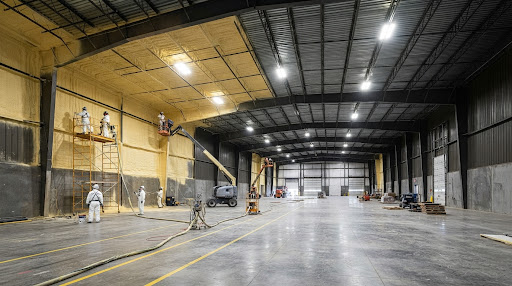
Spray foam insulation cost per square foot depends on thickness, substrate, access, and project size, which is why we quote from a free on-site assessment rather than a phone estimate — and why any contractor quoting sight-unseen is guessing with your money. The honest framing: foam costs more per square foot installed than batts, less than most owners fear, and it's the only option on this list purchased once. Batts in a metal building are a subscription — installed, degraded, replaced — while foam is bonded to the building for the building's life.
The return side has four line items worth naming. Energy: air-sealing plus R-6.5/inch attacks both conduction and infiltration, and summer peak-demand charges respond quickly in this climate. Refrigeration: every added R over cold space is permanent compressor-hour savings. Equipment: HVAC and refrigeration plants sized against a foamed envelope run less, last longer, and can often be downsized at replacement. Asset protection: no more condensation rusting panels and dripping on inventory, no more insulation falling into workspace. On refrigerated and processing buildings, combined paybacks routinely land in the short single-digit years; we'll run your building's numbers with you, not at you. For the way insulation economics interact with roof-side decisions, our cost guide covers the full envelope picture.
Financing note for owners planning capital calendars: insulation retrofits are frequently bundled with our roof work — foam roof above, foam insulation below — because mobilization is shared and the building gets its whole envelope solved in one project window. Bundled scopes price better than sequential ones, and the free assessment can scope both at once, with the written bid in your hands within 48 hours.
California's Title 24 energy code applies to commercial alterations and additions across Tulare County, and its envelope requirements keep tightening with each code cycle. For owners, the practical meaning: when you improve, expand, or re-skin a commercial building, insulation levels and envelope performance are part of the permit conversation, and continuous insulation — insulation without thermal bridges — is increasingly the standard the code steers toward. Closed-cell spray foam is the most direct path to continuous insulation on an existing metal or masonry building, because it applies to the assembly you already own without rebuilding it.
Foam's documented air-barrier performance also works in your favor as codes and utility programs put growing weight on air-tightness. And because foam adds R-value at the highest per-inch rate available, it hits required assembly values in cavities and clearances where batts or boards physically can't — a recurring issue in retrofit work on older Tulare buildings that were framed long before anyone imagined today's requirements.
We're not your Title 24 consultant, and we don't play one — your design professional or energy consultant owns compliance documentation. But we build to spec daily alongside those consultants, we know what the current cycle asks of the assemblies we insulate, and our bids state exactly what R-value and thickness you're buying so the compliance paperwork has real numbers behind it.
A commercial insulation project here follows a clean sequence. Free assessment first: we walk the building, measure, check substrate condition and clearances, identify the humidity and refrigeration realities, and deliver a written bid within 48 hours. Installation day starts with protection and masking — foam goes only where it's meant to — then substrate prep, then spraying in controlled lifts to the specified thickness, with millage checked as we go. Most shop and warehouse projects run one to a few days; occupied facilities get sectioned scheduling so operations continue. Ventilation and re-occupancy timing follow the material manufacturer's requirements, which we build into the schedule up front.
Tulare's calendar gets a vote, and we plan with it. February belongs to the World Ag Expo — facilities near the International Agri-Center want projects wrapped before the show brings its traffic, and we book those windows in the fall. Processing plants often align insulation work with scheduled maintenance shutdowns. Harvest season adds dust and truck traffic that affect staging on ag-adjacent sites. None of it is an obstacle for a crew based twenty minutes away; it's just the rhythm of working in this county, and after twenty-plus years we schedule to it instinctively.
Service area runs the whole southern county: Tulare proper, the dairy belt down Highway 99 through Tipton and Pixley, Lindsay's packing and cold-storage stock out Highway 137, and Porterville's shops, warehouses, and commercial buildings along Highway 190.
Most of our Tulare insulation work is retrofit — the building is up, occupied, and working, and the foam has to go in around that reality. Retrofit is where spray foam's application method becomes its own advantage: it conforms to whatever the decades left behind. Ribbed panels, odd purlin spacing, conduit runs, patched skylight curbs, mixed substrates where additions meet original structure — foam bonds to all of it continuously, where batts and boards would demand custom cutting and still leave gaps at every irregularity. We section the work so operations continue: a warehouse gets foamed bay by bay over a few nights or weekends, a shop over a slow stretch, a processing facility during its scheduled sanitation or maintenance windows.
New shells are the easy case, and worth a word to anyone putting up a building in the county: insulating a pre-engineered metal building with foam at construction time costs less than retrofitting it later, and it spares you the years of oven-summers and drip-winters in between. If your erector is quoting vinyl-faced batt packages, get our number alongside it before the panels go up — the delta is smaller than most owners expect, and the performance difference lasts the life of the building.
Either way, the scoping visit is the same free assessment: we measure, check substrates and clearances, talk through how the building runs and when it can take work, and deliver the written bid within 48 hours with thickness, R-value, and price stated plainly.
If your Tulare building is fighting the climate — a shop that's an oven, a warehouse that drips every fog season, a cooler whose compressors never rest, a processing space with a condensation problem the auditor keeps noting — the fix is measurable, and the first step costs nothing. Call (559) 739-9519. We'll assess the building, run the thermal and moisture logic with you, and put a written bid in your hands within 48 hours: scope, thickness, R-value, price.
You'll be dealing with the same family-owned outfit throughout — licensed (CA Lic #C-2-1052735), BBB accredited, SPFA member, twenty-plus years in foam, and permanently twenty minutes away. And because we also install and restore the roofs above these buildings, the assessment can look at the whole envelope at once: many Tulare owners solve the roof and the insulation in a single mobilization and price better for it. In the dairy capital of America, buildings work hard. We insulate them to work smarter.
Also serving Tulare: Spray Foam Roofing in Tulare · Silicone Roof Coating in Tulare · Foam Roof Repair in Tulare. See all Tulare services on the Tulare service hub, or read our full commercial insulation guide. Nearby: Commercial Insulation in Hanford · Commercial Insulation in Visalia.
Closed-cell foam delivers roughly R-6.5 per inch: about R-13 at two inches and near R-20 at three. Because it's continuous over panels and purlins, there's no thermal bridging through the steel framing, so the building actually experiences the rated value — unlike batts compressed at every purlin.
Yes — that drip is fog-season humidity condensing on cold steel panels, and foam eliminates the cold surface. With closed-cell foam bonded to the panel interior, the exposed surface stays near room temperature and above dew point, so there's nothing for moisture to condense on. It's the definitive fix for metal-building 'indoor rain.'
Closed-cell foam is one of the best-suited insulations for washdown-adjacent environments: it absorbs essentially no water, offers no food source for mold, and installs seamlessly with no cavities. We schedule around production and sanitation windows and document the work for your facility's audit files.
It depends on thickness, substrate, access, and project size, which is why we quote from a free on-site assessment rather than over the phone. Foam costs more up front than fiberglass but is installed once for the life of the building, and on refrigerated or processing space the energy payback is typically the fastest we see. Written bid within 48 hours.
Yes — refrigerated envelopes are core work for us. Closed-cell foam provides high R-value plus an integral vapor barrier in one seamless application, which is exactly what cold-side assemblies require to avoid condensation and ice inside the walls. It's also how several operators have added refrigerated capacity without rebuilding the envelope.
Our insulation practice in the Tulare area is commercial and agricultural-industrial: metal buildings, warehouses, cold storage, dairy and food-processing facilities, shops, and dealerships. That focus is why our crews are set up for washdown environments, refrigeration assemblies, and occupied-facility scheduling.
Free assessment — drone survey, core sampling where needed, and a written bid within 48 hours, anywhere in Tulare County.
Or Call Directly
(559) 739-9519