Seamless, insulating SPF roofing for the dairy capital of America — processing plants, ag buildings, and Highway 99 warehouses, installed by a family-owned Tulare County crew under 20 minutes away.
Spray foam roofing in Tulare has to earn its keep on some of the hardest-working buildings in California. This is the dairy capital of America, and the roofs here cover milk receiving bays, cheese and powder processing lines, refrigerated warehouses, ag equipment showrooms, and Highway 99 truck terminals that never really stop moving. A roof failure in this town doesn't just mean a bucket under a drip — it can mean a food-safety incident, a spoiled load, or a production line standing still while the meter runs. Spray polyurethane foam (SPF) is the roofing system we recommend most often in Tulare because it solves the two problems these buildings fight every single day: heat and water.
Allstate Spray Foam Roofing is a family-owned company with more than 20 years in the spray foam trade, fully licensed under CA License #C-2-1052735, BBB accredited, and a member of the Spray Polyurethane Foam Alliance. Our crews dispatch from our Tulare County shop, which puts us under 20 minutes from just about any roof in Tulare — the Agri-Center corridor, the industrial parks along Highway 99, the downtown blocks off Inyo Avenue, and the dairies and processors spread out toward Tipton and Pixley. When we say we're local, we mean the foreman on your roof probably drove past your building this morning.
This page covers how SPF works, why it fits Tulare's flat-roofed commercial and agricultural building stock so well, what it costs, and how we schedule work in a county where February belongs to the World Ag Expo and late summer belongs to harvest.
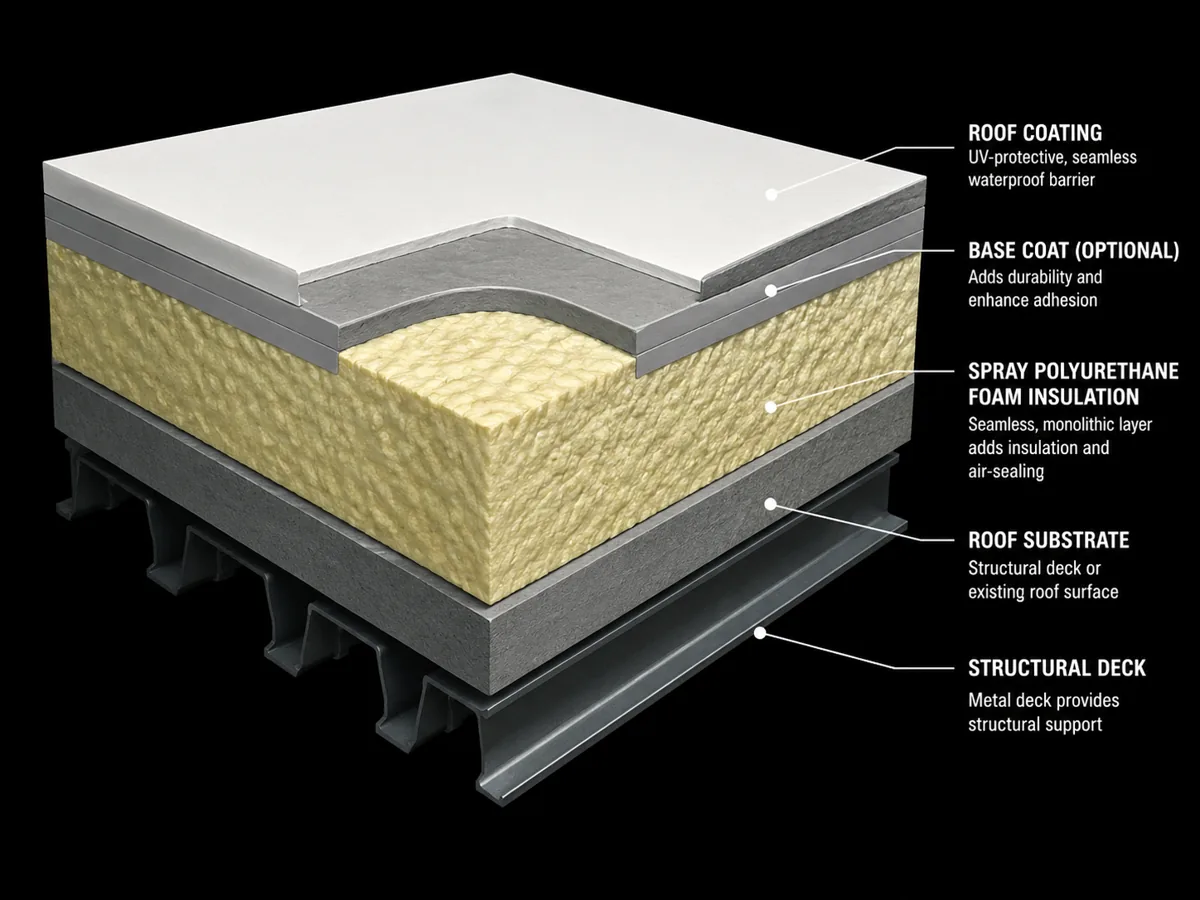
SPF starts as two liquid components that combine at the spray gun and expand within seconds into a rigid, closed-cell foam that bonds directly to your existing roof deck or membrane. The foam cures into a single continuous surface — no seams, no fasteners, no laps, no flashing joints where water can find its way in. We then protect the foam with an elastomeric coating, typically silicone, which shields it from UV and gives the roof its weathering surface. The result is a monolithic roof that is simultaneously your waterproofing layer and your insulation layer.
That dual role is what separates foam from every membrane system on the market. A single-ply membrane keeps water out but adds almost nothing thermally; foam delivers roughly R-6.5 per inch of thickness while sealing the roof in the same pass. On a metal roof, foam locks down every panel seam and fastener head at once. On an aging built-up or modified bitumen roof, it usually goes right over the top after cleaning and prep, avoiding a tear-off entirely. If you want the deeper engineering explanation of the system, our spray polyurethane foam roofing guide walks through the chemistry, the coating options, and the specifications we install to.
Because foam is spray-applied, it also self-flashes around the things that make commercial roofs leak: curbs, pipe penetrations, HVAC stands, skylight frames, exhaust stacks. On a Tulare processing plant roof crowded with refrigeration equipment, vents, and conduit, that matters more than any brochure statistic. Every one of those penetrations is a lifetime leak risk under a membrane system; under foam, each one is encapsulated in a seamless collar of closed-cell insulation.
Walk the commercial corridors of Tulare — Prosperity Avenue, Hillman Street, the industrial parks flanking Highway 99, the blocks around Cross Avenue downtown — and you'll see the same story on nearly every roofline: flat and low-slope. Tilt-up concrete distribution buildings, pre-engineered metal ag shops, older masonry storefronts with built-up roofs, packing and processing structures with acres of nearly level deck. Commercial roofing in Tulare is overwhelmingly a low-slope discipline, and low-slope roofs live or die by two things: how they handle standing water and how they handle heat.
Foam handles both better than the systems it replaces. Because SPF is applied as an expanding liquid, our applicators can build up thickness selectively — adding slope toward drains, filling low spots, and crowning dead-flat areas so water actually leaves the roof instead of ponding through the winter. That's something no rolled or sheet product can do without expensive tapered insulation packages. And because the finished system is topped with a reflective coating, the roof rejects the brutal solar load of a Central Valley summer instead of soaking it into the building below.
The building stock here also skews older than people assume. Plenty of Tulare's commercial roofs are second- or third-generation systems — cap sheet over built-up over the original deck — and the owners are staring down a tear-off quote that includes disposal, downtime, and an exposed building during the work. In most cases foam lets us recover that roof in place. We clean it, make targeted repairs, and spray directly over the prepared surface. The old roof becomes substrate instead of landfill, the building stays sealed and operating throughout the project, and the budget lands dramatically below replacement.
Tulare County may have more steel roofing per square mile than anywhere in California. Ag equipment dealers line the highway with pre-engineered metal buildings; every dairy has its shops, commodity barns, and hay covers; and the industrial parks are full of metal warehouses that have been baking and flexing through Valley summers for thirty or forty years. Metal building roofing has a predictable failure pattern here: thermal movement works the fasteners loose, the neoprene washers dry out and crack under UV, panel end-laps open up, and rust blooms wherever ag dust and winter condensation sit on bare galvanizing.
Chasing those leaks one screw at a time is a treadmill. Foam gets you off it. Sprayed over a prepared metal roof, SPF encapsulates every fastener, seam, and lap in one continuous layer — the thousands of individual leak points simply cease to exist as pathways. The foam also stiffens the panel assembly, quiets rain drum, and stops the daily expansion-contraction cycling at the surface that backed the screws out in the first place.
The insulation upgrade is just as important on metal. An uninsulated or thinly insulated steel roof in Tulare can push interior temperatures well past 110°F on a July afternoon — miserable in a shop, damaging in a parts warehouse, and expensive anywhere there's refrigeration or air conditioning fighting the load. Two inches of closed-cell foam adds roughly R-13 directly on top of the metal, and three inches nearly R-20, cutting radiant gain the moment the coating cures. In winter, the same foam layer keeps the interior face of the roof above dew point, which shuts down the condensation drip that fogs up so many Valley metal buildings between November and February.
Tulare's identity is dairy, and dairy facilities punish roofs from both sides. Below the deck, processing and washdown areas generate constant humidity — sanitizing cycles, steam, hot-water washdown of equipment and floors — and that moisture-laden air rises. When it meets a cool roof deck on a foggy January night, it condenses, and condensation inside a food facility is a problem long before it becomes a roof problem. Above the deck, exhaust stacks, ammonia refrigeration equipment, condensate lines, and cleaning chemical residues create a corrosive rooftop environment that eats fasteners and thins metal panels.
SPF answers both sides at once. As a closed-cell material with the coating sealing its surface, foam functions as a continuous thermal and air barrier — it keeps the interior face of the roof assembly warm enough that washdown humidity doesn't hit dew point at the deck, and it denies humid interior air the seams and gaps it would otherwise migrate through. On the exterior, the silicone-coated surface is seamless and chemically stable, with no exposed fasteners to corrode and no laps to sit in chemical-laden dust.
For refrigerated and cold-storage areas, the math is even more direct. Every degree of roof-driven heat gain is compressor runtime, and compressors at a milk or cheese plant run around the clock. Adding R-13 to R-26 of roof insulation over a refrigerated space in this climate produces some of the fastest paybacks we see anywhere. We also understand what working over an operating food facility requires: coordinating spray windows with plant schedules, controlling overspray absolutely, staging away from intakes, and documenting the work for the facility's audit files. Facilities operating under USDA and third-party food-safety audits need contractors who respect those protocols — that's routine for our crews, not a special request.
Tulare summers are a stress test. From June through September, afternoon highs regularly clear 100°F, and a dark roof surface can sit at 160°F or hotter for hours a day, month after month. That heat degrades asphalt roofs, accelerates single-ply seam failures, and pours load onto every HVAC and refrigeration system under the deck. UV exposure here is relentless — the South Valley records some of the highest annual solar radiation in the country — and it's what ultimately embrittles exposed membranes and dries out fastener gaskets.
A coated foam roof is built for exactly this. The white silicone surface reflects the majority of solar energy, dropping peak roof temperatures dramatically compared with dark cap sheet or aged metal. The foam beneath blocks what heat remains from conducting into the building. Together they flatten the daily thermal cycle that tears other roofs apart at their seams — foam has no seams to tear.
Winter brings the opposite problem: tule fog. From November through February, Tulare can sit under dense fog for days, with humidity pinned near saturation and surfaces staying damp around the clock. Roofs that pond hold that water for weeks because nothing evaporates. Silicone-coated foam shrugs at ponding — silicone is one of the few coatings rated for continuous standing water — and the slope corrections we build into the foam reduce ponding in the first place. Add the Valley's ag dust, which settles on every roof during tillage and harvest and turns abrasive underfoot and corrosive when damp, and the case for a seamless, fastener-free, chemically inert roof surface writes itself.
Closed-cell roofing foam delivers approximately R-6.5 per inch — among the highest R-values per inch of any commonly installed building material. A typical 1.5-inch application adds about R-10 on top of whatever the roof already has; two inches adds roughly R-13; three inches approaches R-20. Because the foam is continuous, there's no thermal bridging through purlins, fasteners, or joists the way there is with batt or board insulation — the rated R-value is what the building actually experiences.
In practical terms for a Tulare building: less compressor runtime on refrigeration, smaller afternoon peaks on demand-billed electrical accounts, a shop floor that's workable in August, and HVAC equipment that cycles instead of running flat-out from noon to eight. California's Title 24 energy code pushes commercial roofs toward exactly this combination — cool-roof reflective surfaces and continuous insulation — and an SPF system with a reflective silicone topcoat satisfies both strategies in a single installation. When re-roofing work triggers Title 24 compliance, foam is frequently the cleanest path to meeting it without rebuilding the roof assembly.
Owners sometimes ask how long that performance lasts. The honest answer: SPF is a renewable system. The foam itself doesn't wear out — it's protected by the coating, and the coating is renewed on a 10-to-20-year cycle at a fraction of original cost. Our guide to spray foam roof lifespan covers the maintenance rhythm in detail, but the short version is that a foam roof maintained on schedule effectively doesn't have an end-of-life date the way membranes do.
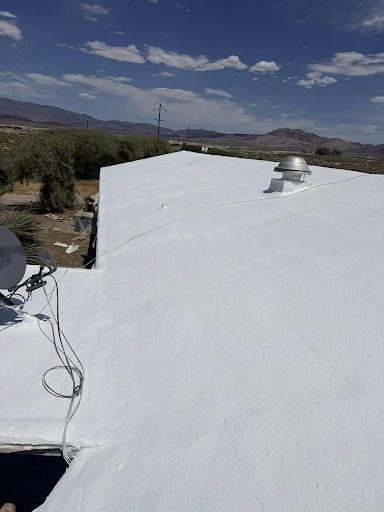
Every roof is different, but our pricing lands in consistent, honest ranges. New SPF systems run $4 to $8 per square foot installed, depending on foam thickness, prep requirements, penetration count, and access. Recoating an existing foam roof — the periodic maintenance that renews the system — runs $2 to $4 per square foot. There's no mystery math: a drone survey, core sampling where the roof's history warrants it, and a written bid in your hands within 48 hours, all free.
| System | Typical Cost | What You Get |
|---|---|---|
| New SPF roof system | $4–$8 / sq ft | Foam + silicone topcoat; seamless waterproofing plus ~R-6.5 per inch of insulation; usually no tear-off |
| Silicone recoat of existing foam | $2–$4 / sq ft | Renews the weathering surface; resets the maintenance clock for another 10–20 years |
| Membrane replacement (typical alternative) | Varies — often exceeds SPF once tear-off and disposal are included | New waterproofing only; little added insulation; seams and fasteners return |
The comparison that matters most in Tulare is total cost of ownership. A membrane roof is a waterproofing purchase; a foam roof is a waterproofing purchase plus an insulation retrofit plus avoided tear-off, and it keeps paying through the utility meter every 100-degree afternoon. We break down the full economics — including how thickness, building type, and existing roof condition move the number — in our spray foam roofing cost guide. For a dairy processor or cold-storage operator, the energy line alone frequently justifies the project before the roofing line is even considered.
A typical Tulare installation starts with the free assessment: drone survey of the whole roof plane, core sampling where we need to know what's under the surface and whether moisture is trapped in the existing assembly, and a written bid within 48 hours. Installation itself begins with preparation — cleaning, drying, repairing wet or damaged sections, and priming where the substrate calls for it. Foam quality is decided in prep and in weather discipline; our crews spray within the temperature, humidity, and wind windows the material demands, which in Tulare means smart scheduling around summer heat (early starts) and winter fog (waiting for the surface to dry). The full sequence, from staging to final coating inspection, is laid out in our spray foam roofing installation guide.
Most projects proceed section by section with the building fully occupied and operating below. There's no tear-off exposing the interior, no kettle, and no mechanical fastening hammering through an occupied workday. For food facilities we coordinate spray windows and overspray control with plant management so production and sanitation schedules aren't disturbed.
Owners comparing systems usually shortlist foam against TPO, and we'd rather you compare with real information than a sales pitch. TPO is a legitimate system with a place in the market; it's also a seamed, fastened membrane whose weaknesses show up in exactly the conditions Tulare serves up — high heat, high UV, ponding-prone flat decks, and rooftops crowded with penetrations. Our spray foam vs. TPO comparison goes point by point: seams, insulation, ponding tolerance, repairability, and lifecycle cost, with the trade-offs stated plainly for both systems.
Tulare runs on an agricultural calendar, and we plan roofing around it. Every February, the World Ag Expo at the International Agri-Center brings over a hundred thousand visitors to town — hotels fill from Visalia to Porterville, the roads around Laspina Street and the Agri-Center get dense, and every facility that serves the show wants its buildings buttoned up beforehand, not under construction during it. If your building is anywhere near the Expo footprint or does business off the show, the smart move is a fall assessment and a completed roof before the gates open. We book those windows early every year.
The rest of the calendar has its own rhythms. Dairy and processing facilities often prefer roofing tied to scheduled maintenance shutdowns. Harvest season puts dust in the air and trucks on every road, which affects both spray scheduling and coating cleanliness — we adjust staging and timing accordingly. Winter tule fog compresses the workable spray window to the drier stretches between fog events, which is why December and January projects need flexible scheduling. None of this is a problem for a local crew; it's simply how you roof in Tulare County. Contractors who dispatch from two hours away burn their margin waiting on weather. We're under 20 minutes out, so we can hit a four-hour dry window on short notice and be productive.
Our Tulare crews cover the whole southern county. Down Highway 99, Tipton and Pixley sit in the heart of the dairy belt — commodity barns, milking parlors' support buildings, feed storage, and processing-adjacent structures where the washdown-humidity and metal-roof-condensation problems described above are daily realities. East on Highway 137, Lindsay's citrus and olive packing heritage left a stock of packinghouse and cold-storage buildings with big, flat, hard-working roofs. Porterville, the southeast anchor of the county on Highway 190, adds retail centers, light industrial parks, and municipal and ag-services buildings to the mix.
Distance is never the obstacle inside Tulare County — every one of these communities is an easy dispatch from our shop. That matters most after the roof is on: recoat cycles, inspection visits, and the occasional repair all happen faster and cheaper when the contractor is genuinely local. A foam roof is a long relationship, not a one-time transaction, and we've built our operation around being close enough to honor that.
Roofing is a trust purchase, so here's what you can verify. We're family-owned and have been in the spray foam business for more than 20 years. We hold CA License #C-2-1052735 — fully licensed, and you can look it up with the CSLB. We're BBB accredited. We're members of the Spray Polyurethane Foam Alliance, the industry's technical body. And we back our systems with industry-leading leak-proof guarantees, in writing, explained before you sign anything.
What we don't do is theater. No inflated "list prices" discounted at the kitchen table, no pressure tactics, no crews subcontracted from out of the region. The free assessment is genuinely free: drone survey, core sampling where the roof's condition warrants it, and a written bid within 48 hours that says exactly what we'll do and what it costs.
If you own or manage a flat, low-slope, or metal-roofed building in Tulare — a processing plant, a warehouse off Highway 99, an equipment dealership, a downtown commercial block — call (559) 739-9519. We'll put a drone over the roof, tell you the truth about its condition, and give you a number you can plan around. Under 20 minutes away, and usually on your roof within days, not weeks.
Also serving Tulare: Silicone Roof Coating in Tulare · Foam Roof Repair in Tulare · Commercial Insulation in Tulare. See all Tulare services on the Tulare service hub, or read our full spray foam roofing guide. Nearby: Spray Foam Roofing in Hanford · Spray Foam Roofing in Visalia.
Yes — it's arguably the best fit available. SPF is seamless and fastener-free, so washdown humidity has no joints to migrate through, and the R-6.5-per-inch insulation cuts refrigeration load directly. We coordinate spray schedules and overspray control with plant management so production and sanitation routines aren't disrupted, and the work is documented for facilities that operate under food-safety audits.
In most cases, yes. After cleaning, rust treatment, and repairing any structurally compromised panels, foam is applied directly over the metal, encapsulating every fastener and seam. You get a seamless waterproof surface plus roughly R-13 of insulation at two inches of foam, and the tear-off is avoided entirely.
New SPF systems run $4 to $8 per square foot installed, depending on thickness, prep, and roof complexity. Recoating an existing foam roof runs $2 to $4 per square foot. We provide a free drone survey, core sampling where needed, and a written bid within 48 hours.
Usually, if we start the conversation in the fall. The weeks before the Expo book up fast because facilities around the International Agri-Center want work completed before the show, and winter tule fog compresses the spray schedule. Call early and we'll build the timeline around your date.
It affects scheduling, not the finished roof. Foam and coatings need a dry surface and the right humidity window to apply, so December and January work gets planned around fog events. Once installed, the silicone-coated system is rated for standing water and handles the Valley's damp winters better than seamed membranes.
Yes. Our crews dispatch from our Tulare County shop and cover the entire southern county — the dairy belt down Highway 99 through Tipton and Pixley, Lindsay's packinghouse district on Highway 137, and Porterville's commercial and industrial buildings along Highway 190.
Free assessment — drone survey, core sampling where needed, and a written bid within 48 hours, anywhere in Tulare County.
Or Call Directly
(559) 739-9519