Seamless SPF roofing for Kings County's ag processors, distributors, metal buildings, and civic flat roofs — installed by a family-owned, licensed crew based 35 minutes east on CA-198.
Spray foam roofing in Hanford solves a problem that conventional roofing keeps failing at: keeping a big, flat, sun-hammered Kings County roof watertight and insulated at the same time, for decades, without seams. Hanford is the county seat and the commercial hub of a county that runs on agriculture — dairy processing, tomato and vegetable packing, cotton moving up and down Highway 43, cold storage, and the distribution buildings that feed all of it along the CA-198 corridor. Nearly every one of those operations sits under a low-slope or metal-panel roof, and nearly every one of those roofs is fighting the same three enemies: relentless summer ultraviolet, winter tule fog that holds moisture against every seam for days, and wind-blown ag dust that abrades surfaces and clogs drains.
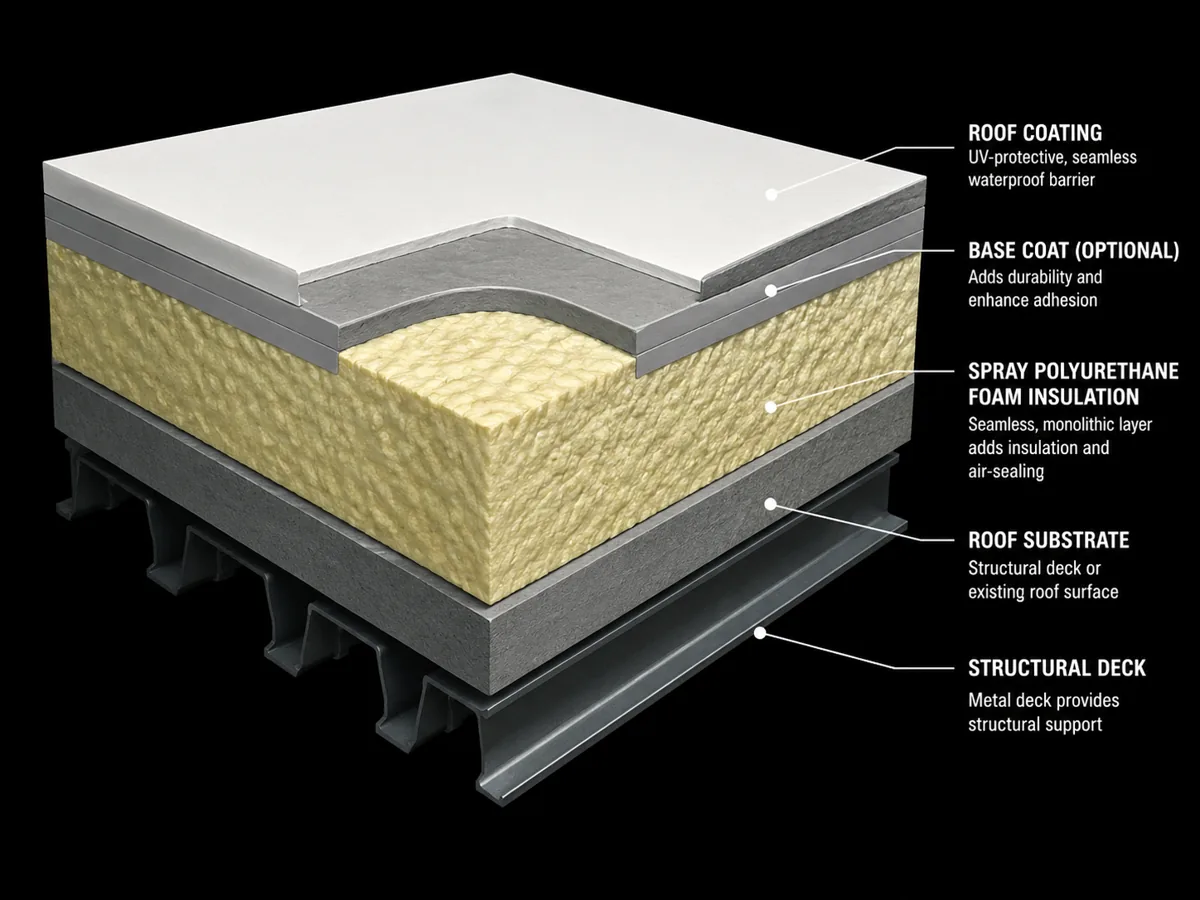
Spray polyurethane foam — SPF — answers all three at once. Applied as a liquid that expands and cures into a rigid, closed-cell layer, it forms a single monolithic surface across the entire roof: no seams to split, no fasteners to back out, no laps for fog-season moisture to wick into. It bonds directly to the substrate, insulates at roughly R-6.5 per inch, and gets finished with a protective coating that turns the whole assembly into a renewable system. Our family-owned crews have been installing it across the South Valley for more than twenty years, and Hanford is a routine dispatch — about 35 minutes west of our Tulare County shop, straight out CA-198.
Most roofing is manufactured somewhere else and assembled on your roof: membranes seamed together, panels screwed down, plies mopped in overlapping courses. Every joint in that assembly is a future maintenance item. Spray polyurethane foam roofing is manufactured on your roof. Two liquid components meet at the spray gun, react in seconds, and expand roughly thirty-fold into rigid foam that welds itself to the deck and to every previous pass. The result is one continuous piece of roofing, custom-fit to your building's exact geometry.
That changes how the roof handles the details that leak first. Penetrations — pipes, curbs, HVAC stands, skylight frames, the conduit runs that ag processing equipment always seems to sprout — get foamed in place, self-flashed by the same material as the field of the roof. Parapets and transitions become smooth, sealed coves instead of caulked joints. And because the foam is closed-cell, with a compressive strength in the 40-to-60-psi range for roofing formulations, it resists foot traffic from your own maintenance crews and shrugs off the thermal cycling that tears seamed systems apart.
The finished SPF layer is then armored with an elastomeric topcoat — typically silicone in our climate — that blocks UV and takes the weathering. That coat, not the foam, is the sacrificial layer, which is why the system renews on a recoat cycle instead of a replacement cycle.
Kings County summers are not gentle. Air temperatures over 100°F are standard from June into September, and a dark built-up or aged single-ply roof surface in Hanford can run 150°F or hotter by mid-afternoon. At those temperatures, asphaltic materials cook — plasticizers migrate out, surfaces alligator, and every degree of extra heat drives the building's cooling equipment harder. Then, sometime after Thanksgiving, the tule fog arrives. Kings County sits low in the basin, and fog can hold at saturation for days at a time, feeding moisture into every lap, blister, and fastener hole that summer opened up.
An SPF roof with a bright white silicone topcoat inverts the summer half of that cycle. High-reflectivity coatings bounce the majority of solar radiation before it ever becomes heat in the assembly, dropping peak surface temperatures dramatically compared to dark membranes. The foam beneath then insulates the deck from what heat remains, at R-6.5 per inch, continuously, with no thermal bridging through fasteners — because there are no fasteners. In fog season, the seamless surface gives condensation and wind-driven moisture nowhere to enter. The same closed-cell structure that insulates also refuses to wick water laterally, which is why a properly maintained SPF roof handles Hanford's wet-winter, brutal-summer swing better than anything assembled from parts.
Dust matters here too. Wind off the surrounding row crops and open ground loads Hanford roofs with fine grit that abrades coatings and dams up drainage on dead-flat decks. SPF lets us rebuild slope where a roof has none — foam can be applied thicker in low areas to re-establish positive drainage toward existing drains and scuppers, turning a chronic ponding roof into one that actually sheds water.
For commercial roofing, Hanford building owners have usually been through the cycle at least once: patch the built-up roof, patch it again, re-membrane, watch the new seams start failing within a decade, repeat. SPF breaks the cycle for a simple reason — in most cases it installs directly over the existing roof after inspection, cleaning, and preparation. That means no tear-off, which means no days with your packing line or county office open to the sky, no dumpsters of old roofing hauled to the landfill, and no gamble on weather mid-project.
For Hanford's commercial mix, that translates specifically:
We are fully licensed (Lic #C-2-1052735), BBB accredited, and an SPFA member — and because our crews dispatch from Tulare County, follow-up service in Hanford is a half-hour drive, not a scheduling negotiation.
Drive any industrial street in Hanford, or out Highway 43 toward the gins and processing yards, and you're looking at metal buildings — pre-engineered steel, R-panel and standing seam roofs, decades of them. Metal building roofing fails in predictable ways here: fastener gaskets dry out and back out under thermal cycling, panel laps open up, rust blooms where dust and fog-season condensation sit, and the un-insulated or minimally insulated interior becomes an oven by July.
SPF over metal is one of the strongest applications in the entire spray foam playbook. The foam locks down the panels and fasteners under a continuous rigid layer, ending the daily expansion-contraction movement that works screws loose. It seals every lap and penetration permanently. It adds real insulation — R-13 in two inches, R-19 in three — directly to the underside of the sun. And it quiets the building; the drumming of wind and the pop and tick of metal moving through a 60-degree daily temperature swing largely disappear under foam.
Condensation is the quiet killer of Valley metal buildings, and it's worth its own paragraph. In fog season, a bare steel roof panel cools to the fog temperature while interior air holds moisture from washdown operations, propane heaters, or simple occupancy — and the underside of the panel rains. On buildings storing ag equipment, packaged product, or hay, that drip does real damage. Closed-cell foam on the panel keeps the steel's interior surface at conditioned-space temperature, which means it never hits the dew point, which means the raining stops. We treat roof-side SPF and interior-side insulation as complementary tools — see our commercial insulation service for the interior half of that equation.
Panel profile changes the prep, not the outcome. On exposed-fastener R-panel — the workhorse profile on Hanford ag buildings — we treat every screw line and lap as part of substrate preparation, because those are the paths water has been using for years. On standing seam, the foam bridges clips and ribs into one plane, ending the seam-cap creep that shows up after a few thousand thermal cycles. Surface rust gets converted and primed, not buried: foam over active corrosion is a shortcut we don't take, and it's the difference between an SPF roof that carries its guarantees for decades and one that delaminates in five years. The drone survey plus a fastener-line inspection tells us which prep level your panels need before we quote the number.
Kings County's processing stock — dairy and cheese operations, tomato packers, nut and vegetable handlers — runs on large, flat or nearly flat roofs crowded with equipment. Those roofs are hard duty: refrigeration curbs and condensate lines, exhaust penetrations, catwalks, and steam or washdown moisture from below. Every piece of rooftop equipment on a seamed membrane roof is a ring of flashing waiting to fail.
SPF was practically designed for this. Foam flows around curbs, stands, and penetrations and seals them as part of the roof field itself. Where equipment vibrates, foam's adhesion and rigidity resist the working-loose that kills pitch pans and term bars. Where washdown steam loads the deck from below, closed-cell foam refuses to absorb it. And where USDA-adjacent cleanliness standards make interior leak staining a compliance issue rather than a cosmetic one, a seamless roof is the difference between an audit note and a clean walk-through.
Scheduling is the other half. Processing runs on harvest calendars — tomato season doesn't pause because a roofer is booked. Because SPF is spray-applied in sections with same-day waterproofing as each area is coated, we stage installations around production: block by block, weekend windows where needed, no long stretches of exposed deck. The installation process is engineered around occupied, operating buildings.
California's Title 24 energy code pushes commercial roofing toward two things: cool-roof surfaces and continuous insulation. SPF with a reflective silicone topcoat delivers both in one system. The foam itself installs at roughly R-6.5 per inch — among the highest R-values per inch of any field-applied insulation — and because it's continuous across the deck, its installed performance isn't degraded by the fastener and joint bridging that undercuts board-stock insulation.
Run the Hanford math. A 30,000-square-foot packing or warehouse roof with minimal existing insulation, in a climate with hundred-plus cooling days, is bleeding conditioned air upward all summer. Two to three inches of SPF adds R-13 to R-19 on top of whatever the roof already has, while the white topcoat drops the surface temperature the insulation has to fight. Owners typically see the impact in the first PG&E summer bill; over a multi-year hold it becomes one of the few roofing decisions that pays for part of itself. For buildings pursuing Title 24 compliance during alterations, the SPF assembly's aged reflectance and continuous R-value make documentation straightforward.
There's a second-order saving worth naming: equipment sizing. Cooling systems on under-insulated Valley buildings are sized for the worst hour of the worst week, and they short-cycle through the shoulder seasons. Pull the roof's heat gain down with foam and reflectivity, and the next HVAC replacement can frequently be specified smaller — a capital saving that arrives quietly a few years after the roof goes on and rarely gets credited back to it.
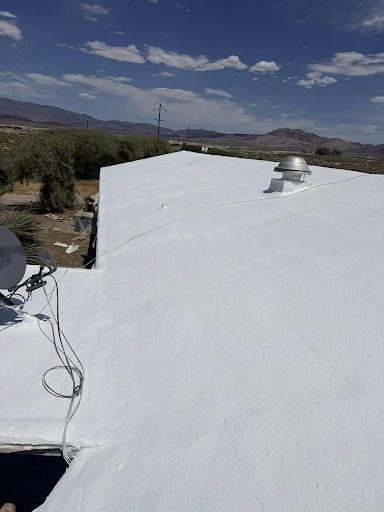
Spray foam roofing costs in Hanford follow the same honest ranges we quote everywhere in the Valley: new SPF systems typically run $4–$8 per square foot depending on foam thickness, substrate preparation, tear-off avoidance, and roof complexity; recoating an existing foam roof runs $2–$4 per square foot. Here's how those numbers frame up against the alternatives over a 30-year hold:
| System | Typical Install Cost | Expected Service Pattern | 30-Year Outlook |
|---|---|---|---|
| SPF + silicone topcoat | $4–$8/sq ft | Recoat every 10–20 years at $2–$4/sq ft | One install + 1–2 recoats; no tear-off |
| Single-ply (TPO/PVC) | $5–$9/sq ft | Seam maintenance; replacement ~15–25 yrs | 1–2 full replacements, tear-off costs |
| Built-up/mod-bit | $5–$9/sq ft | Surface maintenance; replacement ~15–20 yrs | 1–2 replacements; heat-aging in Valley sun |
| Metal re-sheet | $7–$12/sq ft | Fastener/lap maintenance ongoing | Durable but un-insulated without added work |
The pattern that matters: SPF's lifecycle cost bends downward because the expensive event — tear-off and re-install — ideally never recurs. A full breakdown of what drives pricing up or down is on our spray foam roofing cost page. Every Hanford bid we write is preceded by a free assessment — drone survey, core sampling where the existing assembly needs verification, and a written bid in your hands within 48 hours.
Our crews stage out of Tulare County and reach Hanford in about 35 minutes via CA-198 — close enough that mobilization doesn't distort the bid and follow-up doesn't fall off the calendar. A typical Hanford SPF project runs:
Weather windows matter in Kings County: foam wants a dry substrate and reasonable wind, so we schedule around fog-season saturation and afternoon dust events. That's local knowledge, and it's the difference between an SPF roof that lasts decades and one that blisters in year two.
Owners comparing systems usually shortlist SPF against TPO single-ply, and the honest answer is that both are legitimate roofs — the question is which failure modes your building can live with. TPO is factory-consistent sheet membrane with heat-welded seams; its weak points are exactly those seams, its fastener rows, and its flashing details, all of which multiply on equipment-crowded ag roofs. SPF has no seams, self-flashes every penetration, and adds insulation TPO doesn't — but demands a properly prepared substrate and an experienced applicator. Our full side-by-side is at spray foam vs. TPO roofing.
In Hanford specifically, three local factors tilt the comparison. First, equipment density: packing and processing roofs have too many penetrations for seamed systems to protect economically. Second, the thermal swing: 150°F summer decks and 35°F fog nights work seams and fasteners relentlessly, while a monolithic foam layer moves as one piece. Third, dust: grit abrades single-ply surfaces and finds every mechanical joint, while a coated foam roof presents one smooth, renewable surface. For dead-flat roofs with chronic ponding, SPF's ability to rebuild slope is frequently the deciding factor all by itself.
Hanford is the hub, but the same crews cover the whole county. In Lemoore, ten minutes west on 198, we roof the commercial corridor that serves the naval air station community — the medical offices, shops, restaurants, and service businesses that town supports — along with its ag processing base. In Corcoran, down Highway 43, the building stock runs to cotton gins, grain and processing structures, and institutional flat roofs, all of it under the same sun and dust load as Hanford. Avenal, out toward the I-5 corridor on the county's west side, adds oil-country and institutional buildings to the mix. Armona, Home Garden, Stratford, and Kettleman City fall inside the same service radius.
Distance never changes the process: free drone assessment, core sampling where warranted, written bid in 48 hours, and a crew that's based one county over rather than three hours up Highway 99.
Working in the county seat's orbit also means understanding the approval side. Hanford's civic and institutional projects move on procurement calendars, school roofs want summer-break windows, and processing facilities want work sequenced between seasonal packs. We write bids with those calendars in mind — phased scopes, per-building pricing, and documentation that survives a board meeting. It's a small thing until you've watched a roofing project die in committee because the paperwork couldn't answer basic questions.
The most important number in this entire page might be this one: 10 to 20 years. That's the recoat cycle of a properly installed SPF roof — the interval at which the sacrificial silicone topcoat gets cleaned, inspected, and re-applied at $2–$4 per square foot. The foam beneath, protected from UV, doesn't age out; industry experience with SPF roofs now runs past four decades on systems that were simply recoated on schedule. The full story on longevity is at how long does spray foam roofing last.
For a Hanford building owner, that reframes the roof from a recurring capital emergency into a predictable maintenance line. No more budgeting a six-figure tear-off every fifteen years; no more gambling on whether the next membrane outlives the next drought cycle. One system, renewed on schedule, backed by industry-leading leak-proof guarantees and a family-owned company that has been doing exactly this work in the South Valley for more than twenty years.
We back that cycle with a maintenance rhythm rather than a sales rhythm: periodic inspections timed to Kings County's seasons — after the autumn dust settles and before the first storms — plus drain checks, topcoat thickness readings, and small repairs handled while they're still small. An SPF roof asks very little of its owner, but it does ask; the owners who give it that attention are the ones whose roofs quietly pass the thirty-year mark while their neighbors are buying a third membrane.
If your building sits under a flat, low-slope, or metal roof anywhere in Kings County, the next step costs nothing: call (559) 739-9519 and we'll put the drone over your roof this week.
Also serving Hanford: Silicone Roof Coating in Hanford · Foam Roof Repair in Hanford · Commercial Insulation in Hanford. See all Hanford services on the Hanford service hub, or read our full spray foam roofing guide. Nearby: Spray Foam Roofing in Madera · Spray Foam Roofing in Tulare.
Our crews dispatch from our Tulare County shop, about 35 minutes east of Hanford via CA-198. Assessments are typically scheduled within days, and you get a written bid within 48 hours of the drone survey. Because we're one county over, follow-up service calls don't disappear into a scheduling black hole.
Yes — it's arguably the best match for them. The white silicone topcoat reflects most solar radiation before it becomes heat, and the foam beneath insulates at roughly R-6.5 per inch with no seams or fasteners to work loose under thermal cycling. Dark membrane roofs in Hanford can hit 150°F on summer afternoons; a coated SPF roof runs dramatically cooler.
Absolutely — SPF over metal is one of its strongest uses. The foam seals every panel lap and fastener, adds real insulation directly to the panels, stops fog-season condensation drip inside, and ends the daily thermal movement that backs screws out. Most metal roofs need no tear-off, just cleaning, prep, and rust treatment.
No. SPF is applied in staged sections, and each day's area is weathered-in before the crew leaves, so the building is never left open. We schedule around harvest calendars and production shifts — block-by-block work and weekend windows are routine on Kings County processing facilities.
New SPF systems typically run $4–$8 per square foot depending on thickness, prep, and roof complexity; recoating an existing foam roof runs $2–$4 per square foot. Every bid starts with a free assessment — drone survey, core sampling where needed, and a written number within 48 hours.
Yes — they shape how we build here. We schedule application around fog-season substrate moisture, spec coating millage for dust abrasion, and use foam to rebuild slope on dead-flat decks so wind-blown grit stops damming water at the drains. A roof built for the coast fails here; ours are built for the basin.
Free assessment — drone survey, core sampling where needed, and a written bid within 48 hours, anywhere in Kings County.
Or Call Directly
(559) 739-9519