Seamless, self-insulating SPF roofing for Madera County's wineries, food processors, metal buildings, and commercial flat roofs — installed by a family-owned, SPFA-member contractor with 20+ years in the Valley.
Spray foam roofing in Madera solves the two problems every flat and low-slope roof in the county fights at once: relentless Valley heat and water that finds every seam. Madera County's commercial building stock — wineries and wine-processing plants along the 99 corridor, nut hullers and packing houses, warehouses in the Madera Industrial Park, and thousands of metal ag buildings from the west-side plains to the Coarsegold foothills — runs heavily to big, low-slope roofs. Those roofs bake past 150°F surface temperature in July, sit damp under tule fog for weeks in December and January, and collect a steady film of abrasive ag dust in between. Spray polyurethane foam (SPF) is the one roofing system engineered for exactly that duty cycle: a monolithic, fully adhered membrane with no seams, no fasteners, and built-in insulation of roughly R-6.5 per inch.
Allstate Spray Foam Roofing is a family-owned contractor with more than twenty years in the San Joaquin Valley, California license #C-2-1052735, BBB accreditation, and membership in the Spray Polyurethane Foam Alliance. Our crews dispatch from our Tulare County shop, about sixty minutes south of Madera via CA-99 — close enough that Madera, Chowchilla, Oakhurst, and Coarsegold are routine service territory for us, not an occasional stretch.
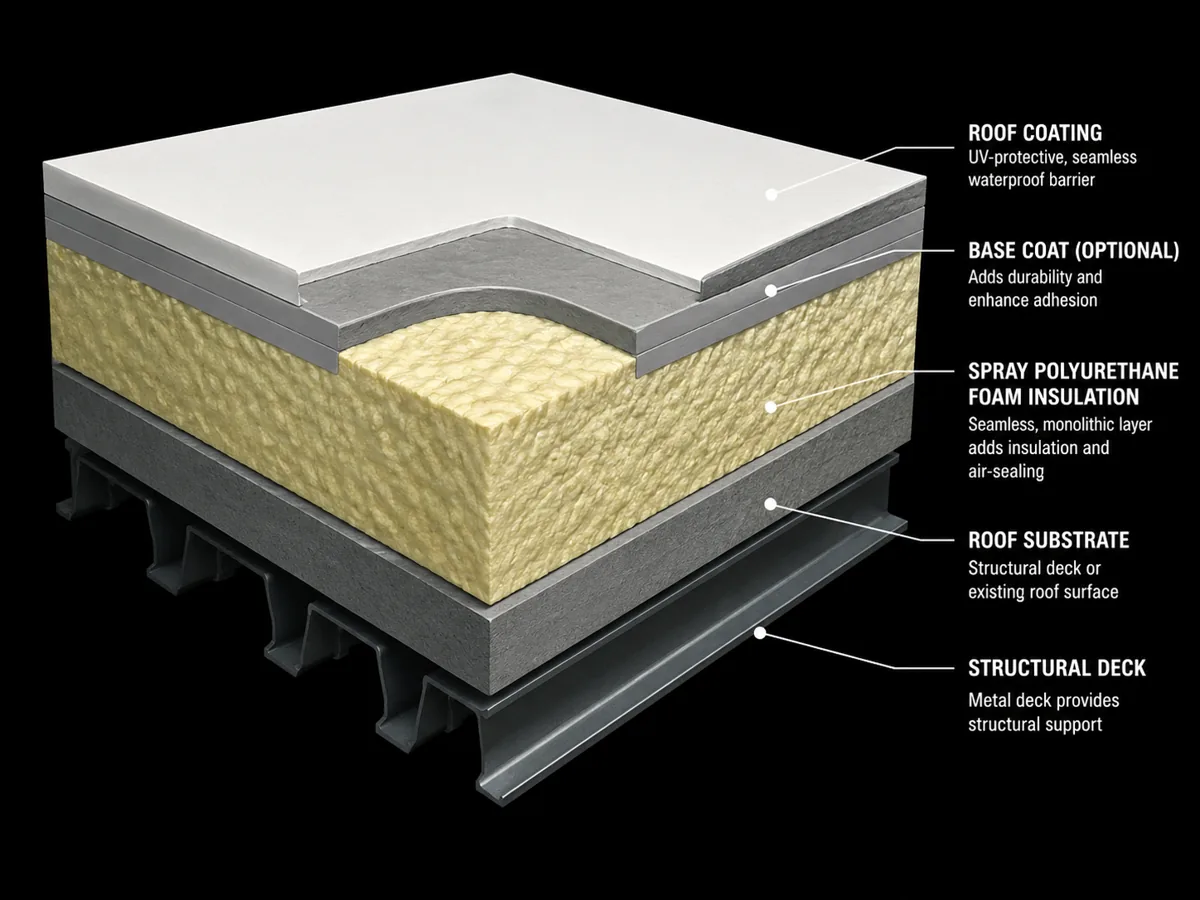
SPF roofing is applied as a liquid. Two components — an isocyanate and a polyol resin — meet at the spray gun, react in seconds, and expand about thirty times in volume into rigid closed-cell foam that bonds directly to your existing roof deck or membrane. The foam cures into one continuous surface with no laps, no welds, and no fastener penetrations. Because the applicator sprays it in place, the foam self-flashes around every curb, pipe, drain, HVAC stand, and skylight — the exact details where conventional roofs fail first. Over the cured foam we apply an elastomeric topcoat, typically high-solids silicone with embedded granules, which shields the foam from UV and gives the roof its weathering surface.
Three properties matter most for a Madera building. First, the finished roof is seamless — there is simply no joint for wind-driven rain or ponded water to exploit. Second, it is fully adhered across its entire area, so leaks cannot travel laterally under the membrane the way they do under mechanically fastened single-ply. Third, it insulates: closed-cell SPF delivers about R-6.5 per inch, so a two-inch application adds roughly R-13 to the top of your building while it waterproofs it. No other roof system does both jobs in one installation. For the full technical background, see our spray polyurethane foam roofing guide.
A word about the material itself, because owners sometimes picture the soft foam in a couch cushion. Roofing SPF is rigid, dense, closed-cell foam — you walk on it, set ladders on it, and mount equipment over it. Its closed-cell structure means the foam itself resists water absorption; even if the topcoat is damaged, moisture doesn't wick through the foam body the way it saturates fibrous insulation. The full adhesion also gives SPF exceptional wind-uplift performance, because there are no edges or fastener rows for wind to peel — a genuine consideration on the open west-side plains along CA-145, where wind runs unobstructed across miles of cropland, and on exposed foothill sites toward Coarsegold. And when something does damage the surface — hail, a dropped tool, a careless trade — the fix is local and simple: cut back, fill, recoat. No membrane hunt, no welder, no proprietary repair crew.
Madera sits in California Climate Zone 13, the hot interior of the San Joaquin Valley. Summer highs top 100°F for weeks at a stretch, and rooftop surface temperatures on dark membranes run far higher. That heat does two expensive things: it pours into the building through the roof assembly, driving cooling loads on everything from tasting rooms to refrigerated storage, and it cycles the roof through brutal daily expansion and contraction that fatigues seams, flashings, and fastener lines. A white silicone-coated SPF roof reflects the majority of that solar load, and the foam beneath blocks what's left — buildings in this climate zone commonly see meaningful drops in summer cooling demand after an SPF installation, which also helps projects pencil against California's Title 24 cool-roof and insulation requirements for roof replacements and new low-slope construction.
Winter brings the opposite problem. Tule fog settles over the Madera Plains and the 99 corridor for days at a time, keeping roof surfaces wet without any actual rainfall. Conventional roofs with aging seams wick that persistent moisture into laps and fastener holes; metal roofs drip condensation from every cold purlin. A seamless foam roof gives fog nothing to work with, and the insulation keeps the interior face of the roof assembly above dew point, which shuts down interior condensation. Between those seasons, harvest fills the air with fine ag dust from the county's almond, pistachio, and grape operations — grit that abrades coatings and clogs drains. SPF's smooth, monolithic surface sheds dust to the drains instead of trapping it in seams and ballast.
There's an energy-code dimension too. California's Title 24 sets cool-roof and insulation requirements that come into play when a low-slope roof is replaced or a building is significantly altered, and Climate Zone 13's requirements are among the state's most demanding because the cooling loads are among the state's highest. An SPF system addresses both halves of the requirement in a single installation: the reflective silicone surface satisfies the cool-roof side, and the foam's R-6.5 per inch contributes real, continuous insulation with no thermal bridging — no fasteners conducting heat through the assembly, no gaps at board joints. For owners planning a reroof anyway, that means the code-compliance spend and the energy-savings spend are the same dollars, which is rarely true of membrane systems that need separate cover board and insulation layers to get there.
Madera is one of the oldest wine regions in the Central Valley, and its production facilities are a core part of our work in the county. Wineries are unusually demanding roof customers. Barrel rooms and case-goods warehouses want temperature stability — every degree of rooftop heat that gets into the building is a degree the refrigeration plant has to pull back out, and temperature swing is itself an enemy of wine in storage. Crush pads, tank rooms, and bottling halls run sanitation and washdown programs that make ceiling drips, rust flakes, and condensation unacceptable over product and equipment. And harvest season means the roof has to be dependable precisely when a shutdown is most costly.
SPF answers each of those constraints. The insulation value flattens the daily temperature curve inside barrel and case storage, easing refrigeration duty and smoothing out the swings. The seamless membrane eliminates the drip points that plague seamed roofs over processing areas. On metal-roofed tank rooms and barrel barns, foam applied over the panels stops the morning condensation rain that bare metal produces under fog. And because SPF installs over most existing roofs without tear-off, a winery can reroof between vintages — or even during production, since we can sequence work area by area — without opening the building to the sky. The same logic serves Madera's broader food-processing base: nut hullers and processors, raisin and dried-fruit operations, and cold-chain warehouses all get the same combination of dry, stable, and fast.
Scheduling deserves its own mention for wine-country work. Crush season is sacred; nobody wants a spray rig on the roof while trucks are dumping fruit below. We plan winery projects around the production calendar — late winter and spring are ideal windows, after bottling runs and before the summer heat peaks — and we coordinate overspray control, parking, and access with your operations staff before the first crew arrives. Wineries with tasting rooms and event spaces have a second constraint: the customer-facing side of the property has to stay presentable while the production side gets reroofed. Because SPF work is contained, quiet compared to tear-off, and fast, that's a manageable ask — and it's one more reason foam has become the default reroof for working wineries across the Valley's older wine regions, Madera very much included.
Drive any avenue west of the 99 and you'll pass the building type spray foam serves best: the pre-engineered metal building. Shops, equipment barns, hay and commodity storage, well houses, and packing sheds across Madera County share the same weaknesses — fastener lines that back out and weep, panel laps that open as the steel expands and contracts, oil-canning that stresses old sealant, rust creeping along every screw head, and condensation that drips off the underside of cold panels onto equipment, feed, and stored crop.
Foam over a metal roof fixes all of it in one pass. The foam encapsulates every fastener and lap, locks the panels together into one rigid diaphragm, and adds enough stiffness to quiet oil-canning. The insulation keeps the panel's interior face warm enough that fog-season condensation never forms. And the silicone topcoat seals out the moisture that drives rust. For a metal building that's structurally sound but leaking at every screw, SPF is nearly always cheaper than re-skinning the roof — and dramatically better insulated afterward. If you're weighing foam against replacing panels or overlaying single-ply, our spray foam vs TPO comparison walks through how the systems differ on exactly this building type.
Two practical notes for metal-building owners. First, condition matters: foam bonds to sound steel, so panels with active rust get treated and heavily corroded sections addressed during prep — our core-and-inspection process catches this before it becomes a change order. Second, think about what's coming to the roof later. Foam handles roof-mounted equipment well — curbs and stands get self-flashed into the membrane — and if solar is in your future, the time to plan mounting details is while the roof system is being designed, not after. We detail for both routinely on ag and shop buildings across the county.
Madera's commercial footprint is growing. The Madera Industrial Park and the corridors along Avenue 12, Avenue 17, and CA-145 have picked up steady logistics and light-industrial spillover as Fresno's distribution market pushes north up the 99, and the Rio Mesa area continues to develop. Most of that stock — tilt-up warehouses, distribution buildings, retail centers, offices — carries flat or low-slope roofs that are ideal SPF candidates. For commercial roofing in Madera, foam offers building owners a specific business case: installation over the existing roof in most cases (no tear-off, no dumpsters, no exposure), a renewable surface that resets with a recoat instead of a replacement, and an insulation upgrade that shows up on every summer utility bill.
For property managers running multiple buildings, the maintenance profile matters as much as the install. An SPF roof is inspected and touched up on a simple schedule, and small damage is repairable with caulk-grade sealant or spot foam by any competent maintenance tech — no heat welders, no proprietary crews for minor work. When the topcoat weathers thin after 10–20 years, a recoat at $2–$4 per square foot renews the roof without touching the foam. That cycle repeats indefinitely, which is why foam roofs from the 1980s are still in service across the Valley.
The growth story matters here too. Madera has been absorbing logistics and light-industrial demand as Fresno's distribution market pushes north — land along the Avenue 12 corridor and around the Industrial Park prices below comparable Fresno sites, and the Rio Mesa area's long-term development keeps pulling commercial investment east of the 99. New and repurposed buildings alike need roofs specified for this climate, and occupied buildings need reroofs that don't interrupt tenants. SPF serves both: on an occupied distribution building, work proceeds section by section over the existing roof with no tear-off debris, no open deck, and no disruption to the dock schedule below. For an owner comparing systems on a new shell, the honest head-to-head with single-ply is in our spray foam vs TPO breakdown.
New SPF roofing typically runs $4–$8 per square foot installed in the Madera area. Where a project lands in that range depends on foam thickness (driven by insulation goals and Title 24 requirements), the condition and type of the existing roof, how much prep and repair the substrate needs, roof access and staging, and the complexity of penetrations and details. A straightforward warehouse with good access prices near the bottom of the range; a winery roof crowded with equipment curbs, vents, and piping runs higher. Recoating an existing foam roof runs $2–$4 per square foot — that's the renewal cost that makes the lifecycle math work.
| System | Typical Installed Cost | Insulation Included | Seams | End of Life |
|---|---|---|---|---|
| SPF + silicone topcoat | $4–$8/sq ft | Yes — ~R-6.5/inch | None — monolithic | Recoat $2–$4/sq ft, every 10–20 yrs |
| Single-ply (TPO/PVC) | $5–$9/sq ft | Separate board stock | Heat-welded laps | Tear-off and replace |
| Built-up / mod-bit | $5–$10/sq ft | Separate board stock | Torched/mopped laps | Tear-off and replace |
| Metal re-skin | $7–$12/sq ft | Blanket (compressed at purlins) | Panel laps + fasteners | Replace panels |
Numbers for competing systems are market ranges for comparison, not our quotes — your actual bid comes from a measured survey of your roof. For a deeper breakdown of what drives pricing, read our spray foam roofing cost guide.
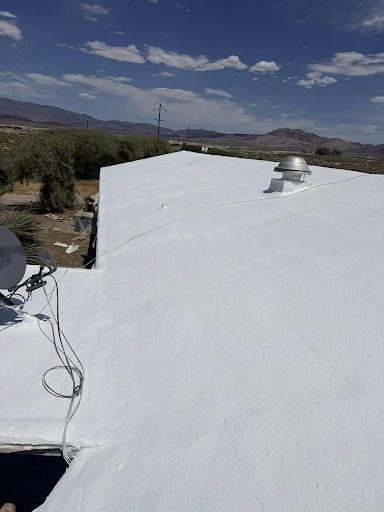
The foam itself does not wear out. What weathers is the protective topcoat, sacrificially, under UV. On the standard maintenance cycle, you recoat every 10–20 years depending on coating thickness and exposure; each recoat resets the clock, and the foam underneath keeps performing. That's the fundamental difference from every membrane system, where end-of-life means tear-off, landfill, and a full repurchase. Well-maintained SPF roofs in the Central Valley have been in continuous service for four decades and counting. We cover the maintenance schedule, warranty considerations, and real-world case history in how long does spray foam roofing last.
Every Madera project starts with the free assessment: we fly a drone survey of the full roof area, pull core samples where the assembly's history is unclear (critical on older buildings that may carry multiple roof layers), and deliver a written bid within 48 hours. On award, the sequence runs: substrate prep — cleaning, drying, removing saturated areas found in the cores, and priming as needed; masking and wind screening to protect adjacent surfaces, vehicles, and equipment (a real consideration at working wineries and packing houses — we plan overspray control around your operations); foam application in passes to the specified thickness, self-flashing every penetration; then the base and top coats of silicone with granules broadcast into the final coat for traction and hail resistance. Most projects finish in days, not weeks, and the roof is watertight behind the spray gun each day — there's no point in the schedule where your building sits open. Full detail is in our installation process overview.
Weather windows are part of honest scheduling in the Valley. Foam and coatings have application requirements for surface temperature, humidity, and wind, which makes late fall through winter — fog season — the trickiest stretch for spray work and the long dry season from spring through fall the productive one. We schedule Madera projects with those windows in mind rather than fighting the weather and compromising the application, and we tell you up front when a start date is realistic. The good news: the Valley's dry season is long, and most projects have far more workable days than a coastal contractor could dream of.
Our Madera service area covers the whole county. In Chowchilla, the work runs to ag processing, dairy-support buildings, and metal shops along the 99 and CA-233 — classic SPF-over-metal territory. Up CA-41 in the foothills, Oakhurst and Coarsegold present a different profile: gateway-to-Yosemite commercial buildings, lodges, restaurants, and shops at 2,000+ feet of elevation, where summers still bake but winters bring real cold snaps and occasional snow load on low-slope sections. SPF performs well in the foothill climate — the insulation value works both directions, and the seamless membrane handles freeze-thaw far better than seamed systems. Drive time from our Tulare County shop runs about an hour to Madera proper and somewhat more into the hill country; either way, these are roads our crews run regularly.
Chowchilla in particular is a foam town waiting to happen: its commercial and ag stock is overwhelmingly metal, its processing buildings carry exactly the condensation and fastener-leak profile SPF eliminates, and its position on the 99 keeps mobilization simple. If you own or manage buildings in more than one of these communities, ask about assessing them together — one drone day across a small portfolio produces a prioritized, budget-ready picture of every roof you're responsible for.
We're a family-owned company, not a franchise or a storm-chasing outfit — more than twenty years of our work is on roofs within an hour's drive of our shop, and our reputation lives or dies in the Valley. We hold California contractor license #C-2-1052735, we're BBB Accredited, and we're SPFA members, which keeps our crews aligned with the industry's application standards for thickness, density, and coating coverage. We back our work with industry-leading leak-proof guarantees, and because we're sixty minutes down the 99, service after the sale is a phone call, not a mystery. When we bid your roof, the numbers come from drone imagery and core data on your actual building — never from a satellite photo and a price-per-square guess.
If your Madera building's roof is aging, leaking, or costing you a fortune in summer cooling, get real data before you decide anything. The assessment is free: drone survey, core sampling where needed, and a written bid in 48 hours with the numbers and scope in plain language. Call (559) 739-9519 and tell us where the building is — Madera, Chowchilla, Oakhurst, Coarsegold, or anywhere between — and we'll get you on the schedule.
Also serving Madera: Silicone Roof Coating in Madera · Foam Roof Repair in Madera · Commercial Insulation in Madera. See all Madera services on the Madera service hub, or read our full spray foam roofing guide. Nearby: Spray Foam Roofing in Merced · Spray Foam Roofing in Hanford.
Yes — wineries are some of the best-fit buildings for SPF in Madera County. The foam's insulation stabilizes temperatures in barrel and case-goods storage, the seamless membrane eliminates drip points over processing and bottling areas, and installation over the existing roof means reroofing can be scheduled around harvest and crush without opening the building.
Yes, and metal buildings are among the most common SPF projects we do in Madera County. Foam encapsulates leaking fastener lines and panel laps, adds about R-6.5 per inch of insulation, and stops the condensation that drips off bare metal panels during tule fog season. The building's steel must be structurally sound; our free assessment confirms that first.
New SPF roofs typically run $4 to $8 per square foot in the Madera area, depending on foam thickness, existing roof condition, prep, and detail complexity. Recoating an existing foam roof runs $2 to $4 per square foot. We provide exact numbers in a written bid within 48 hours of our free drone survey.
That combination is exactly what SPF is built for. The white silicone topcoat reflects summer sun while the foam blocks heat from entering the building, and in winter the seamless surface gives persistent fog moisture no seams or fastener holes to penetrate. The insulation also keeps the roof deck above dew point, preventing interior condensation.
We cover the full county, including the CA-41 foothill corridor through Coarsegold and Oakhurst. SPF performs well at foothill elevations — the insulation helps with both summer heat and winter cold snaps, and the monolithic membrane handles freeze-thaw cycling better than seamed roofing. Our crews dispatch from our Tulare County shop, about an hour south of Madera.
It helps on both fronts Title 24 cares about for low-slope roofs: the reflective silicone topcoat addresses cool-roof requirements, and the foam's R-6.5 per inch contributes real insulation value to the roof assembly. We size foam thickness to your project's requirements during the bid.
Free assessment — drone survey, core sampling where needed, and a written bid within 48 hours, anywhere in Madera County.
Or Call Directly
(559) 739-9519