One seamless system that waterproofs, insulates, and fixes slope — installed on Merced County's commercial, industrial, and ag buildings by a licensed family crew with 20+ years of Valley foam behind it.
Spray foam roofing in Merced, CA solves the two problems that define every low-slope commercial roof in the north San Joaquin Valley: seams that leak and heat that pours through an uninsulated deck all summer long. Allstate Spray Foam Insulation has been installing spray polyurethane foam (SPF) roofing systems across the Central Valley for more than twenty years — family-owned, fully licensed (CA Lic #C-2-1052735), BBB accredited, and a member of the Spray Polyurethane Foam Alliance. Our crews dispatch from our Tulare County shop, about 75 minutes south of Merced on CA-99, and we batch our north-Valley assessments weekly so Merced, Atwater, Livingston, and Los Banos owners get the same fast, written answers our home-turf clients get.
If you own or manage commercial roofing in Merced — a Castle Commerce Center industrial building, a distribution box on the 99 corridor, a processing plant near Livingston, a downtown block on Main Street, or a metal shop building out toward the airport — this page explains how SPF works, what it costs, why it suits Merced County's climate better than almost any alternative, and how to get a free drone-and-core-sample assessment with a written bid in 48 hours. Or skip ahead and call (559) 739-9519.
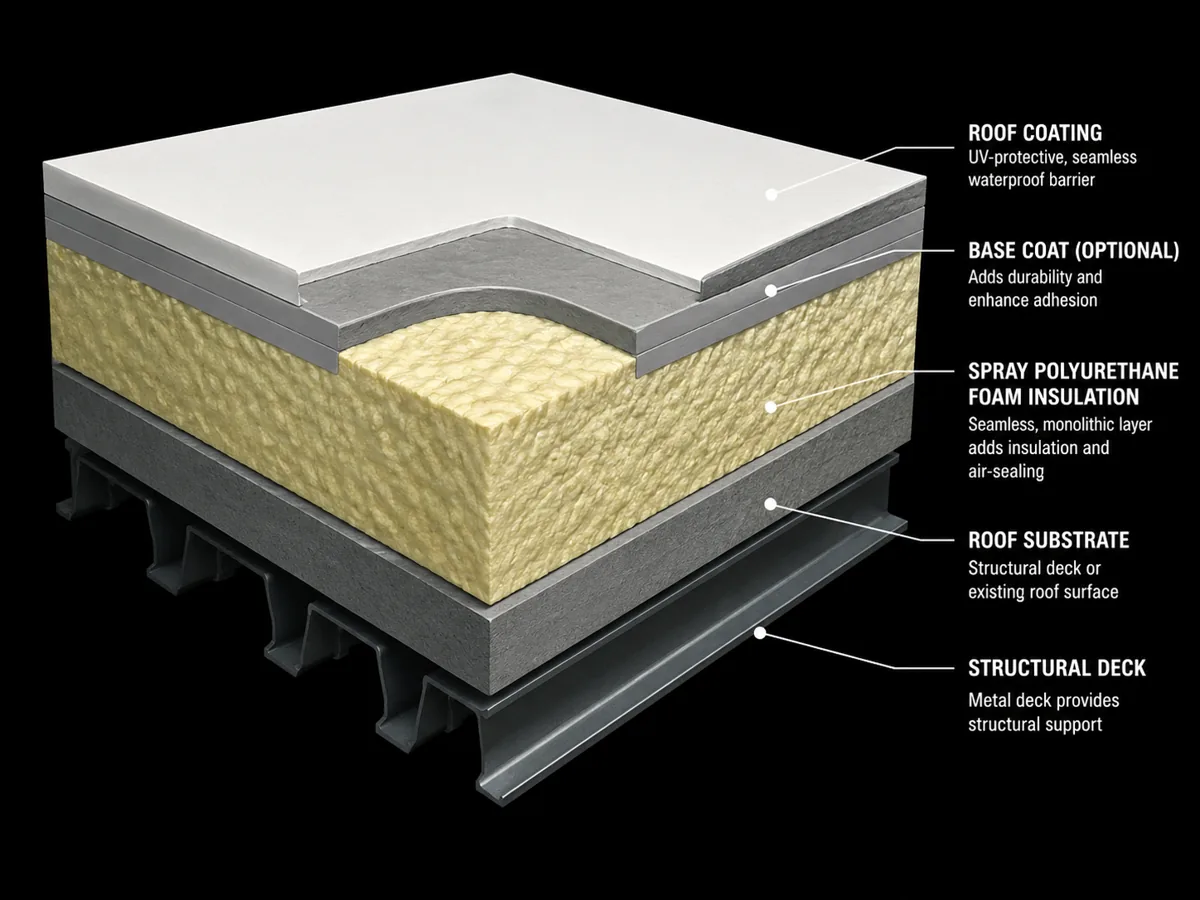
Spray polyurethane foam roofing is a two-part liquid — an isocyanate and a polyol resin — mixed at high pressure in a heated spray gun and applied directly to your existing roof deck or, in many cases, right over a prepared existing roof. The liquid expands about thirty times in seconds and cures into a rigid, closed-cell foam blanket that is bonded to the substrate across its entire surface. There are no seams, no fasteners, no laps, and no edges except where the roof itself ends — and there the foam self-flashes, curving up parapets and around penetrations in one continuous piece.
Over the cured foam we apply a protective elastomeric topcoat — on nearly all our Merced-area work that means high-solids silicone, because silicone is the coating that stands up to Valley UV and ponding water without chalking away. The finished system is lightweight (typically under a third of the weight of a built-up roof), fully adhered, and renewable: when the coating wears down in 10 to 20 years, you clean the roof and recoat it for a fraction of replacement cost, keeping the same foam in service for decades. Buildings foamed in the 1980s are still dry today under their third or fourth coating. That renewability is the core economic argument for SPF, and it is why institutional owners — school districts, ag processors, logistics REITs — keep specifying it across the Valley.
Merced County's commercial inventory splits into a few big families, and spray foam happens to be the right answer for every one of them. Start with the former Castle Air Force Base in Atwater, now the Castle Commerce Center. The base closed in 1995 and left behind some of the largest industrial buildings between Sacramento and Fresno — hangars, maintenance shops, and warehouse blocks with enormous low-slope and barrel roofs, many of them metal, most of them dating to the Cold War. Roofs like that are a maintenance treadmill under conventional systems: thousands of linear feet of seam, thousands of fastener heads, thermal movement that works every joint loose a little more each summer. SPF ends the treadmill by burying the seams and fasteners under a monolithic foam layer that moves with the building instead of against it.
Second family: the distribution and logistics boxes rising along Highway 99 as Bay Area freight pushes inland. These tilt-ups are born with single-ply roofs that carry ten-to-twenty-year clocks. Foaming over a tired single-ply (after adhesion testing and prep) upgrades the roof and the insulation in one pass, without a tear-off that would shut down dock operations. Third: food processing. Livingston's poultry plants and the surrounding ag processors run refrigeration hard all year; roof insulation is a direct line item on their energy bill, and SPF's R-6.5 per inch is the highest practical R-value you can add to an existing roof without raising it structurally. Fourth: the older masonry blocks of downtown Merced and the newer commercial spillover around UC Merced — offices, clinics, student housing service buildings — where flat roofs meet ownership groups who would rather restore than replace.
Merced sits in California Energy Commission climate zone 12, which is a polite way of saying it gets both barrels. Summer afternoons routinely pass 100°F, and roof-surface temperatures on dark membranes push 160°F and beyond — heat that cooks plasticizers out of single-ply, dries out asphalt, and drives cooling costs through the deck of any under-insulated building. Then winter arrives and the tule fog settles in for days at a time, holding surface moisture against every seam, ponding low spots that never get sun long enough to dry, and finding its way into any crack that summer's expansion opened. Between the two seasons, the wind pulls dust off tens of thousands of surrounding acres of almonds, sweet potatoes, and dairies and deposits it on your roof, where it abrades coatings, clogs drains and scuppers, and holds moisture like a poultice.
An SPF roof with a white silicone topcoat counters all three attacks at once. The bright, reflective surface keeps the roof within a couple dozen degrees of air temperature instead of a hundred, cutting heat load and slowing every chemical aging process on the roof. The seamless membrane gives fog and dust-borne moisture nothing to wick into. And because the foam is applied as a liquid, our installers build slope into it as they spray — filling the low spots and directing water to drains so ponding stops being a feature of your roof at all. On the Title 24 side, a high-reflectance, high-emittance coated foam roof is a straightforward path to California's cool-roof prescriptive requirements for low-slope commercial re-roofing, and the added R-value works in your favor on any energy-compliance calculation.
SPF is one of the few roof systems where the waterproofing layer is also the insulation layer. At roughly R-6.5 per inch, a common 1.5-to-2-inch application adds R-10 to R-13 to a building that may have been built with next to nothing over the deck — and thicker lifts are available where an energy target or a slope correction calls for them. Because the foam adheres continuously, wind uplift performance is excellent; there is no membrane edge for wind to peel and no billowing, which matters on the huge open-fetch roofs at Castle where wind has a runway. The weight story matters too: at about a third of a pound per square foot per inch, SPF adds almost nothing to structure, which is why it is so often the right call over older decks — including the mid-century bow-string and metal roofs common in Atwater and downtown Merced — that were never designed for the dead load of a second built-up roof.
There's also a durability figure owners rarely hear until they own foam: hail and foot-traffic damage to an SPF roof is repairable with a caulk gun and a coating kit, because damage stays local — a gouge in seamless foam doesn't propagate the way a puncture in a stretched membrane does. Maintenance crews servicing rooftop HVAC on a Merced warehouse can walk a granulated silicone-over-foam roof without a ballet of walkway pads, and the twice-a-year inspection that keeps the warranty healthy takes an hour, not a day. Small facts like these are why facility managers who inherit one foam roof tend to spec foam for the next building too.
Every project follows the same disciplined sequence, and it starts before anyone quotes a price. First, assessment: we fly the roof with a drone to map its condition, then pull core samples where the history is unclear — a core tells us in minutes whether there's wet insulation trapped under your existing membrane, something no walkover can prove. Wet material gets cut out and replaced; foaming over trapped moisture is how bad contractors create blistered roofs, and we don't do it. Second, preparation: the roof is cleaned, loose material removed, drains and penetrations detailed, and adhesion verified for the specific substrate — metal, concrete, wood, built-up, or single-ply each get their own prep spec. Third, application: our rig mixes and sprays the foam in controlled lifts, building thickness and slope to plan, self-flashing every curb, pipe, and parapet as we go. Fourth, coating: once the foam has cured, we apply the silicone topcoat at specified millage, with embedded granules where foot traffic warrants. Fifth, verification: thickness checks, coating millage readings, and a final walkthrough with photos you keep. The full playbook is on our spray foam roofing installation page.
Scheduling in Merced County is a real skill, and it is mostly about weather windows. Foam wants a dry substrate and reasonable humidity; we don't spray into tule fog mornings, so winter jobs get planned around burn-off hours, and summer jobs start early to stay ahead of afternoon heat and any breeze that could carry overspray. Our crews have run this calendar for twenty years — it's the difference between a roof that cures right and one that gets argued about later.
Metal building roofing deserves its own section in Merced County because there is so much of it — Castle's Air Force-era structures, ag shops and equipment barns from Livingston to Los Banos, and the pre-engineered steel buildings that dominate light-industrial parks off Highway 140 and Santa Fe Drive. Metal roofs fail at their fasteners and laps: tens of thousands of screws, each with a neoprene washer that Valley UV destroys on schedule, each one a future leak. They also condense — on fog mornings, the underside of an uninsulated metal roof rains on whatever's stored beneath it — and they hammer tenants with radiant heat all summer.
SPF fixes the whole list in one application. The foam encapsulates every fastener and lap seam, ends condensation by keeping the metal above dew point, adds real insulation to a building that usually has none or has compressed batt scraps, and stiffens the panels audibly — rain noise and oil-canning both drop. For the big-span structures at Castle Commerce Center, foam-over-metal is frequently the only economically sane option, because tearing off and replacing thousands of squares of structural metal panel is a capital project few owners will ever green-light. We prep the metal, treat rust, verify adhesion, and deliver a seamless insulated roof over the exact structure you already own.
Honest numbers, stated plainly: a new SPF roof system typically runs $4 to $8 per square foot installed, depending on foam thickness, substrate preparation, tear-off requirements (rarely needed), roof complexity, and coating spec. Restoration recoats of an existing foam roof run $2 to $4 per square foot. Where your project lands in those ranges is exactly what the free assessment determines — which is why we put a drone over the roof and cores in the deck before we put numbers on paper. For a deeper breakdown of the variables, see our spray foam roofing cost guide.
| Building type (Merced County examples) | Typical scope | Ballpark range |
|---|---|---|
| Castle Commerce Center industrial / hangar roofs | Foam over prepared metal or BUR, silicone topcoat | $4–$7 / sq ft |
| Highway 99 distribution / tilt-up warehouse | Foam over prepped single-ply or deck, cool-roof coating | $4–$6 / sq ft |
| Food processing / refrigerated plant (Livingston area) | Thicker foam lifts for R-value, wash-down-aware detailing | $5–$8 / sq ft |
| Downtown Merced masonry commercial block | Foam over BUR, slope correction at drains | $4–$7 / sq ft |
| Existing SPF roof, coating at end of life | Clean, repair, silicone recoat | $2–$4 / sq ft |
Two financial notes worth making. First, because SPF usually goes over the existing roof, you avoid most tear-off and landfill cost — and avoid exposing your building during the work. Second, the energy savings are not hand-waving: adding R-10-plus and a reflective surface to an under-insulated Valley roof measurably cuts summer cooling load, and for refrigerated facilities the payback math gets aggressive. We'll walk the numbers for your specific building, not a brochure average.
Owners comparing systems usually shortlist single-ply TPO, and it's a fair fight worth having openly — we lay it out in detail in spray foam vs. TPO roofing. The short version: TPO is a seamed, mechanically-attached or adhered sheet with zero added insulation unless you buy and install board stock separately; its seams are heat-welded by hand, and every one is a future quality question; and at end of life it is a tear-off. SPF is seamless, insulating, self-flashing, and renewable by recoat. TPO can make sense on new construction where insulation board is going down anyway; on an occupied, existing Merced building with a serviceable deck, foam wins the lifecycle math far more often than not. Built-up and modified bitumen are heavier, hotter, seam-dependent systems that mostly persist by inertia. Metal-over-metal retrofits solve structure but not insulation or condensation. We're an SPF company because after twenty years in the Valley we've watched the comparison play out on real roofs.
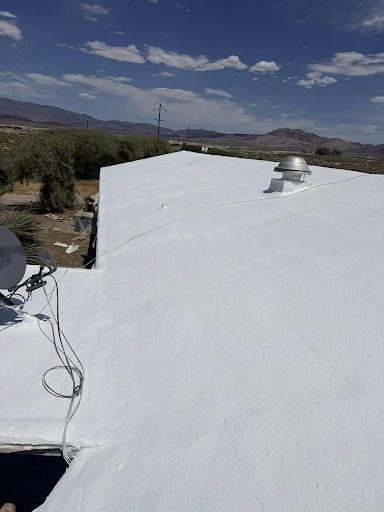
Walk any aging flat roof in Merced after a January storm and you'll find the ponds — dark rings of standing water that mark where the structure sagged, the drains sit high, or the original slope was never right. Ponding water accelerates every failure mode a roof has: it magnifies UV attack, breeds algae and mosquitoes, loads the structure, freezes on cold Valley mornings, and probes relentlessly at any seam it can reach. Most roof systems can only address ponding by expensive tapered insulation packages. SPF is unique in that slope correction is native to the application — our sprayers build up the low areas and feather toward drains as part of the same pass that waterproofs the roof. Fixing drainage while re-roofing, in one operation, is one of foam's quietest and most valuable advantages, and on the broad, minimally-sloped roofs common at Castle and along the 99 corridor it is often the deciding factor.
Highway 140 out of Merced is the all-weather gateway to Yosemite, and the hospitality, fuel, and service businesses strung along it — plus those on 99 and out CA-152 toward Los Banos — live and die by season. We plan around your calendar: pre-summer completion for buildings that can't have crews on the roof during peak visitor months, dock-schedule-aware phasing for distribution buildings, sanitation-window coordination for food plants. Because our crews are based 75 minutes south at our Tulare County shop, Merced projects get mobilized as planned campaigns, not squeezed-in afternoons — the rig arrives with materials staged for your job, and the crew stays on it until the coating cures. For assessments, we batch north-Valley visits weekly, so the drone survey that starts your project is typically days away, not weeks: call (559) 739-9519 and we'll slot you into the next run.
Commercial re-roofing in California is regulated work, and Merced County owners deserve a contractor who treats it that way. Low-slope re-roofs on nonresidential buildings generally trigger Title 24 cool-roof requirements — minimum aged solar reflectance and thermal emittance values that a white silicone-coated SPF system meets comfortably — and roofing permits run through the City of Merced, the City of Atwater, City of Livingston, City of Los Banos, or Merced County depending on the parcel. We handle the paperwork as part of the job: permit applications, product documentation with CRRC-rated coating data, and the inspection scheduling that keeps your project legitimate and your future sale or refinance clean. It's unglamorous, and it's exactly the kind of thing that separates a licensed twenty-year contractor from a truck with a sprayer. If your building is inside a planned district near UC Merced or on leased ground at Castle, we've navigated landlord and authority approvals before and will do it again without drama.
One more compliance note that matters to ag and food operators: foam and coating systems for processing facilities get specified with wash-down zones, exhaust locations, and sanitation schedules in mind. We detail around rooftop process equipment — evaporators, exhaust stacks, condensate lines — so the roof supports the plant instead of fighting it, and we coordinate spray days against production calendars so odor-sensitive operations are never surprised.
Allstate Spray Foam Insulation is a family-owned Central Valley company, not a franchise and not a storm-chasing crew with out-of-state plates. We've sprayed foam for over twenty years; we hold California C-2 license #C-2-1052735; we're BBB accredited; and we're members of the Spray Polyurethane Foam Alliance, the industry body that sets SPF best practice. Our work carries industry-leading leak-proof guarantees, and — more to the point — our history is checkable: Valley building owners, managers, and ag operators who will tell you whether we did what we said. We don't sell foam where foam is wrong. If your core samples say the deck is too far gone, or a targeted repair buys you five more years cheaper, the written assessment will say so.
Here's the process, start to finish. You call (559) 739-9519 or send the roof's address through the site. We put your building on the next weekly north-Valley assessment run — Merced, Atwater, Livingston, and Los Banos are all covered. On site, we fly the roof with a drone, document every detail and defect, and pull core samples where the deck's condition needs proof. Within 48 hours you have a written bid — with honest options laid out, whether that's full SPF, a restoration coating, or a repair scope. No pressure, no expiring-tonight pricing, no surprises when the crew shows up. That's how a family company keeps its name good for twenty years, and it's how your flat roof stops being the line item you dread. Spray foam roofing in Merced starts with one phone call — make it before the next 100-degree stretch or the next fog season does its work on the roof you have now.
Also serving Merced: Silicone Roof Coating in Merced · Foam Roof Repair in Merced · Commercial Insulation in Merced. See all Merced services on the Merced service hub, or read our full spray foam roofing guide. Nearby: Spray Foam Roofing in Bakersfield · Spray Foam Roofing in Madera.
Yes — Merced, Atwater, Livingston, and Los Banos are all inside our regular service area. Our crews dispatch from our Tulare County shop about 75 minutes south on CA-99, and we batch north-Valley assessments weekly, so a drone survey is typically days away and projects are mobilized as planned campaigns with materials staged for your job.
It's often the only economically sane option. Foam encapsulates the thousands of fastener heads and lap seams where Air Force-era metal roofs leak, adds insulation those buildings never had, and avoids a structural panel replacement that few budgets would survive. Adhesion testing and metal prep come first, and the assessment is free.
In most cases SPF goes directly over the prepared existing roof — built-up, metal, and many single-ply roofs qualify after cleaning and adhesion verification. Core samples tell us whether any wet insulation is trapped underneath; wet areas get cut out and replaced rather than foamed over, which is how the system stays honest.
That combination is exactly what the system is built for. The white silicone topcoat reflects summer sun so the roof runs far cooler and ages slower, while the seamless foam gives fog-season moisture no seams or fastener heads to wick into. Slope built into the foam also eliminates the ponding that fog weeks never let dry.
New SPF systems typically run $4 to $8 per square foot depending on thickness, prep, and roof complexity, while recoating an existing foam roof runs $2 to $4. We put a drone over the roof and cores in the deck before quoting, so the written bid you get within 48 hours is a firm number, not a placeholder.
Yes — a high-reflectance silicone-coated SPF roof comfortably meets Title 24's aged reflectance and emittance requirements for low-slope commercial re-roofing in climate zone 12, and the added R-6.5 per inch works in your favor on the energy side. We include the CRRC-rated product documentation with your permit package.
Free assessment — drone survey, core sampling where needed, and a written bid within 48 hours, anywhere in Merced County.
Or Call Directly
(559) 739-9519