Restore your existing flat or metal roof with a seamless 100% silicone membrane for $2–$4 per square foot — no tear-off, no shutdown, and a system built to sit under Valley sun and fog-season ponds without flinching.
Silicone roof coating in Merced, CA is the restoration path that lets a tired flat roof skip the dumpster: instead of tearing off and starting over, a 100% silicone membrane is applied over your existing roof — foam, metal, TPO, built-up, or modified bitumen — sealing it into a seamless, white, UV-proof surface for a fraction of replacement cost. Allstate Spray Foam Insulation has coated Central Valley roofs for more than twenty years, family-owned and fully licensed (CA Lic #C-2-1052735), BBB accredited, and SPFA members. Our crews run out of our Tulare County shop, 75 minutes down CA-99, and we batch north-Valley assessments weekly across Merced, Atwater, Livingston, and Los Banos. Restoration pricing typically lands at $2 to $4 per square foot — against $4 to $8 for a new roof system — which is why roof coating is the first option we price for any Merced building whose deck is still sound. Call (559) 739-9519 for a free drone survey and a written bid within 48 hours.
Not all roof coatings are the same chemistry, and in Merced County the difference is not academic. Acrylic coatings are water-based; they're cheaper, but they re-emulsify under standing water — and standing water is a fact of life on Valley flat roofs, where minimal slope meets winter storm cells and weeks of tule fog that never let ponds dry. High-solids silicone is moisture-cured and genuinely hydrophobic: it can sit under a pond indefinitely without softening, peeling, or losing adhesion. It is also the most UV-stable coating chemistry in common use, which matters when your roof spends June through September under a sun that pushes air temperatures past 100°F and surface temperatures far higher. When we say we install 100% silicone systems, we mean high-solids silicone applied at specified thickness — not a bargain blend, not an acrylic with silicone in the marketing. On Merced roofs, chemistry is destiny.
The restoration candidates in Merced County are everywhere once you know how to look. At the Castle Commerce Center in Atwater, the former Air Force base's inventory of huge industrial roofs — metal, built-up, and everything in between, much of it dating to the base era — is exactly the stock where replacement costs are so enormous that restoration is often the only capital plan that pencils. Along the Highway 99 corridor, distribution and logistics buildings wear single-ply membranes that are aging out of warranty but not out of usefulness; a silicone overlay buys those roofs another decade-plus without interrupting dock schedules. Livingston's poultry and food-processing plants need roofs that stay watertight over refrigerated space, where a slow leak means insulation saturation and energy bleed long before anyone sees a stain. Downtown Merced's older commercial blocks carry built-up roofs with decades of patches; the commercial growth spreading toward UC Merced adds a younger generation of flat roofs that will need their first restoration decision within the coming decade. And across the county's ag belt — from Atwater shops to Los Banos warehouses off CA-152 — metal roof coating is its own steady demand, because Valley sun destroys fastener washers on a schedule you can set a calendar by.
A coating is only as good as what's under it, so the process starts with proof, not paint. First, assessment: drone survey of the entire roof, moisture inspection, and core sampling where the roof's history is uncertain — if there's saturated insulation under your membrane, we find it now, cut it out, and replace it, because coating over trapped water is how restoration projects fail. Second, cleaning: pressure washing to strip the Valley's signature load of ag dust, almond-harvest grit, and diesel film off the surface — adhesion lives and dies on this step. Third, repairs: seams reinforced, splits and punctures patched, ponding areas addressed, penetrations re-flashed, rusted metal treated and primed. Fourth, application: high-solids silicone applied by spray or roller at the specified millage — thickness is measured, not eyeballed, because millage is the difference between a 10-year and a 20-year system. Fifth, verification: wet-film readings during application, a final inspection with photo documentation, and a written record of the system installed. The whole sequence usually takes days, not weeks, and your building stays occupied and operating throughout — no tear-off, no exposed deck, no dumpster train through the parking lot.
If your building already has a spray polyurethane foam roof — and plenty of Valley buildings foamed over the past forty years do — silicone recoating is not an option, it's the design. SPF systems are engineered to be recoated every 10 to 20 years; the coating sacrifices itself to the sun so the foam never has to. Recoat on schedule and the same foam stays in service for decades — this is the renewability that makes spray polyurethane foam roofing the lowest lifecycle-cost system in the Valley. Miss the window, though, and UV starts eating exposed foam surface, turning a $2-to-$4 recoat into a scarify-and-refoam project. If you've bought or inherited a Merced building with a foam roof of unknown age, that's reason enough for a free assessment: ten minutes of drone footage and a millage check tell us whether you're due, overdue, or fine for years. Owners near the university who picked up older commercial property in the UC Merced expansion wave — this one's for you.
Merced County may have more square feet of low-slope metal roof than any other roof type — pre-engineered steel buildings in the industrial parks, equipment barns and shop buildings across the dairy and almond country, and the big Air Force-era structures at Castle. Metal fails predictably: UV kills the neoprene fastener washers, thermal cycling elongates screw holes, panel laps open, rust blooms wherever coating wears, and on fog mornings the whole underside condenses and drips on inventory. A silicone metal-roof system attacks the full list — every fastener head gets encapsulated (brushed or injected detail work, thousands of them, done by hand), every lap seam gets reinforced, rust gets converted and primed, and then the entire roof is coated into one seamless white membrane. The building runs cooler, the drips stop, and the roof you already own gets another 10 to 20 years of service for $2 to $4 per square foot instead of the panel-replacement quote that made you sit down. For the hangar-scale metal at Castle Commerce Center, this math isn't just attractive — it's usually the only line the budget will hold.
We sell this system, and we'll still give you both columns honestly, because a coating in the wrong application fails and takes our name with it.
The pros. Ponding-water immunity — silicone is the only mainstream coating that shrugs at standing water, which on minimal-slope Valley roofs is disqualifying for the alternatives. Best-in-class UV stability under a Central Valley sun that logs more than 3,000 hours of annual sunshine. Reflectivity that drops roof surface temperature by up to 60–80°F on a 100-degree day, with real cooling-load savings and easy Title 24 cool-roof compliance. No tear-off: the existing roof stays as substrate, landfill fees stay unspent, and the building never sits open. Speed and quiet — days on the roof, no demolition, business as usual below. Renewability — when the coating ages, you clean and recoat again; the roof becomes a maintained asset instead of a periodic catastrophe. And price: $2 to $4 per square foot against $4 to $8 for new systems.
The cons. Silicone is slick when wet — walkable areas get granulated surfacing, and we detail walkpads at service equipment. Once silicone is down, only silicone sticks to it; you're committed to the chemistry for future recoats (a fair trade, but a real one). It holds dirt visibly more than acrylics, and under Merced's ag-dust load the bright white will mellow — reflectivity declines a little as it does, and an occasional wash restores most of it. It is a restoration system, not a resurrection system: a roof with widespread saturated insulation or a failing deck needs repair or replacement first, and our core samples will say so in writing. And thin-mil bargain jobs fail — millage discipline is everything, which is why we document wet-film thickness as we go. Weigh the columns and the conclusion for most structurally-sound Merced flat roofs is lopsided, but you should get to see both columns before you sign anything.
Here is the decision every Merced owner is actually making, in numbers. For the full variable breakdown see our cost guide.
| Path | Typical cost / sq ft | Disruption | What you get |
|---|---|---|---|
| Silicone restoration over sound existing roof | $2–$4 | Days; building stays open | Seamless white membrane, 10–20 yr cycle, renewable |
| New SPF roof system (foam + silicone) | $4–$8 | Short; usually no tear-off | New insulation (~R-6.5/inch) + membrane, slope correction |
| Single-ply replacement (TPO) | Varies; plus tear-off + disposal | Weeks; deck exposed during work | New seamed membrane, insulation only if bought separately |
| Do nothing another year | "Free" | None yet | Interior damage risk, saturated insulation, shrinking options |
The fourth row is the one that costs the most in practice. Every season a marginal roof waits, water finds more insulation to soak — and saturated insulation can't be coated over, so the affordable options shrink while the expensive one grows. The free assessment exists precisely to tell you which rows are still available to your building.
Single-ply membranes age in a known arc: the sheet chalks, seams get brittle, and somewhere past year fifteen the warranty conversation turns into a replacement conversation. But a TPO or PVC roof that is aging is not the same as a roof that is failing — and a silicone flat roof coating over a prepared, adhesion-primed single-ply routinely resets the clock for a decade or more at a quarter of replacement cost. The prep is substrate-specific: single-ply gets cleaned aggressively and primed for adhesion, seams get reinforced with mesh or sealant, and any punctured or wet areas get cut out and patched before a drop of coating goes down. Built-up and modified bitumen roofs — the standard on downtown Merced's older commercial blocks and plenty of county buildings — take silicone well too, once blisters are addressed and the surface is stabilized; the coating locks down alligatored surfaces that would otherwise keep shedding gravel into the drains every storm. The disqualifier is always the same and it's always underneath: saturated insulation. That's what our core samples are for, and it's why our restoration bids hold up while cheaper drive-by quotes turn into change orders.
Merced sits in CEC climate zone 12, where cooling drives the commercial energy bill for most of the year. An aged, dark flat roof on a July afternoon can run 150–170°F; a fresh high-reflectance silicone surface on the same afternoon runs dramatically cooler — commonly 60–80°F closer to air temperature. That difference conducts straight into your cooling load, your rooftop-unit runtime, and — for Livingston's refrigerated processors — compressor duty cycles that never get a season off. The reflective surface also extends the roof's own life, because nearly every aging mechanism on a roof runs on heat. On the compliance side, California's Title 24 sets aged-reflectance and emittance minimums for low-slope nonresidential re-roofing, and CRRC-rated 100% silicone systems clear them cleanly — we include the product documentation with your permit package. We won't promise a specific percentage off your utility bill, because honest contractors don't guess at your building's load profile; we will say that the direction is always down, the effect is largest on under-insulated metal and single-story buildings, and the owners who feel it most are the ones running conditioned or refrigerated space under big Valley roofs.
Every flat roof in Merced County ponds somewhere — around settled drains, along the sagging mid-span of a fifty-year-old structure at Castle, behind parapets where the original slope was optimistic. Winter makes it worse: storm water lands, tule fog keeps it from evaporating, and the same pools sit for weeks. Ponding is where acrylic coatings die and where seamed membranes get probed relentlessly at their weakest points. Silicone's defining trait is that it does not care — it cures into a waterproof solid that maintains adhesion under standing water indefinitely, which is why it is the only coating chemistry we will put on a minimal-slope Valley roof. That said, tolerance is not endorsement: chronic ponds still load the structure and collect the ag-dust sludge that clogs drains, so our restoration scope usually includes drainage improvements — pond fills with foam or leveling compound, drain and scupper service, added overflow paths — so the coated roof sheds water the way the original design intended. Coating plus drainage correction, done together, is what turns a problem roof into a quiet one.
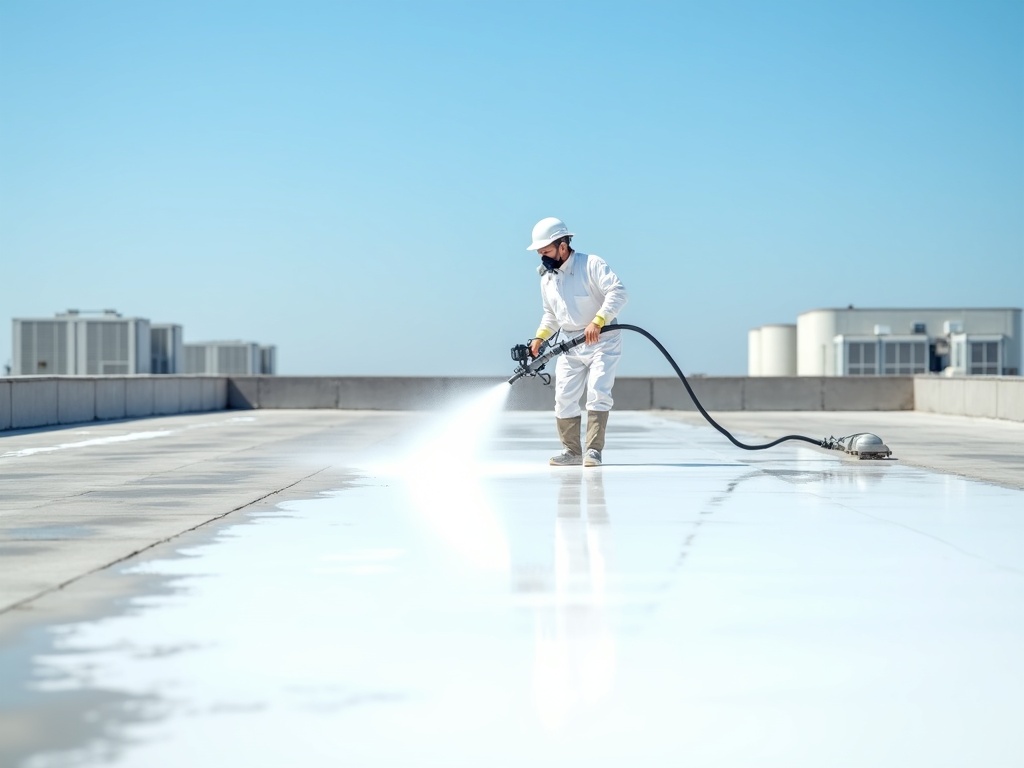
Silicone is moisture-cured, which makes it forgiving, but application still wants a clean weather window: dry surface, temperatures in range, and no dew flash before skin-over. In practice that means Merced's long dry season — April into November — is prime coating season, and we schedule winter work around tule-fog burn-off and storm gaps. Summer work starts at first light to beat the afternoon heat. This is also why waiting until the first November leak to think about your roof is expensive: the best restoration window is the dry months before the storm season that will test it. Get assessed in spring or summer, coat on schedule, and let the first atmospheric river of the season hit a brand-new membrane. Buildings on the Highway 140 Yosemite corridor with summer-peak businesses get the inverse plan — we coat in the shoulder seasons so crews aren't overhead during your revenue months.
Within the $2-to-$4 range, five factors set your exact price. Size — bigger roofs cost less per square foot, and Castle-scale roofs benefit most. Condition — a roof needing extensive seam work, saturated-insulation removal, or heavy rust treatment carries more prep cost than one that needs washing and touch-ups; this is most of the spread. Substrate — coating over existing foam is typically the least prep-intensive; metal with thousands of fasteners carries detail-labor hours; single-ply needs adhesion priming. Millage spec — a 20-year system carries more material than a 10-year system, priced accordingly and documented. Access and logistics — a single-story warehouse with drive-up access prices better than a downtown Merced block over occupied storefronts. Your written bid itemizes all five, and because we survey by drone and core-sample before quoting, the number on the paper is the number on the invoice — no discovery surcharges three days into the job.
A restored roof is a low-maintenance roof, not a no-maintenance roof, and the habits that protect it are cheap. Twice a year — once after almond harvest dusts the county in late summer, once after the first big storms — walk the roof or have it walked: clear the drains and scuppers, sweep debris off the field, and look at the detail work around every penetration. After any trade works on the roof — HVAC techs, solar installers, sign hangers — check where they walked and what they screwed down, because service punctures are the leading cause of leaks on otherwise healthy coated roofs, and a silicone repair caught early is a ten-minute patch. Keep the documentation we hand you at closeout — millage readings, photos, product data — with the building's records; it matters at sale, refinance, and warranty time. And when the coating begins to show honest wear a decade or two out, the renewal is a wash-and-recoat, not a project: that recoat-forever cycle is the entire economic point of the system, covered in depth in how long spray foam roofing lasts. Owners who want it handled entirely can ask about scheduled maintenance visits when we write the bid — for multi-building owners at Castle or along the 99 corridor, one standing arrangement covers the whole portfolio.
There are national coating franchises and there are paint contractors who'll roll anything on anything. We're neither. Allstate Spray Foam Insulation is a Central Valley family company that has done this work — foam and coatings, together, as a system — for more than twenty years, under California C-2 license #C-2-1052735, with BBB accreditation and SPFA membership. Coatings are not a sideline we added last year; they are half of the SPF craft, because every foam roof we've ever installed depends on its coating. That's the experience you want evaluating whether your existing roof can be restored: people who know exactly what silicone can and cannot save, backed by industry-leading leak-proof guarantees and a name that has to stay good in this Valley. Our repair crews also handle the punch-list work restoration sometimes reveals — see foam roof repair for how we handle localized damage.
One call starts it: (559) 739-9519. We put your building on this week's north-Valley assessment run — Merced, Atwater, Livingston, and Los Banos — fly the roof, pull cores where the history is murky, and hand you a written bid within 48 hours that prices your real options side by side: restore, repair, or re-roof. If silicone restoration is right for your building, you'll know exactly what it costs and what it buys. If it isn't, you'll know that too, in writing, before you've spent a dollar. Either way, you stop guessing about the biggest maintenance line item your building has — and you get ahead of the next fog season instead of chasing it with buckets.
Also serving Merced: Spray Foam Roofing in Merced · Foam Roof Repair in Merced · Commercial Insulation in Merced. See all Merced services on the Merced service hub, or read our full silicone roof coating guide. Nearby: Silicone Roof Coating in Bakersfield · Silicone Roof Coating in Madera.
Restoration coatings typically run $2 to $4 per square foot, against $4 to $8 for a new roof system. Where your building lands depends on size, prep and repair needs, substrate, and the coating thickness specified — all of which the free drone-and-core assessment pins down before you see a number in writing.
Silicone is the one mainstream coating that tolerates standing water indefinitely, so ponds won't destroy it the way they destroy acrylics. But our scope usually corrects the drainage too — foam pond fills, drain and scupper service, added overflow paths — so the restored roof sheds water instead of just surviving it.
Yes — metal is one of our most common substrates in Merced County. Every fastener head gets encapsulated by hand, laps get reinforced, rust gets converted and primed, and the whole roof becomes one seamless white membrane, usually for a small fraction of what panel replacement would cost.
SPF systems are designed to be recoated every 10 to 20 years; the silicone sacrifices itself to UV so the foam never has to. If you don't know the roof's coating age, a free assessment with millage readings will tell you whether you're due, overdue, or fine for years — catching it on time keeps the cost at $2–$4 per square foot instead of a re-foam.
No, and we'll tell you in writing when yours isn't. A roof with widespread saturated insulation or a failing deck needs repair or replacement first — that's what our core samples are for. Coating over trapped moisture is how restoration projects fail, so we prove the roof is sound before we quote a coating.
The dry season — roughly April into November — is prime, because silicone application wants a dry surface and a clean weather window. Winter work is possible around tule-fog burn-off and storm gaps, but the smart play is assessing in spring or summer so the new membrane is cured before the first November storm tests it.
Free assessment — drone survey, core sampling where needed, and a written bid within 48 hours, anywhere in Merced County.
Or Call Directly
(559) 739-9519