100% silicone restoration that adds 10–20 years to aging flat, foam, and metal roofs across the Fresno metro — without tear-off and without closing your business.
Silicone roof coating in Fresno, CA is the most cost-effective way to add 10–20 years of life to an aging flat, foam, or metal roof — without tear-off, without landfill fees, and usually without interrupting the business under it. A 100% silicone membrane is applied as a fluid over your existing roof and cures into a seamless, UV-immune, permanently flexible surface that sheds the Valley's brutal sun and shrugs off the ponding water that kills most other coatings. At $2–$4 per square foot for a typical recoat, it costs a fraction of replacement and resets your roof's maintenance clock.
Allstate Spray Foam has been coating Central Valley roofs for over twenty years. Family-owned, Fully Licensed · Lic #C-2-1052735, BBB Accredited, and an SPFA member, we run coating crews into Fresno, Clovis, Sanger, Selma, Fowler, Kerman, and Kingsburg — about 45 minutes north on CA-99 from our Tulare County shop.
Not all roof coatings are close to equal. Acrylic coatings are water-based, cheaper, and genuinely useful in the right spot — but they re-emulsify under standing water and erode faster under UV. High-solids 100% silicone is a different animal: it is moisture-cure chemistry that is unaffected by ponding water, essentially immune to UV degradation, and stays flexible through Fresno's 100°F-plus summers and foggy near-freezing winters alike. On a flat roof in this climate — where drainage is rarely perfect and the sun is never merciful — silicone is the coating we specify most, because it is the one that is still performing in year fifteen. When we quote a silicone flat roof coating for a Fresno building, we quote high-solids 100% silicone at the manufacturer's specified millage, not a bargain blend stretched thin.
Two specification lines separate a fifteen-year coating from a five-year one, and both are invisible once the roof is white. The first is dry-film thickness — coating performance and coating warranties are written in mils, and a system applied thin fails early no matter whose bucket it came from. We measure thickness during application rather than estimating by the bucket count, and the specified millage appears on your written bid where you can hold us to it. The second is granule embedment: broadcasting ceramic granules into the wet topcoat produces a tougher, higher-traction surface that resists foot traffic, hail bruising, and bird pecking, and it moderates silicone's two honest weaknesses — slickness when wet and dirt pickup. On Fresno roofs with regular HVAC service traffic, we recommend granules as a matter of course; the modest cost difference buys years of wear.
Consider what a coated roof endures here in a single year. From June through September, surface temperatures cycle from warm mornings to a scorching afternoon peak day after day — the thermal expansion and contraction that cracks brittle coatings. UV exposure in the south Valley is among the most intense in the country, chalking and thinning lesser products year by year. Autumn drops ag dust from harvest across every horizontal surface in the county, clogging scuppers so winter water sits in ponds. Then tule fog season keeps the roof wet for days at a stretch, probing every pinhole while acrylics soften. A 100% silicone membrane is the only coating class that treats all of that as a normal Tuesday: ponded water cannot re-emulsify it, UV cannot meaningfully degrade it, and it stays elastic through every thermal cycle. That is why silicone dominates our Fresno recoat work from Blackstone Avenue retail to Malaga warehouses.
There is an energy dimension to all this heat as well. A fresh white silicone surface reflects the large majority of the solar energy that a weathered dark roof absorbs, which means the deck under it runs dramatically cooler on a 105°F afternoon and the rooftop HVAC equipment stops fighting a radiant oven all summer. California's Title 24 cool-roof requirements for low-slope re-roofs point in the same direction, and a silicone restoration typically satisfies them without any additional scope. For most Fresno owners the coating decision is made on leak protection and replacement avoidance — the summer utility relief and the code compliance arrive as bonuses in the same bucket.
Owners searching for roof coating in Fresno get pitched everything from asphalt emulsions to elastomerics, so here is the straight comparison we give on assessments:
| Coating | Ponding Water | UV Resistance | Typical Role in Fresno |
|---|---|---|---|
| 100% Silicone | Excellent — unaffected | Excellent | Our default for flat/foam/metal recoats |
| Acrylic elastomeric | Poor — re-emulsifies | Good | Sloped metal with positive drainage, tight budgets |
| Aluminized asphalt | Poor | Fair | Short-term touch-up on old BUR only |
| Urethane | Good | Fair — often topcoated | High-traffic zones, base coat under silicone |
The pattern is simple: where a roof drains perfectly and the budget is tight, acrylic can earn its keep; everywhere water lingers — which on Fresno's aging flat roofs is nearly everywhere — silicone is worth the difference. We will tell you which one your roof actually needs, because a coating in the wrong application fails early and takes our reputation with it.
Hybrid specifications also exist and sometimes win: a urethane base coat for toughness under a silicone finish for UV and ponding immunity, or acrylic fields with silicone reserved for the pond-prone zones behind parapets. The point of an assessment done by an installer — rather than a coating salesman working a route — is that the specification follows the roof's actual conditions, drain by drain and low spot by low spot.
No product is perfect, and you should hear the cons from your contractor, not from the internet after you sign. The honest ledger:
Weigh that ledger against Fresno's specific conditions and the pros compound while the cons stay manageable. Slickness is solved with walk pads and granules; dirt pickup costs a little reflectivity, not waterproofing; prep discipline is a contractor-selection problem, not a product problem. Meanwhile the ponding immunity and UV permanence address exactly the two failure modes that end most Valley flat roofs. That asymmetry — cons you can engineer around versus pros that target your actual climate — is why silicone has become the default restoration spec across the region's commercial stock, and why the buildings that tried bargain acrylic on ponding decks a decade ago are calling us now.
Silicone roof coating price questions deserve real numbers. In the Fresno market, a silicone recoat on a sound roof runs $2–$4 per square foot. Position inside that range is driven by surface condition and cleaning needs (harvest-season dust and old coating chalk take real prep hours), how much cut-and-patch repair precedes the coating, specified dry-film thickness, and detail density — a roof crowded with HVAC curbs and penetrations takes more hand work per square than an open field. Compare that against $4–$8 per square foot for a new SPF system, or far more for tear-off and membrane replacement, and the economics of restoring rather than replacing are hard to argue with — provided the roof underneath is genuinely restorable, which is exactly what the free assessment establishes. Our spray foam roofing cost guide walks through the recoat-versus-replace math in detail.
Every Fresno coating bid we issue follows the same free process: drone survey of the whole field, core sampling where moisture is suspected, and a written scope and price within 48 hours. If a coating is the wrong answer for your roof, the assessment is where we tell you — before you have spent anything.
A note on how to compare bids, because coating quotes in the Fresno market can look identical on the surface and differ enormously underneath. Ask every bidder the same four questions: what dry-film thickness is being applied and how will it be verified; what repairs are included before coating begins; is the product high-solids 100% silicone or a blend; and what exactly does the guarantee cover, in writing. A per-square-foot number without those answers is not a bid — it is a guess you will finance. Our proposals answer all four on paper, which is precisely why we are comfortable being compared line for line against anyone working this market.
If your building already has a spray foam roof, silicone recoating is not an option — it is the scheduled event the whole system is designed around. The foam provides the insulation and the seamless waterproofing; the coating is the sacrificial UV shield that wears in its place. In Fresno sun, that shield lasts roughly 10–20 years depending on product and millage, and each $2–$4 per square foot recoat resets it completely without touching the foam beneath. Owners who keep that cycle never buy another roof; owners who skip it let UV reach the foam itself, and then the repair scope grows. The aging math is laid out in how long does spray foam roofing last, and the underlying system is explained in our spray polyurethane foam roofing guide. If your foam roof already has open blisters, exposed foam, or ponding damage, we handle that scope through our foam roof repair Fresno service before any coating goes down — coating over damage just hides it for a season.
Metal roof coating is its own discipline, and the Fresno area — with its packing sheds around Sanger and Selma, shop buildings out toward Kerman, and older industrial metal in Calwa and Malaga — has no shortage of candidates. Aging metal roofs fail at fasteners and lap seams: thousands of them, each backing out or rusting as panels cycle through the Valley's daily temperature swing. Our metal restoration process treats rust, seals every fastener head individually, bridges the lap seams with reinforcement, and then floods the whole field with silicone into one seamless membrane. The result stops existing leaks, prevents the next generation of them, and drops summer surface temperatures dramatically — metal buildings feel the reflective difference more than any other type because so many of them are barely insulated. Where a metal building also needs real R-value, we pair coating work with foam — see the metal retrofit section of our Fresno spray foam roofing service.
Owners of metal buildings often ask whether coating is worth doing on a roof that is already rust-streaked, and the answer depends on what the rust means. Surface oxidation on panels that are still structurally sound is exactly what restoration is for — it gets treated, primed, and sealed under the membrane, and the corrosion clock stops because water and oxygen no longer reach the steel. Panels rusted through, or purlin-level structural issues, are a different conversation, and the drone survey plus a hands-on walk tells us which building you have before anyone quotes anything. What we will not do is spray a bright white coat over failing steel to buy two quiet years — a coating should be the end of your leak story, not an intermission.
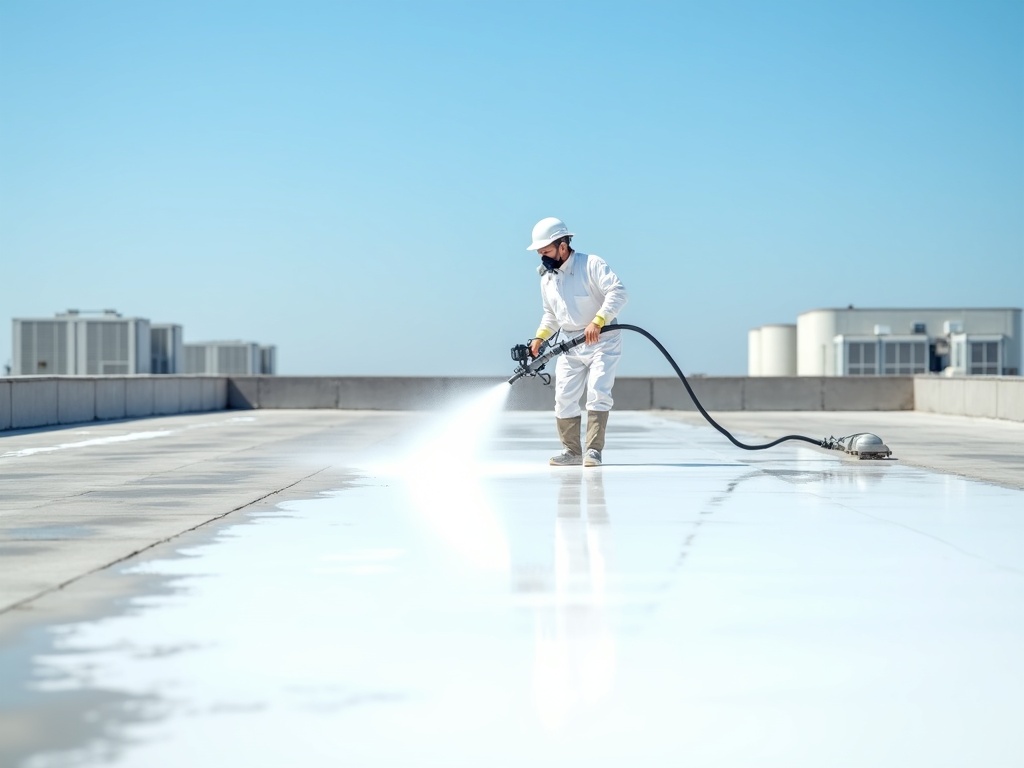
A sampling of where silicone work takes our crews in the metro: retail strips along Blackstone and Shaw with twenty-year-old built-up roofs that pond behind parapets; downtown Fresno offices where tear-off logistics over occupied space make restoration the only sane option; distribution and cold storage boxes in south Fresno and Malaga where owners want the reflectivity gain as much as the leak protection; Clovis flex-commercial along the CA-168 corridor hitting its first recoat window; and metal ag buildings from Kingsburg to Kerman with fastener leaks in the hundreds. The building types differ; the physics — UV, heat, dust, fog, imperfect drainage — are the same everywhere in Fresno County, and silicone answers all of them.
The substrates vary as much as the neighborhoods, and each gets its own prep protocol:
First the free assessment: drone survey, core samples where the deck's moisture history is unclear, written bid in 48 hours. Then preparation, which is most of the labor: pressure-washing the field (that ag-dust film again), drying, cutting out and patching failed areas, sealing seams and fasteners, and priming where the substrate demands it. Only then does silicone go down, sprayed or rolled in measured passes to the specified thickness, with detail work at every curb, drain, and penetration done by hand. We verify millage as we go — coating warranties are written in mils, and thin spots are where leaks are born. Most Fresno projects finish in days, the building operating underneath the whole time. Weather discipline matters here as much as on foam work: we do not coat wet steel or fog-damp decks, because adhesion is everything.
The Valley gives coating crews a generous but not unlimited season. Late spring through early fall offers the long dry windows where production runs fastest — though peak-summer afternoons ask for early starts so material behaves on a hot deck. The window to respect is tule fog season: from roughly late November into February, decks can stay damp past midday, and moisture trapped under fresh coating is a blister factory. We schedule winter work around the fog rather than through it, and we tell owners plainly when a December call should become a January project. The practical advice: if your roof showed wear this summer, book the assessment now rather than after the first winter leak — the calendar is kindest to owners who plan one season ahead, and the free drone survey costs nothing to schedule.
Our silicone systems carry industry-leading leak-proof guarantees, and the written scope tells you exactly what stands behind them: the product installed, the millage applied, the repairs completed before coating, and the maintenance expected of the owner (chiefly keeping drains clear and calling us rather than a handyman when rooftop trades cut into the membrane). We would rather set those expectations in writing on day one than argue about them in year eight — and because we are family-owned and 45 minutes away, the name on the guarantee answers the phone.
The honest boundary: silicone restoration is for roofs that are aged but fundamentally sound — dry insulation, attached membrane, workable drainage. It is not for roofs whose insulation is waterlogged or whose substrate is failing; coating those is disguising a problem you will pay for twice. That is why our assessment includes core sampling and not just a walk-around. Roughly speaking, when a roof's wet area stays small, restoration wins economically by a wide margin; when saturation is widespread, we will show you the cores and talk about foam or replacement instead. Either way you get the evidence, the numbers, and a written recommendation — and the decision stays yours.
There is also a middle path worth knowing about: when a roof is too far gone for coating alone but the owner wants the seamless, renewable endgame, a new spray foam system over the existing deck delivers both — fresh insulation and waterproofing at $4–$8 per square foot, finished with the same silicone surface and entering the same 10–20 year recoat cycle. Plenty of our coating assessments end with that recommendation instead, and the same 48-hour written bid covers whichever scope the cores justify. The point of doing the diagnostics before the proposal is that you are choosing between real options priced from real evidence, not between a salesman's good-better-best sheet.
Allstate Spray Foam is family-owned, twenty-plus years in this exact climate, Fully Licensed · Lic #C-2-1052735, BBB Accredited, SPFA member, and 45 minutes from your roof via CA-99. Our coating work carries industry-leading leak-proof guarantees, and our recommendation comes with core-sample evidence, not sales pressure. Call (559) 739-9519 and get the free drone assessment on the calendar — in 48 hours you will hold a written number for exactly what your Fresno roof needs.
Also serving Fresno: Spray Foam Roofing in Fresno · Commercial Insulation in Fresno. See all Fresno services on the Fresno service hub, or read our full silicone roof coating guide. Nearby: Silicone Roof Coating in Clovis · Silicone Roof Coating in Bakersfield.
Typical silicone recoats in the Fresno area run $2-$4 per square foot, depending on prep needs, repairs, specified thickness, and how many details the roof carries. You get an exact written price within 48 hours of the free drone assessment.
Silicone is the one mainstream coating unaffected by standing water, so it is the right surface for ponding-prone Fresno roofs. But coating does not fix why water sits there - where ponding is severe we correct slope or drainage as part of the scope, and we verify the deck under the pond is dry before coating.
Usually yes, after testing. New silicone bonds to old silicone and to properly prepped foam, acrylic, metal, and smooth-surface roofs; adhesion testing and core sampling during the free assessment confirm it. Saturated or badly damaged sections get repaired first through our foam roof repair service.
Expect 10-20 years from a properly specified high-solids silicone system before the next recoat, even under Valley UV. Thickness is the main variable, which is why we measure millage during application rather than eyeballing it.
When the roof is fundamentally sound - dry insulation, attached substrate - restoration at $2-$4 per square foot beats replacement economics decisively. When core samples show widespread saturation, coating is the wrong answer and we will say so. The free assessment settles it with evidence.
Yes - Clovis, Sanger, Selma, Fowler, Kerman, and Kingsburg are in our standard service pattern. Crews dispatch about 45 minutes north via CA-99 from our Tulare County shop.
Free assessment — drone survey, core sampling where needed, and a written bid within 48 hours, anywhere in Fresno County.
Or Call Directly
(559) 739-9519