Seamless SPF roof systems for Fresno's flat, low-slope, and metal roofs — insulation, waterproofing, and Title 24 cool-roof surface in a single application.
Spray foam roofing in Fresno, CA solves the two problems every flat-roof owner in this city fights at once: brutal heat gain and a roof surface full of seams waiting to leak. Spray polyurethane foam (SPF) is applied as a liquid that expands into a seamless, fully-adhered blanket over your existing roof, curing in seconds into a rigid, closed-cell layer that insulates at roughly R-6.5 per inch and self-flashes around every curb, pipe, drain, and skylight. Topped with a UV-stable protective coating, it becomes a monolithic roof system with no laps, no fasteners, and no field seams — which in a climate like Fresno's is the difference between a roof that survives and a roof that needs a bucket brigade every time the weather turns.
Allstate Spray Foam has installed SPF across the Central Valley for more than twenty years. We are family-owned, Fully Licensed · Lic #C-2-1052735, BBB Accredited, and a Spray Polyurethane Foam Alliance member. Our crews reach Fresno in about 45 minutes, running north on CA-99 from our Tulare County shop, and we work the entire metro — Fresno proper, Clovis, Sanger, Selma, Fowler, Kerman, and Kingsburg.
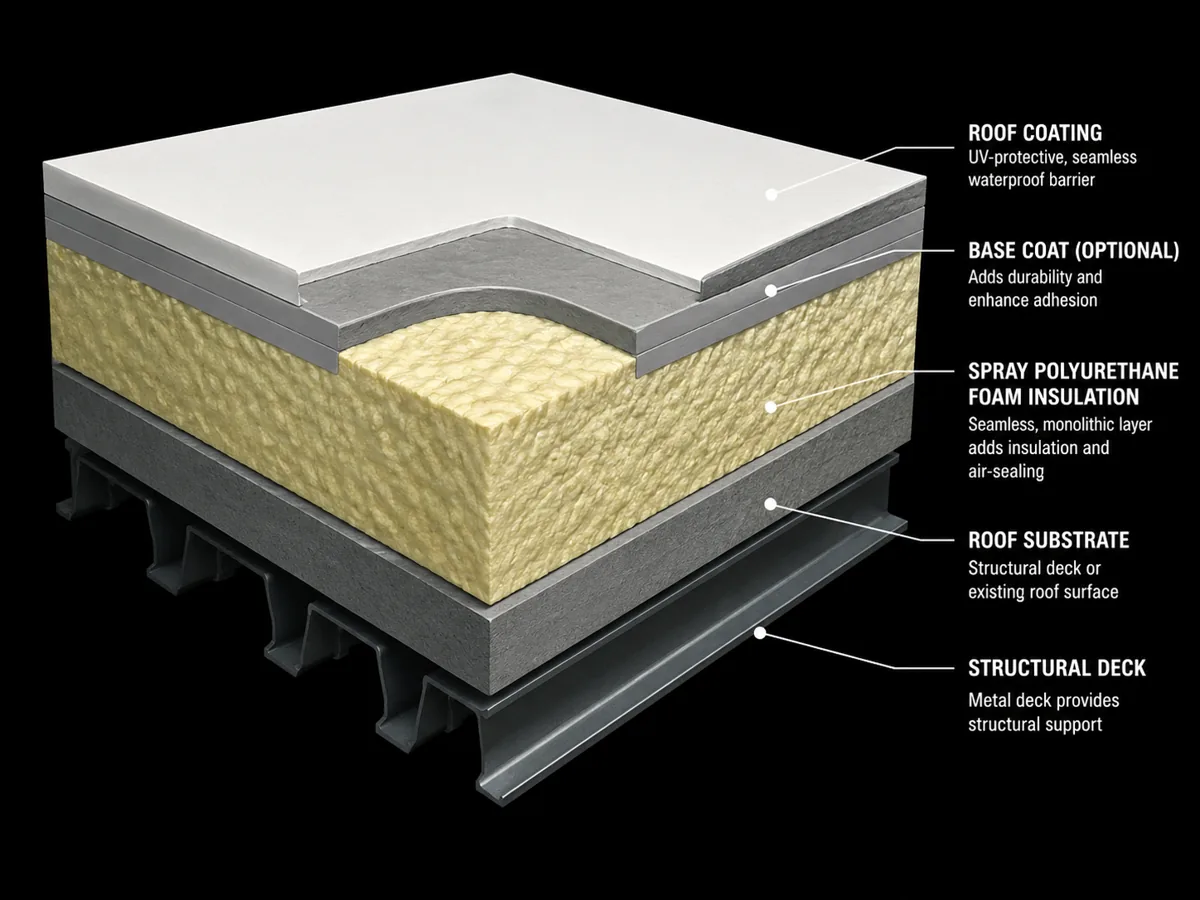
SPF starts as two liquid components mixed at the spray gun. On contact with the roof, the mixture expands about thirty times its volume and cures into rigid closed-cell foam within seconds. Because it is sprayed rather than rolled out in sheets, it conforms to whatever is up there — HVAC curbs, parapet transitions, pipe penetrations, sagging deck sections — and bonds directly to the substrate with no mechanical fasteners punching holes through your roof. The cured foam is then protected with an elastomeric or silicone topcoat, usually embedded with granules for durability, which shields the foam from UV and gives the roof its bright, reflective finish. The result is one continuous material from parapet to parapet. If you want the deeper technical background on the chemistry and system build-up, our spray polyurethane foam roofing guide covers it layer by layer.
Two properties make SPF unusual among roof systems. First, it is the only major roofing technology that is also insulation — the R-value is in the roof itself, not in a separate board layer that seams and joints can bypass. Second, it is renewable: when the topcoat wears after 10–20 years, you recoat rather than replace, and the foam underneath keeps performing indefinitely.
It helps to picture the finished roof as three cooperating layers. The substrate is whatever your building already has — built-up roofing, modified bitumen, concrete, plywood, or metal panels — cleaned, dried, and repaired so the foam has something sound to grip. The foam body is the structural heart: rigid closed-cell polyurethane, typically installed at one and a half inches or more, providing the insulation value, the slope corrections, and the seamless waterproofing plane. The coating and granule surface is the wear layer — the part Fresno's UV is allowed to attack, because it is designed to be sacrificial and renewable. Understanding that division of labor explains almost every maintenance recommendation we make: protect the coating and the foam never ages; let the coating go and you convert a cheap recoat into a repair project. It also explains why SPF quotes vary — each layer has a specification, and a low bid usually means one of the three has been quietly thinned.
Weight is worth a mention too, because Fresno has plenty of older buildings with tired structures: a complete SPF system adds well under a pound per square foot — a fraction of the load of a gravel-surfaced built-up roof or a concrete-paver ballasted system. On buildings where the structural engineer winces at adding another conventional roof layer, foam is frequently the only re-cover option that pencils without reinforcement work.
Fresno summers routinely stack up weeks of 100°F-plus days, and roof surface temperatures on dark membranes can exceed 160°F. That thermal load does three things: it drives heat straight into the building and onto your cooling bill, it accelerates the chemical aging of asphalt and single-ply membranes, and it makes every seam and fastener expand and contract daily until something opens up. Then winter arrives and the tule fog settles in — days of near-100% humidity that keep rooftops wet long enough to find every hairline opening the summer created. Add the constant film of ag dust blowing off the county's orchards, vineyards, and row crops, which holds moisture against the surface and clogs drains and scuppers, and you have a climate that destroys seamed roofing from both ends of the calendar.
SPF is unusually well matched to this. There are no seams to open. The foam's closed cells will not wick water. The reflective topcoat keeps surface temperatures dramatically lower than a dark membrane, cutting both heat gain and thermal cycling stress. And because foam is sprayed to slope, chronic low spots that pond after fog-drip and winter storms can be filled and pitched to drain during installation — a fix sheet goods simply cannot make.
Most of our Fresno work is commercial roofing — the flat and low-slope decks that dominate the city's commercial building stock. Retail centers along the Blackstone Avenue corridor and Shaw Avenue, downtown office and mixed-use buildings, tilt-up warehouses in the south Fresno industrial belt, packing and processing plants toward Sanger and Selma, and metal-roofed shops from Kerman to Kingsburg all fall inside the same service pattern. SPF competes directly with TPO, PVC, modified bitumen, and built-up roofing on these buildings, and it usually wins on lifecycle cost because the insulation is included and the roof is renewable rather than disposable. For a broader look at how we approach commercial roofing in Fresno across all these system choices — including when we would honestly steer you away from foam — see our dedicated commercial roofing Fresno page. This page stays focused on the SPF system itself: what it is, what it costs, and how it behaves on Fresno buildings.
One commercial-specific advantage deserves emphasis: SPF installs over most existing roofs. That means no tear-off, no dumpsters cycling through your loading dock, no days where the deck is open to the sky, and in most cases no interruption to the business operating underneath. For a food processor or cold storage operator that cannot shut down, that is often the deciding factor.
Twenty years in the Valley means we have seen what is actually on Fresno's roofs, neighborhood by neighborhood:
Knowing the building stock matters because SPF is specified to the building, not sold off a brochure. A 1960s built-up roof on Blackstone needs different prep and coring than a 1990s tilt-up in Malaga; a fog-belt packing shed near Sanger carries a different coating spec than a downtown office with parapet walls on four sides. Two decades of Valley roofs is the pattern library that makes our 48-hour bids accurate instead of padded — we have almost certainly already foamed a building like yours, within a few miles of yours.
A large share of the metro's ag infrastructure sits under corrugated or standing-seam metal — and aging metal roofs leak in a characteristic way: at thousands of fasteners and lap seams, all cycling with the Valley's daily temperature swing. Replacing metal panels is disruptive and expensive. Spraying foam directly over the metal is usually smarter: the foam locks down the panels, encapsulates every fastener head and lap, kills the rattle and thermal ping, adds R-6.5 per inch where the building had little or none, and stops the underside condensation that drips onto equipment during tule fog season. The foam also stiffens the roof diaphragm measurably. For packing houses around Sanger and Selma and shop buildings out toward Kerman, metal-over-foam retrofits are some of the most satisfying work we do — buildings that leaked at a hundred fasteners simply stop leaking.
Honest numbers, because budgeting a roof on vague ranges wastes everyone's time. A new SPF roof system installed over a prepared existing roof typically runs $4–$8 per square foot in the Fresno market. Where your project lands inside that range depends on foam thickness (driven by insulation goals and slope corrections), the condition and prep needs of the existing roof, detail density (a roof crowded with HVAC curbs costs more per foot than a clean deck), and coating specification. Recoating an existing foam roof — the scheduled maintenance event that renews the system — runs $2–$4 per square foot.
| Scope | Typical Fresno Range | What Drives It |
|---|---|---|
| New SPF roof over existing deck | $4–$8 / sq ft | Foam thickness, prep, details, coating spec |
| Silicone recoat of existing foam | $2–$4 / sq ft | Surface condition, repairs needed, coating mils |
| Metal roof foam retrofit | $4–$8 / sq ft | Rust remediation, panel condition, thickness |
| Free assessment & written bid | $0 | Drone survey, core sampling where needed, bid in 48 hours |
Compare those numbers against tear-off-and-replace pricing for membrane systems — which must also add insulation board to match SPF's thermal performance — and foam's lifecycle math usually speaks for itself. We break the whole calculation down, including energy payback, in our spray foam roofing cost guide.
Three cost factors deserve a closer look because they are where Fresno bids genuinely differ. Thickness is the biggest lever: foam sprayed at one and a half inches waterproofs; foam at two and a half or three inches waterproofs and meaningfully insulates, and the material difference shows in the price. Buildings with high cooling loads — most of them, in this city — usually come out ahead specifying more foam, because the energy delta pays for the increment. Existing roof condition is the second: a dry, sound deck needs cleaning and priming, while a roof with saturated sections needs those areas cut out and rebuilt before anything is sprayed, which is precisely what the core sampling in our free assessment is designed to find before the bid rather than as a change order after. Detail density is the third: every HVAC curb, pipe, drain, and skylight is hand-detail work, so a mechanical-heavy restaurant roof prices differently per foot than a clean warehouse field even at identical square footage. Our bids line-item all three, which is why they hold.
Every inch of SPF adds roughly R-6.5 of continuous insulation with zero thermal bridging — no fasteners conducting heat through the assembly, no board joints leaking air. On a Fresno warehouse or retail box running air conditioning against 100°F-plus outdoor air for four months a year, upgrading a nearly uninsulated roof deck to R-13 or R-20 of continuous foam changes the building's operating economics permanently. The reflective topcoat compounds the effect by rejecting solar gain before it enters the assembly at all; aged reflective coatings still bounce a large majority of solar energy compared with the 5–10% a black roof reflects.
California's Title 24 energy code is also in play on most Fresno commercial re-roof projects: low-slope re-roofs in our climate zone generally trigger cool-roof surface requirements, and SPF with a white silicone or elastomeric topcoat satisfies them as a matter of course. Rather than treating code compliance as an added cost line, an SPF roof folds it into the system you were buying anyway. We handle the paperwork realities of CA energy compliance on every bid — it is baked into how we specify coatings, not an afterthought.
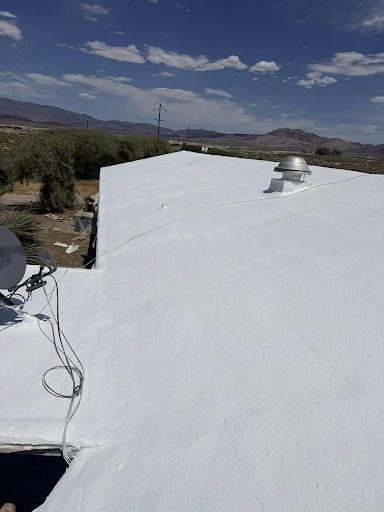
A typical Fresno SPF project runs in five stages. First, the assessment: drone survey of the full roof field, core sampling where the roof's build-up or moisture condition is uncertain, and a written bid within 48 hours. Second, preparation — the single biggest determinant of roof quality. We clean the surface (Fresno's ag dust film matters here; foam bonds to substrate, not to dust), address saturated areas found in coring, and prime where the substrate requires it. Third, foam application: the crew sprays in controlled passes, building thickness to spec and sloping foam into chronic ponding areas so water finally moves to the drains. Fourth, the protective topcoat goes on in multiple passes with embedded granules. Fifth, we walk the roof with you, document the installed system, and put the maintenance schedule in writing. Most Fresno projects, even large ones, proceed section by section so the building operates normally throughout. The full stage-by-stage detail lives on our spray foam roofing installation page.
Weather windows matter in the Valley: we plan around summer wind for overspray control and around winter fog for surface moisture, and we do not spray onto a damp deck. A crew that will spray through tule fog conditions is a crew whose foam will not stay bonded — scheduling discipline is part of the product.
Duration questions come up on every bid, so as honest orientation: production rate depends on prep scope and detail density far more than on raw square footage, and the drone survey lets us schedule realistically instead of optimistically. What we can promise on every Fresno project is sequencing that respects the business below — loading docks kept usable, exhaust and intake vents coordinated with your facilities staff, and overspray protection for the cars, equipment, and neighboring property around the building. Foam work done carelessly announces itself all over the parking lot; foam work done right is invisible until the utility bills arrive.
The foam itself, kept coated, does not have a practical expiration date — SPF roofs from the 1970s are still in service nationally. What wears is the sacrificial topcoat, and in Fresno's UV that means a recoat roughly every 10–20 years depending on coating type and mils applied. Each recoat, at $2–$4 per square foot, resets the cycle without touching the foam. That renewability is the core of SPF's lifecycle advantage: you buy the roof once and maintain it forever, instead of buying a new roof every 15–20 years. We wrote up the full aging story, including what actually kills foam roofs (neglect, not weather), in how long does spray foam roofing last.
Between recoats, a Fresno foam roof asks very little of you, but the little it asks matters in this dust-and-fog climate:
We put this schedule in writing at handover, and because our shop is 45 minutes away, having us walk the roof with you is a phone call, not a project.
Fresno owners usually price foam against TPO, and the comparison deserves straight talk. TPO is cheaper on day one for a plain, empty rectangle of roof. But TPO arrives in sheets, which means seams — miles of heat-welded seam on a big warehouse — and every seam is future maintenance in a climate with Fresno's thermal cycling. TPO also carries no insulation of its own, so matching SPF's thermal performance means adding polyiso board, which narrows the price gap fast. On detail-heavy roofs, roofs with ponding to correct, or buildings where energy cost matters, foam tends to win outright. We lay out the head-to-head honestly — including the cases where TPO is the right call — in spray foam vs TPO roofing.
Spray foam is an installer's product: the same chemistry applied by two different crews yields two very different roofs. Our case for your business is simple. Twenty-plus years of SPF work in this exact climate, family-owned accountability rather than a franchise chasing volume, full state licensing (Lic #C-2-1052735), BBB accreditation, SPFA membership, and industry-leading leak-proof guarantees on the systems we install. We are 45 minutes down CA-99, close enough that service after the sale is real — when a Fresno customer calls, a truck from our Tulare County shop is on your roof quickly, not "in the area next month."
The next step costs nothing: call (559) 739-9519 for the free assessment. Drone survey, core sampling where the roof's history warrants it, and a written bid in your hands within 48 hours. Whether you manage a Blackstone retail center, a Malaga distribution box, or a packing shed outside Kingsburg, you will know exactly what your roof needs and exactly what it costs — before you spend a dollar.
Also serving Fresno: Silicone Roof Coating in Fresno · Commercial Insulation in Fresno. See all Fresno services on the Fresno service hub, or read our full spray foam roofing guide. Nearby: Spray Foam Roofing in Clovis · Spray Foam Roofing in Bakersfield.
New SPF roof systems in the Fresno market typically run $4-$8 per square foot installed over an existing roof, and recoats of existing foam run $2-$4 per square foot. The final number depends on foam thickness, roof prep, and detail density, which is why we put a written bid in your hands within 48 hours of the free drone assessment.
In most cases, yes. SPF adheres directly over prepared built-up, modified bitumen, metal, and many single-ply roofs, so the business below keeps operating and nothing goes to the landfill. Core sampling during the free assessment tells us whether any saturated sections need to come out first.
Better than any dark membrane. The reflective topcoat keeps surface temperatures far below a black roof, and the foam itself adds about R-6.5 of insulation per inch, so far less heat ever reaches the space below. Owners typically see the difference on their first summer PG&E bills.
Not for a properly installed one. Closed-cell foam does not absorb water and the system has no seams for fog-soaked winters to exploit. Weather matters during installation, though - we schedule around damp and windy conditions because foam must be sprayed onto a dry surface to bond correctly.
Yes. Clovis, Sanger, Selma, Fowler, Kerman, and Kingsburg are all part of our regular Fresno-area service pattern, and our crews dispatch about 45 minutes north via CA-99 from our Tulare County shop.
Yes. SPF finished with a white silicone or elastomeric topcoat meets the cool-roof surface requirements that apply to most low-slope commercial re-roofs in our climate zone, and we specify coatings with Title 24 compliance in mind on every Fresno bid.
Free assessment — drone survey, core sampling where needed, and a written bid within 48 hours, anywhere in Fresno County.
Or Call Directly
(559) 739-9519