One seamless, insulating membrane for the hardest roofing climate in our territory — installed over your existing roof with no tear-off and no shutdown.
Home / Bakersfield / Spray Foam Roofing
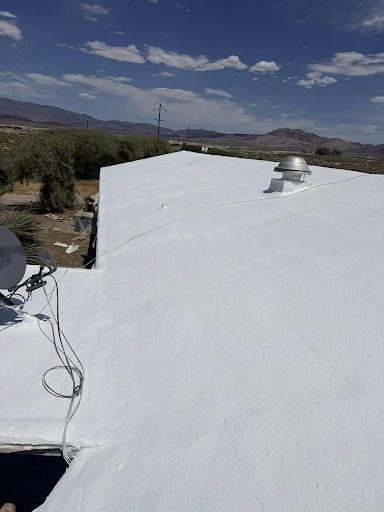
Spray foam roofing in Bakersfield has to survive conditions that destroy conventional flat roofs on an accelerated schedule: triple-digit heat that holds for weeks, some of the most intense rooftop UV in California, wide day-night temperature swings that work every seam and fastener, and a constant film of ag and oilfield dust that clogs drains and turns ponding water abrasive. Spray polyurethane foam — SPF — is the one roofing system that treats those conditions as a design input rather than a threat. It goes down as a liquid, expands into a seamless insulating membrane bonded to the entire deck, and gets finished with a reflective, UV-stable coating. No seams to split. No fasteners to back out. No laps to peel in the heat. Allstate Spray Foam Roofing has been installing and maintaining these systems across the southern San Joaquin Valley for more than twenty years, and Bakersfield — the hottest market we serve — is where the system's payback shows up fastest.
It sounds backwards until you look at the failure modes. Single-ply membranes like TPO and EPDM fail in Bakersfield primarily at their seams and penetrations — tens of thousands of linear feet of heat-welded or glued joints, every one of them flexing through a 40-degree thermal swing between a July afternoon and the same night. Built-up and modified bitumen roofs lose oils to the heat and crack. Metal roofs expand and contract enough to elongate fastener holes and shear washers. SPF has none of those weak points. The foam is one continuous piece of material, chemically bonded to the substrate, and it moves with the building instead of against it. The coating on top — typically a high-reflectivity silicone or acrylic — bounces the majority of solar load before it ever reaches the foam. On a 100°F Bakersfield afternoon, the surface of a reflective SPF roof can run dramatically cooler than a dark cap sheet, and everything below it — the foam, the deck, the conditioned space, the rooftop units — benefits.
Then there is the dust. Sitting between working oilfields and some of the most intensively farmed ground in America, Bakersfield rooftops collect a constant film of fine grit — almond harvest dust in late summer, field dust whenever the wind moves, oil-patch particulates on the east side. On a seamed roof, that grit washes into laps and drains with the first rain and grinds at every joint the water crosses. On an SPF roof there are no joints to grind. The dust rinses across a continuous surface toward drainage we have already corrected during installation, and the annual maintenance walk we recommend clears drains and scuppers before the winter storms arrive. Small thing on paper; in Kern County it is the difference between a roof that ages and a roof that erodes.
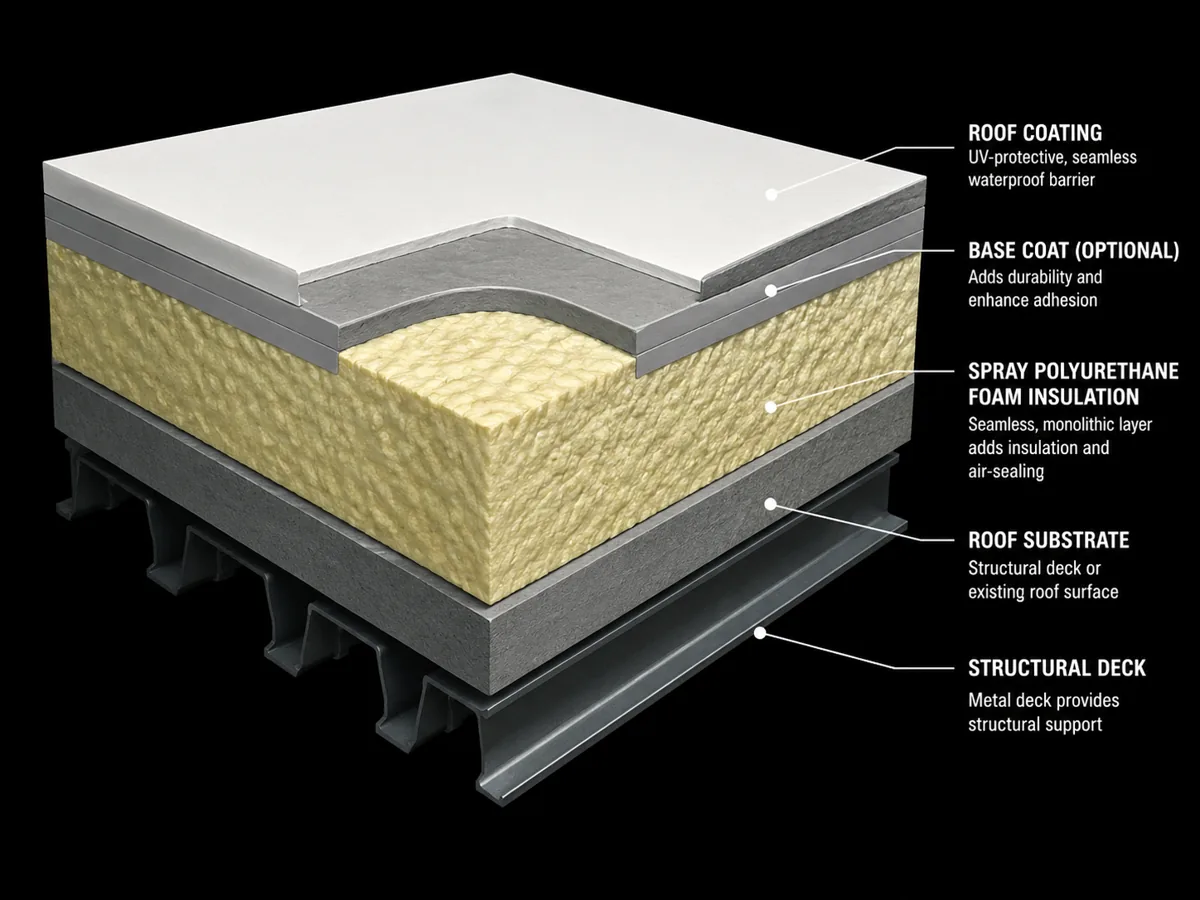
The economic case for spray polyurethane foam roofing in Kern County rests on the fact that you are buying two building systems in a single installation. Closed-cell SPF delivers roughly R-6.5 per inch of thickness, applied directly to the roof deck where it stops heat at the boundary instead of letting it soak into the structure. A typical 1.5-to-2-inch application adds R-10 to R-13 on top of whatever the building already has — and on the bare metal decks common in Bakersfield's older industrial stock, "whatever it already has" is frequently nothing at all. In a market where air conditioning runs hard from May through October, that insulation layer starts repaying the roof investment with the first utility bill. Owners replacing a failed conventional roof with SPF are not just fixing a leak problem; they are permanently changing the building's operating cost.
The insulation layer pays a second, less obvious dividend: it protects everything mounted on the roof. Rooftop HVAC units in Bakersfield fight a losing battle when the deck around them is radiating stored heat back at their condensers all evening; a reflective, insulated SPF surface lowers the micro-climate those units operate in, which shows up as less compressor strain, fewer peak-heat trip-outs, and longer equipment life. The deck itself benefits too — thermal movement in the structure drops when the sun never reaches the steel, and that means less stress on every connection, joint, and interior finish in the building. Owners tend to buy SPF for the leak-proofing and the utility savings; the maintenance managers who live with the building afterward tend to talk about everything else that stopped going wrong.
Bakersfield's position at the junction of Highway 99 and Highway 58 has made it one of the state's fastest-growing distribution markets — freight moving between Southern California, the valley, and the high desert passes through Kern County, and the big-box distribution centers that serve that flow carry some of the largest single roof areas in our territory. Commercial roofing at that scale magnifies everything: a minor per-square-foot energy saving becomes six figures over a decade, a slow leak becomes damaged inventory and a slip hazard on a pick line, and a tear-off becomes a logistical nightmare nobody will approve. SPF answers all three. It installs over most existing substrates after cleaning and preparation, which means no tear-off, no exposed deck, and no interruption to what is happening under the roof. Our crews work section by section, the building stays weather-tight every night, and operations below continue uninterrupted.
The corridor keeps growing, and the growth changes the roofing conversation. Shafter's logistics park has pulled national-scale distribution users north of the metro; the industrial parks around Meadows Field and along the 99 south of town keep adding tilt-up boxes; and every one of those roofs is a thirty-year asset decision being made in a market where cooling is the dominant utility cost. For owners and developers, an SPF roof is also a leasing argument — tenants increasingly ask about energy performance before they sign, and a roof that demonstrably cuts operating cost is a line in the brochure, not just a line in the maintenance budget. For occupiers who own their buildings, the calculation is even simpler: the roof either fights the Bakersfield sun for you or it charges you rent for the privilege.
Head northeast toward Oildale or east along Highway 58 and the building stock changes: pre-engineered metal shops, pipe and equipment yards, pump service buildings, and field offices that support Kern County's energy sector. Metal building roofing has a characteristic set of problems in this climate — fastener holes that wallow out under thermal cycling, rusted lap seams, condensation dripping from an uninsulated underside, and interior heat that makes shop floors brutal by mid-morning in summer. SPF applied over a structurally sound metal roof solves the whole list at once. The foam encapsulates every fastener and lap seam, ends the leak hunt permanently, adds R-6.5 per inch where there was often bare steel, and quiets the drumming of the roof in wind. For shops running welders and machine tools under a steel roof in a Bakersfield August, the change in working conditions is immediate and dramatic.
Winter brings the metal building's other problem: condensation. When the tule fog settles over the valley floor and night temperatures drop, the underside of an uninsulated steel roof becomes a condensing surface — and by morning it is raining indoors, onto equipment, stock, and electrical gear. Foam applied to the panel underside (or a new SPF roof applied above) moves the dew point out of the interior air path and ends the drip cycle outright. It also adds a structural bonus that metal-building owners appreciate: the cured foam stiffens panels, damps oil-canning, and encapsulates fastener penetrations against the slow loosening that thermal cycling causes. A metal roof under SPF is not just insulated; it is mechanically calmer than it has been since the day it was erected.
Kern County's ag processing economy — citrus packing, carrot processing, almond hulling and storage — runs on buildings where the roof is part of the production system. Cold storage and cooled packing floors fight the valley heat around the clock, and every BTU that gets through the roof is paid for at the compressor. Product safety auditors do not tolerate roof leaks over food-contact areas. Dust from surrounding operations settles on everything. SPF roofing fits this world unusually well: the seamless membrane eliminates the seam-leak risk that auditors flag, the insulation directly reduces refrigeration load, and the coated surface stands up to the wash-down and foot traffic that maintenance requires. We schedule ag work around harvest and pack seasons — a carrot plant in Shafter and a citrus house in Arvin have very different calendars, and a roofing contractor who does not respect that does not get invited back.
Food-adjacent roofing also means designing for wash-down and traffic. Processing facilities put more feet on their roofs than almost any other building type — refrigeration techs, sanitation crews, inspectors — and an SPF system for that duty gets specified accordingly: granule-surfaced walk paths between access points and equipment, extra coating thickness in traffic zones, and drainage crickets that keep wash water and the valley's dust from pooling around curbs and units. These are small line items at installation time and enormous ones five years later, which is why our bids for ag facilities spell them out rather than treating every roof as a flat rectangle. The drone survey maps actual traffic wear patterns on existing roofs, so the new system reinforces where your people actually walk, not where a template assumes they do.
We publish our ranges because guessing games waste everyone's time. New spray foam roofing installs for $4–$8 per square foot in the Bakersfield market, with the spread driven by foam thickness, roof complexity, access, and the condition of the existing substrate. Recoating an existing foam roof — the periodic maintenance that renews the system — runs $2–$4 per square foot. For a deeper breakdown of what moves a project within those ranges, see our spray foam roofing cost guide.
| Scenario | Typical Bakersfield range | What drives the price |
|---|---|---|
| New SPF over prepared existing roof | $4–$8 / sq ft | Foam thickness, penetrations, parapet detail, access |
| SPF over structurally sound metal roof | $4–$8 / sq ft | Rust remediation, fastener condition, panel profile |
| Recoat of existing SPF roof | $2–$4 / sq ft | Coating condition, repairs needed, granule choice |
| Free assessment & written bid | $0 | Drone survey, core sampling where needed, bid in 48 hours |
Compare those recoat numbers against a tear-off-and-replace cycle and the long-term math becomes lopsided: an SPF roof maintained on its 10-to-20-year recoat cycle never goes to the landfill and never exposes the building during construction.
Two more things about our numbers. First, the bid you receive is itemized — foam thickness, coating type and millage, granule and walk-path scope, penetration and parapet detail — so you can compare it against any competitor line by line instead of guessing at what a round number includes. Second, the energy math belongs in the decision: on a large Bakersfield roof, the cooling savings from added R-value and reflectivity are a real income stream, and when you net them against the price difference between SPF and a cheaper membrane, the effective payback period is usually far shorter than owners expect. We will run that calculation against your actual square footage and utility rates during the assessment — it takes minutes and it turns a gut-feel decision into an arithmetic one.
Bakersfield owners rightly ask whether any roof can be called long-term in this climate. The honest answer is that SPF is not a roof you replace — it is a roof you renew. The foam itself, protected from UV by its coating, does not meaningfully degrade. The coating is the sacrificial layer: it slowly wears under sun and weather, and somewhere in the 10-to-20-year window it gets cleaned and recoated at $2–$4 per square foot, resetting the clock. Roofs maintained on that cycle have effectively indefinite service lives, which is why SPF systems installed decades ago are still in service across the valley. We cover the full aging story, including what shortens and extends the cycle in high-UV markets like Bakersfield, in our guide to how long spray foam roofing lasts.
What moves a Bakersfield roof toward the early or late end of that recoat window? Mostly the things you can see from the drone: dust abrasion in drainage paths, foot-traffic wear around rooftop units, bird activity pecking at exposed high points, and how much coating thickness the original installer actually applied. This is why we tell Kern County owners to treat the assessment as a recurring habit rather than a crisis response — a five-year drone check costs you nothing, catches coating wear while it is still a spot-repair, and keeps the roof permanently ahead of the curve instead of permanently behind it.
TPO won huge market share nationally on installed price, and on a mild-climate roof with a short ownership horizon it can be a rational choice. Bakersfield is not that market. The heat that merely ages TPO in Sacramento actively hunts its seams here, and the insulation boards beneath a mechanically fastened membrane do nothing to stop the thermal bridging at every fastener and plate. SPF costs somewhat more up front, insulates as it waterproofs, has no seams to fail, and renews instead of replacing. We lay the two systems side by side — installed cost, energy performance, failure modes, lifecycle cost — in our spray foam vs. TPO comparison, and we are happy to walk any Bakersfield owner through the same analysis against their actual utility rates and roof geometry.
Every Bakersfield project starts with the free assessment. We batch Kern County assessments weekly, so your building gets flown within days, not weeks: a drone survey maps the whole roof at high resolution, we pull core samples where the roof's layered history is unclear, and you get a written bid within 48 hours. On installation day, our rigs roll out of our Tulare County shop — about ninety minutes up CA-99 — fully self-contained: foam sets, coating, compressors, generators, everything on the truck. We prep and mask, apply foam to the specified thickness with continuous quality checks, and finish with the protective coating and granules where specified. The full sequence, including how we handle rooftop units, penetrations, and phased sections on occupied buildings, is documented in our spray foam roofing installation guide.
High-resolution aerial mapping finds what a walk-over misses: subtle ponding signatures in the dust patterns, coating wear gradients you cannot see at eye level, thermal stress patterns radiating from penetrations, and the true drainage behavior of the roof plane. On large Bakersfield distribution roofs, it also gives us an exact, measurable base map — so the bid is calculated from real geometry, not paced-off guesswork, and so the before-and-after documentation lives in your file when you sell, refinance, or renew insurance on the building.
Many Kern County roofs are archaeology — original deck, a built-up roof from the eighties, a recover board, a single-ply from the two-thousands. A core sample tells us in minutes what that stack actually is and, critically, whether any layer is holding moisture. Wet layers change the specification: they get dried, removed locally, or vented before foam goes down, because foaming over trapped moisture is how bad contractors create blister farms. Five minutes with a core cutter is the cheapest insurance in roofing, and every core is patched and sealed the same hour it is pulled.
California's Title 24 energy code pushes commercial roof work toward higher insulation values and cool-roof surfaces, and SPF happens to satisfy both requirements in a single system: continuous insulation with no thermal bridging, topped by a high-reflectance coating. For Bakersfield buildings — sitting in one of the state's most demanding cooling climates — that is not paperwork compliance, it is real operating money. When a reroof triggers energy requirements, SPF typically meets them without the extra board stock and cover layers other systems need, which narrows the true installed-cost gap between SPF and cheaper-looking alternatives. The aged-reflectance story matters here too: cool-roof surfaces are rated both new and aged, and in a dust-heavy market the practical difference between surfaces that rinse clean and surfaces that hold grime is real energy money. A maintained silicone-coated SPF roof keeps most of its reflectivity for the life of the coating cycle — another quiet advantage that never shows up in a first-cost comparison.
Our Bakersfield service area covers the full metro and its satellite towns: Delano's packing and distribution buildings up Highway 99, Shafter's fast-growing logistics park and cold storage cluster, Wasco's ag processing stock, and Arvin's farm-adjacent commercial buildings at the valley's southeastern edge. Because our crews mobilize self-contained, a project in Wasco is no harder for us to service than one on Rosedale Highway. Assessments across all of these communities ride the same weekly batch, so nobody waits longer because they are outside the city limits. And because these towns share Bakersfield's climate — the same heat, the same UV, the same dust load off the surrounding fields — everything on this page applies to them without an asterisk: the same foam thicknesses, the same coating specifications, the same recoat economics, the same honest assessment before anyone talks price.
Allstate Spray Foam Roofing is family-owned and has spent twenty-plus years on valley roofs. We are fully licensed — CA Lic #C-2-1052735 — BBB accredited, and members of the Spray Polyurethane Foam Alliance. We do not run high-pressure sales, we do not quote from the driveway, and we back our work with industry-leading leak-proof guarantees. If spray foam roofing is the wrong answer for your building, the assessment will say so and we will tell you what the right answer is. Call (559) 739-9519 and get your Bakersfield building on this week's drone-survey run.
Also serving Bakersfield: Silicone Roof Coating in Bakersfield · Foam Roof Repair in Bakersfield · Commercial Insulation in Bakersfield. See all Bakersfield services on the Bakersfield service hub, or read our full spray foam roofing guide. Nearby: Spray Foam Roofing in Fresno · Spray Foam Roofing in Merced.
New SPF roofing runs $4-$8 per square foot installed in the Bakersfield market, and recoating an existing foam roof runs $2-$4 per square foot. The exact number depends on foam thickness, roof complexity, and substrate condition, which is why we do a free drone survey and put a written bid in your hands within 48 hours.
Yes - it is arguably the best-suited system for them. The foam is a single seamless membrane with no seams or fasteners for thermal cycling to attack, and the reflective coating rejects most of the solar load before it reaches the foam. The R-6.5 per inch of insulation also cuts the cooling load that those summers create.
Yes. SPF over structurally sound metal is one of our most common Kern County projects - it encapsulates every fastener and lap seam, stops chronic leaks, insulates bare steel at R-6.5 per inch, and makes shops dramatically more workable in summer. We roof shops, pipe-yard buildings, and field offices throughout the Bakersfield and Oildale area.
The foam itself is protected by the coating and does not meaningfully degrade. The coating wears slowly under UV and gets renewed every 10 to 20 years at $2-$4 per square foot, which resets the system. Maintained on that cycle, an SPF roof has an effectively indefinite service life.
Yes, all four - plus the full Bakersfield metro. We batch Kern County assessments weekly and our installation rigs mobilize fully self-contained from our Tulare County shop, so satellite-town projects get the same scheduling as jobs inside Bakersfield.
No. SPF installs over most existing roofs without a tear-off, and we work in sections so the building stays weather-tight every night. Distribution centers, ag processors, and shops typically keep running below us for the entire project, and we schedule around harvest and pack seasons for food facilities.
Free assessment — drone survey, core sampling where needed, and a written bid within 48 hours, anywhere in Kern County.
Or Call Directly
(559) 739-9519