Closed-cell foam at ~R-6.5 per inch for metal buildings, warehouses, cold storage, and processing plants across Merced County — insulation, air sealing, and condensation control in one application. Commercial and ag buildings only; that's our lane.
Commercial spray foam insulation in Merced, CA is how the north Valley's working buildings — metal shops, warehouses, distribution centers, cold storage, and food-processing plants — get real thermal performance without tearing anything apart. Allstate Spray Foam Insulation has sprayed closed-cell foam in Central Valley commercial and agricultural buildings for more than twenty years: family-owned, fully licensed (CA Lic #C-2-1052735), BBB accredited, and members of the Spray Polyurethane Foam Alliance. Our crews dispatch from our Tulare County shop, about 75 minutes south of Merced on CA-99, and we batch north-Valley assessments weekly, covering Merced, Atwater, Livingston, and Los Banos. To be clear about our lane: this page is about commercial and ag buildings — we leave residential insulation to others and put our rigs where they've spent twenty years, in buildings that work for a living. Call (559) 739-9519 for a free assessment and a written bid within 48 hours.
The case for insulation in Merced County writes itself every July and every January. Summer afternoons over 100°F turn an uninsulated metal building into an oven that punishes people, product, and equipment; winter tule fog holds buildings cold and damp for weeks and makes condensation rain from bare metal roofs onto whatever's stored below. Between those seasons, every conditioned or refrigerated square foot pays an energy bill sized by how much thermal resistance stands between inside and out. Closed-cell spray foam — roughly R-6.5 per inch, air-sealing and vapor-retarding in the same pass — is the most performance per inch you can add to an existing building, and it's the only insulation that also stiffens metal panels, seals air leaks, and stops condensation in one application.
Closed-cell polyurethane foam is sprayed as a liquid and expands into a rigid, fully-adhered insulation layer with millions of sealed gas-filled cells. That structure is why it outperforms everything else per inch. It insulates at roughly R-6.5 per inch — nearly double fiberglass batt performance — so meaningful R-values fit in the shallow cavities and tight clearances of real commercial buildings. It air-seals as it insulates: heat loss in metal and warehouse buildings is driven as much by uncontrolled air movement as by conduction, and foam closes the laps, gaps, and joints that batts can only drape over. At two inches and beyond, closed-cell foam functions as a vapor retarder, which is what actually stops condensation on metal skins. It adheres structurally — walls and roof panels stiffen noticeably, rattle and rain-noise drop, and there is nothing to sag, slump, or fall out of an overhead cavity in year five. And it doesn't feed mold or hold water. Fiberglass in a Valley metal building fails the same way every time: it absorbs the condensation the building was already making, mats down, and becomes a damp blanket doing single-digit R-value. We've pulled tons of it out of ag buildings from Livingston to Los Banos, and what goes back in is foam.
Merced County's commercial fabric is substantially steel: pre-engineered metal buildings in the industrial parks off Highway 99 and Highway 140, shop and equipment buildings across the ag belt, and the Air Force-era structures at Castle Commerce Center in Atwater — big-span metal buildings by the dozen, most never insulated to modern standards, some never insulated at all. Bare metal buildings have two chronic diseases in this climate. Radiant heat: a steel skin in July Valley sun turns the interior brutal by mid-morning — bad for crews, bad for inventory, hopeless for anything you're trying to condition. Condensation: on fog-season mornings, interior humidity meets cold steel and the roof drips — rusting equipment, wetting stored product, and corroding the building from the inside. Two inches of closed-cell foam on the underside of the roof and walls ends both. The foam keeps the steel above dew point, so condensation never forms; it cuts the radiant load so dramatically that un-conditioned shops become workable in summer; and buildings that add HVAC after foaming get to size the equipment for a sealed, insulated envelope instead of a colander. For Castle tenants fitting out Air Force-era square footage for modern industrial use, underside foam is routinely the single highest-impact improvement per dollar in the whole fit-out budget.
The west side of the county deserves its own mention. Los Banos and the CA-152 corridor carry a growing load of ag-service, trucking, and warehouse buildings that sit a long way from any insulation contractor's shop — which is exactly why our weekly batched-visit model works there. A Los Banos metal building gets the same assessment, the same spec discipline, and the same crew that Castle and the 99 corridor get; distance shows up in our scheduling, not in your price structure or the quality of the work. If you've been told your building is too far out for a proper foam job, that was the wrong contractor, not the wrong building.
The distribution and logistics boxes multiplying along the 99 corridor between Livingston, Atwater, and Merced live on margins where energy and comfort are operating math. An under-insulated warehouse roof deck radiates summer heat straight down onto pick lines and product; dock zones leak air around doors all year; and any building running even partial conditioning pays for its envelope every month. Spray foam applied to the underside of roof decks — steel, wood, or concrete — adds R-value exactly where the building loses most, air-seals the deck's every joint and penetration, and does it around racking, sprinklers, and conduit that would make board or batt retrofits impractical. We sequence work with your operation: zone by zone, nights or weekends where needed, with masking and overspray control around racking and equipment treated as a first-class part of the job, not an apology afterward. And if the same building's roof is aging from above, remember the two-birds option: a spray foam roof system adds R-6.5-per-inch insulation and a seamless membrane from the top side, often the cleaner retrofit when the interior can't be interrupted at all — we'll price both approaches in the same written assessment.
Nowhere does insulation math get more serious than refrigerated space, and Merced County — with Livingston's poultry processing and the food and ag processors scattered from Atwater to Los Banos — has serious refrigerated square footage. Every BTU that leaks into a cold room is purchased twice: once through the wall, once at the compressor. Closed-cell foam is the industry answer because it delivers maximum R per inch, seals air infiltration (the silent killer of cold-room efficiency and the source of ice buildup at leaks), and controls vapor drive — in freezer applications, vapor moving toward the cold side condenses and ices inside under-detailed assemblies, and foam's monolithic, vapor-retarding layer is the defense. We insulate cold rooms, coolers, dock transition zones, and processing areas, and we plan every food-facility job around sanitation windows, production schedules, and containment requirements — your plant manager sets the calendar and we build the work plan inside it. If your facility is expanding cold capacity, get us in at design stage; foam thickness, vapor detailing, and refrigeration sizing decided together cost less than any of them decided apart.
California's Title 24 energy code sets the floor for conditioned commercial buildings, and Merced's climate zone 12 — hot-summer, cool-winter — rewards going beyond it. Practical closed-cell targets we spec most often: metal building roofs at 2–3 inches (R-13 to R-20) for condensation control plus meaningful thermal performance, walls at 1.5–2 inches, conditioned warehouse decks at 2–3 inches, and refrigerated envelopes at 4–6 inches or more (R-26 to R-40), assembly-dependent. Thickness is a design decision, not a sales decision: we calculate against your building's use, conditioning, and utility reality, and put the numbers in the bid. As context for budgeting, closed-cell spray foam insulation cost in commercial applications is usually discussed per square foot per inch — with the per-inch rate dropping as area grows — so a metal-building underside job and a freezer envelope land in very different places even at the same footprint. The free assessment turns those generalities into a firm written price for your building within 48 hours; broader cost background lives in our cost guide.
| Factor | Closed-cell spray foam | Fiberglass batt / blanket |
|---|---|---|
| R-value per inch | ~R-6.5 | ~R-3 to R-3.7 |
| Air sealing | Yes — seals laps, gaps, penetrations as it's applied | No — air moves through and around it |
| Condensation on metal | Stops it (keeps steel above dew point; vapor retarder at 2"+) | Absorbs it; wet batts mat down and grow mold |
| Moisture behavior | Closed cells don't absorb water | Loses R-value when damp; sags |
| Structural effect | Stiffens panels; quiets rain noise | None |
| Retrofit fit | Conforms around purlins, conduit, odd cavities | Needs cavities and fastening; poor around obstructions |
| Service life | Decades, adhered in place | Degrades with moisture, pests, gravity |
Fiberglass keeps its place in new construction with clean framed cavities and controlled interiors. In the buildings Merced County actually runs — steel skins, fog-season humidity, ag dust, forklifts, wash-downs — foam is the assembly that's still performing in year fifteen.
Beyond the industrial parks, Merced County's agricultural buildings carry their own insulation logic, and after twenty years in the Valley's ag belt we know it well. Dairy-adjacent buildings — milk rooms, commodity barns, shops — fight humidity and wash-down moisture that destroys batt insulation in a season or two; closed-cell foam shrugs at both and wipes down clean. Nut and sweet-potato handlers around Livingston and Atwater run seasonal spaces where product quality depends on temperature stability during exactly the months the Valley is hottest; foaming the envelope flattens the daily temperature swing that bare-metal storage inflicts on everything inside it. Equipment barns benefit for a simpler reason: condensation dripping on half a million dollars of harvesters and sprayers is corrosion on a payment plan, and two inches of underside foam ends it permanently. Ag work also means dust — the fine grit of harvest season that loads every surface — so our prep and containment approach is built for real farm buildings, not showroom conditions. If the building works for a living, foam is usually the last insulation it will ever need, and the assessment that proves it costs nothing.
Spray polyurethane foam is a code-recognized building material with clear rules, and following them is not optional — it's the difference between an asset and a liability at inspection time. California building code generally requires foam plastic insulation to be separated from occupied interior spaces by a thermal barrier, or in specific attic and crawl applications by an ignition barrier; in many commercial and storage occupancies, an intumescent or code-approved coating over exposed foam is the compliant path, and the right answer depends on the space's occupancy classification and use. We spec this per building, include it in the written bid, and install it as part of the job — because a low bid that omits the barrier coating isn't cheaper, it's just incomplete, and it becomes your problem at permit final, at insurance renewal, or at sale. Permits for commercial insulation work run through the City of Merced, Atwater, Livingston, Los Banos, or Merced County depending on your parcel, and Title 24 documentation comes with the package where the project triggers it. Twenty-plus years, license #C-2-1052735, and a stack of passed inspections say we'd rather do it right than argue about it later.
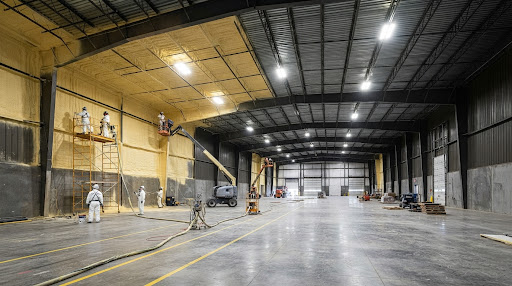
Almost every commercial insulation job we do in Merced County happens inside a building that can't stop working, so the logistics are half the craft. Foam application needs controlled conditions and clear zones — so we phase: rack aisle by rack aisle in a warehouse, bay by bay in a shop, nights and weekends where daytime operations can't share the space. Containment and masking protect equipment, product, and finished surfaces from overspray; ventilation is planned per zone; and re-occupancy timing for sprayed areas follows the material manufacturer's cure guidance, communicated up front so your team can plan shifts around it. Forklift traffic, sprinkler clearances, lighting, and dock schedules all get walked and mapped during the assessment visit, not discovered on day one. This is another place where twenty years of Valley ag and industrial work shows: our crews have foamed around processing lines, live cold rooms, and harvest-season storage without stopping any of them, and the work plan that makes it possible is written into the bid you approve before we mobilize.
First, assessment: we walk the building, measure, check existing conditions (including any old wet batt insulation that should come out), talk through your operation's constraints, and deliver a written, itemized bid within 48 hours — free. Second, preparation: masking and containment around equipment, racking, lighting, and openings; surface prep on the substrate; ventilation planned for the application window. Third, application: our rig sprays closed-cell foam to the specified thickness in controlled passes, with depth checks as we go — thickness is measured, not estimated. Fourth, where the spec calls for it, an ignition-barrier or thermal-barrier coating goes over the foam to meet code for the space's use and occupancy — a detail some low-bid outfits skip and inspectors don't. Fifth, closeout: documentation of thickness, coverage, and materials for your building file, useful at inspection, sale, and insurance time. Most metal-building and warehouse jobs run days, not weeks, and zoned scheduling keeps your operation running while we work overhead.
Merced is in the middle of a building-reuse wave, and insulation is where most of those projects succeed or stall. UC Merced's growth keeps pulling new employers, labs-adjacent suppliers, and service businesses into town, and many of them land in existing shells — older tilt-ups, downtown masonry buildings, metal flex space — that were never insulated for modern occupancy. At Castle Commerce Center, tenants keep converting Air Force-era square footage into manufacturing, logistics, and aviation-services space, and the gap between "leased it" and "can actually condition it" is almost always the envelope. Closed-cell foam is the retrofit tool built for exactly this: it goes into buildings as they stand — around existing structure, conduit, and odd geometries — delivers code-relevant R-value in inches of depth, and air-seals shells that were built loose in an era of cheap electricity. If you're budgeting a fit-out anywhere in the county, get the envelope assessed before the HVAC is designed; right-sizing mechanical equipment against a foamed shell is one of the few places in construction where spending on one line item genuinely shrinks another. We coordinate with your GC or design-builder and deliver our scope on their schedule.
Owners buy foam for the energy math and then discover the second dividend: the building is simply better to be in. Closed-cell foam adhered to metal panels damps the drum: rain stops sounding like applause, wind stops rattling the skin, and the forklift echo in a big open box noticeably softens. Radiant heat off the roof deck — the reason crews wilt on a warehouse floor in August even with fans running — drops the day the foam goes on. Dust infiltration through panel laps falls with the air sealing, which product-sensitive operations notice within the first harvest season. None of this shows up on a Title 24 form, but it shows up in retention, in summer productivity, and in what a tenant is willing to pay per square foot. In a market where Merced's industrial and flex space is competing for tenants who have options up and down the 99, a sealed, insulated, quiet building is a leasing advantage that outlasts any concession.
What do Merced owners actually feel after foaming a working building? Summer first: interior peak temperatures in un-conditioned metal buildings drop hard once the radiant path is broken — shops that were unusable by 10 a.m. stay workable through the afternoon, and conditioned buildings watch rooftop units cycle instead of running flat-out from June to September. Winter: the building holds heat, the morning drip from the roof steel is gone, and humidity-sensitive inventory stops sweating. Year-round: HVAC equipment sized for a sealed envelope runs less, lasts longer, and — on new installs — can often be specified smaller, an avoided capital cost that quietly pays for a chunk of the foam. For refrigerated operators, compressor runtime falls and product-temperature stability improves, which shows up in both the utility bill and the QA log. We don't promise percentages — no honest contractor prices your savings without knowing your loads — but the direction is one-way, and the owners who feel it most are the ones under the biggest, barest roofs. Ask the operators of any foamed building at Castle or along 99 what July feels like now; better, ask us to assess yours before the next one.
A last point that saves Merced owners real money: we work both sides of your roof deck. Interior closed-cell foam solves condensation, comfort, and energy; an exterior SPF roof installation solves waterproofing and adds insulation from above; and many buildings need one now and the other eventually. Because Allstate does both — and has for twenty-plus years under one license and one family name — the assessment weighs the building as a system: if your metal roof is both leaking and dripping condensation, we'll tell you whether foam-over-the-top, foam-underneath, or a sequenced combination serves the building best, with each path priced in writing. Contractors who only do one half of that equation recommend the half they sell. Call (559) 739-9519, get on this week's north-Valley run, and get an insulation answer built for your building — not for our truck.
Also serving Merced: Spray Foam Roofing in Merced · Silicone Roof Coating in Merced · Foam Roof Repair in Merced. See all Merced services on the Merced service hub, or read our full commercial insulation guide. Nearby: Commercial Insulation in Bakersfield · Commercial Insulation in Madera.
Fiberglass in a Valley metal building absorbs the condensation the building already makes, mats down, and quietly stops insulating. Closed-cell foam delivers about R-6.5 per inch, air-seals the panel laps as it's applied, keeps the steel above dew point so condensation never forms, and stiffens the building — we've pulled tons of failed batts out of ag buildings and replaced them with foam.
Yes — that drip is condensation, not a leak, and it's the classic Merced County fog-morning complaint. Two inches of closed-cell foam on the underside keeps the metal skin above dew point so moisture never condenses in the first place, which protects equipment, inventory, and the building's own steel from the inside out.
We do, and we plan those jobs around sanitation windows and production calendars with your plant manager. Refrigerated envelopes typically get 4 to 6 inches or more of closed-cell foam, with vapor detailing that prevents the ice buildup under-detailed cold rooms suffer — in refrigerated space, every point of R-value shows up on the compressor runtime.
That's how most of our Merced County jobs run. We phase the work zone by zone — aisle by aisle, bay by bay, nights and weekends where needed — with containment and masking around racking and equipment, and re-occupancy timing for each sprayed zone communicated up front so your shifts can plan around it.
Foam plastic insulation generally requires a code-approved thermal or ignition barrier, and in many commercial occupancies an intumescent coating over the foam is the compliant path. We spec the barrier per your building's occupancy, include it in the written bid, and pull the permit — a low bid that omits it isn't cheaper, it's just incomplete.
No — commercial and agricultural buildings are our lane: metal buildings, warehouses, distribution, cold storage, processing plants, shops, and ag structures. Keeping the rigs where they've spent twenty-plus years is part of why the commercial work is as good as it is.
Free assessment — drone survey, core sampling where needed, and a written bid within 48 hours, anywhere in Merced County.
Or Call Directly
(559) 739-9519