Closed-cell spray foam for Madera County's metal buildings, warehouses, wineries, and cold storage — real R-value against 100°F summers and condensation control for tule fog winters.
Commercial spray foam insulation solves the problem most Madera buildings were born with: they were built to hold equipment, product, and crop — not to hold a temperature. The county's metal shops, warehouses, hullers, packing sheds, winery buildings, and cold-storage boxes overwhelmingly went up as bare or minimally insulated shells, and in Climate Zone 13 that bill comes due twice a year. Summer drives interior temperatures brutal enough to punish workers, equipment, and stored product; winter's tule fog turns every cold metal panel into a condensation machine that literally rains on whatever's below. Closed-cell spray polyurethane foam — applied to roof decks, metal panels, and walls at roughly R-6.5 per inch — fixes both at once, and it's the commercial insulation work we've been doing across the Valley for more than twenty years. To be clear about our lane: we insulate commercial, agricultural, and industrial buildings. We don't do residential work — if you need a house insulated, we're not your contractor, and we'll say so on the phone.
The typical call sounds like one of these: a shop between Madera and Chowchilla that's unusable by 2 p.m. in July; a huller whose product bins get dripped on every foggy morning; a winery adding barrel capacity in a metal building that swings thirty degrees a day; a warehouse operator whose new lease requires conditioned space the shell was never built to hold; a cold-storage box whose compressors run flat-out because the envelope leaks. Different symptoms, same underlying condition — an uninsulated or badly insulated envelope — and in this climate, the same class of fix. What varies is thickness, surface, and sequencing, and that's what the free assessment establishes building by building.
Closed-cell SPF is the highest-performing insulation you can put in a commercial building, and in a metal building it's arguably the only one that fully works. Its R-6.5 per inch leads every common alternative, so it delivers code-level performance in inches where batt systems need feet. It adheres directly to steel panels and purlins, conforming to every rib and lap with no gaps, no sag, and no fastener penetrations — compare that with vinyl-faced metal-building blanket, which crushes to near-zero R-value at every purlin it crosses and tears at every point a forklift or a repair ever touches it. Closed-cell foam is also a Class II vapor retarder and an air barrier in one material, which is what actually stops fog-season condensation (more below). And it adds rigidity: foam bonded across panels stiffens the whole diaphragm, quieting rattle and oil-canning in wind. Open-cell foam, at roughly half the R-value per inch and vapor-open, has interior uses but is the wrong tool against metal skin in this climate; closed-cell is what we spec for Madera's building stock.
The air-sealing half of foam's performance deserves emphasis, because R-value alone understates it. A metal building leaks air at every panel lap, fastener, eave, and trim line — and in a 100°F afternoon, every cubic foot of conditioned air that escapes gets replaced by furnace-hot outside air your cooling has to process. Foam applied across the interior surface closes those paths as it insulates, which is why foamed buildings routinely outperform what their nominal R-value alone would predict. There are side benefits owners notice immediately: the building gets quieter — rain on a foamed metal roof drops from a drum to a murmur, worth real money in occupied shops and tasting-adjacent spaces — and the stiffened panels stop rattling in wind.
Ask anyone who runs a metal building between Madera and Chowchilla what January is like inside, and you'll hear about the drip. The physics is simple: fog-season air is saturated, nights are cold, and an uninsulated steel panel sits at outdoor temperature. Warm, moist interior air — from propane heaters, equipment, stored crop respiration, or just people working — touches that cold steel and condenses instantly. The result is water dripping from every purlin line onto equipment, hay, packaged nuts, cased wine, stored machinery. Rust follows on the building; mold and spoilage follow on the contents. Closed-cell foam ends it by breaking the thermal path: with even an inch or two bonded to the panel, the surface the interior air touches is warm foam, not cold steel, and it never reaches dew point. Because the foam is its own vapor retarder and air barrier, humid air can't sneak behind it to find cold metal either — the failure mode that dooms blanket-and-liner retrofits. Condensation control alone justifies foam in a large share of the ag buildings we insulate in Madera County.
Think about what's actually under the drip line in these buildings: harvested nuts waiting on processing, baled hay, sacked feed, wine cases, tractors and implements whose electronics and seats don't love water, welders and machine tools that rust where drops land. Chronic condensation also attacks the building itself — rust blooms along every purlin and fastener the drips track over, and the floor slab stays wet enough to grow slick algae in winter. Owners tend to call us about the product damage; they end up equally glad about what the foam does for the building's own service life.
Chowchilla's ag belt is a condensation case study all by itself. The corridor's dairy-support buildings, commodity barns, and processing structures combine high interior humidity sources with big uninsulated steel envelopes — the exact recipe for winter drip — and the flat, open country between the 99 and CA-233 gets some of the county's densest fog. Foam applications there follow the same pattern as everywhere else: panels prepped, closed-cell foam bonded across roof and wall steel, and the dew-point problem ends at the panel face. The same physics serves the well houses, pump buildings, and shop structures scattered down every avenue west of Madera along CA-145 — small buildings individually, but ones whose contents (pumps, controls, tools, chemicals) punch above their square footage in replacement cost when condensation gets to them.
Madera's wine industry gives insulation work here a specific character. The AVA's wineries run barrel rooms, case-goods storage, tank rooms, and crush facilities where temperature stability is a quality variable, not just a utility line item. Wine in barrel wants steady conditions; every degree of daily swing works the wine and the cooperage. Tank rooms carry process cooling whose runtime tracks the building envelope directly. Closed-cell foam on the roof deck and walls of these buildings flattens the daily temperature curve dramatically — the difference between a metal-skinned barrel barn that tracks the outdoor swing from 105°F afternoons to 65°F nights and one that drifts a few degrees around its setpoint. The same performance serves food-grade processors and cold-chain operators: hullers and processors protecting product condition, refrigerated and freezer storage where every point of R-value is compressor runtime you stop paying for. Foam's seamless application also suits washdown-adjacent spaces — no fibrous insulation to shed, sag, or harbor moisture above a sanitation zone, and interior applications can be finished with coatings where a cleanable surface is required.
The economics land in the refrigeration line item. Cooling equipment sized to fight an uninsulated envelope runs longer, cycles harder, and dies younger; the same load behind a foamed envelope runs a fraction of the duty cycle. For a barrel room or cold box, that's three payoffs from one installation — lower energy cost, longer equipment life, and a building that holds its setpoint through a summer afternoon power hiccup instead of losing it in minutes. In a region where the wine industry's margins live and die on energy and quality, envelope work is quietly one of the highest-return investments a production facility can make.
Madera's industrial base is expanding as logistics spillover from Fresno pushes north up the 99 — the Madera Industrial Park, the Avenue 12 and Avenue 17 corridors, and new light-industrial development around the city are adding and re-purposing big-box space steadily. For warehouse operators, insulation math is simple and large: an uninsulated or under-insulated roof deck over hundreds of thousands of cubic feet means conditioning costs that scale with every 100°F+ day, and worker-comfort problems that OSHA heat rules have made harder to ignore. Spray foam applied to the underside of the roof deck — or as a spray polyurethane foam roofing system on top, insulating and waterproofing in one move — brings these shells up to modern performance without reconstruction. Title 24 matters here too: California's energy code sets real insulation and envelope requirements when buildings are altered, expanded, or newly conditioned, and foam's per-inch efficiency is often the most practical path to compliance in a retrofit where framing depth is fixed.
Worker heat is the other half of the warehouse case. California's indoor heat-illness standard puts real obligations on employers when indoor temperatures climb, and an uninsulated metal-deck roof over a work floor practically guarantees they will. Insulating the deck drops radiant load on the people below it — the difference between a floor that's brutal by noon and one that's workable through a shift. We also zone the work sensibly: dock areas, office build-outs, and mezzanines each get spec'd for what they are, rather than one thickness blanket-applied where it isn't needed.
The assessment itself is straightforward and free: we walk the building, measure areas and existing conditions, check what insulation (if any) is present and what state it's in, identify the humidity sources and the surfaces where condensation is actually forming, and talk through what the building needs to do — target temperatures, conditioned zones, storage requirements, expansion plans. From that we spec surface-by-surface thickness and coatings and put the whole scope in a written bid within 48 hours. Owners are sometimes surprised how targeted the recommendation is; not every square foot of a building earns foam, and a spec that concentrates R-value where the loads actually are beats a uniform blanket on both performance and price.
| Property | Closed-Cell SPF | Fiberglass Batt / Blanket | Rigid Board (Poly-iso) |
|---|---|---|---|
| R-value per inch | ~R-6.5 | ~R-3.0–3.7 (less when compressed) | ~R-5.6–6.0 |
| Air barrier | Yes — monolithic | No | Only if joints sealed perfectly |
| Vapor retarder | Yes (Class II at 1.5"+) | Facing only, tears easily | Facer-dependent |
| Fits metal-building geometry | Conforms to ribs, laps, purlins | Compressed at every purlin | Poor — flat stock on ribbed panels |
| Condensation control on steel | Excellent — bonds to panel | Poor — air reaches cold metal | Fair — gaps defeat it |
| Adds structural rigidity | Yes | No | No |
| Installed cost | Highest upfront | Lowest upfront | Middle |
The pattern: fiberglass is cheap to install and routinely fails to perform in metal buildings; rigid board performs on paper and leaks air at every joint in practice; closed-cell foam costs more per inch and is the only one of the three that delivers its rated performance on a ribbed steel panel in a foggy Valley winter. We'd rather you spend once.
Durability compounds the comparison over time. Fiberglass in an ag building sags, slips its pins, soaks up washdown humidity, tears at every forklift graze, and gives birds and rodents nesting material — walk any twenty-year-old metal building with blanket insulation and you'll see it hanging in sheets. Cured closed-cell foam is a rigid, bonded part of the building: nothing to sag, nothing to harbor pests, nothing to reinstall after a decade. The upfront premium buys an assembly that's still performing when the cheap alternative has been replaced once and is failing again.
Interior commercial foam work is priced per square foot at a given thickness, and honest context beats a teaser number. Closed-cell spray foam insulation generally runs in the low single dollars per square foot per inch of thickness for commercial-scale work, with total cost driven by area, specified R-value, surface prep (rust, dust, and oils must be addressed for adhesion), access and lift requirements, masking scope, and whether an ignition-barrier or thermal-barrier coating is required over the foam for code in the space. A large open warehouse deck prices efficiently; a working winery with equipment to protect and zones to sequence takes more labor per square foot. Every job gets the same process: free on-site assessment, and a written bid within 48 hours with thickness, R-value, coatings, and prep spelled out. If the roof itself is also at end of life, ask us to price the rooftop-SPF alternative at the same time — the combined roof-plus-insulation economics, covered in our cost guide, frequently beat doing the two jobs separately.
On the fire-code point, here's the plain-language version: building codes generally require spray foam in occupied interiors to be separated from the space by a thermal barrier (like drywall) or, in specific occupancies such as many storage and ag buildings, protected with an approved ignition-barrier coating applied over the foam. Which one applies depends on the building's use and the authority having jurisdiction. We spec it into the bid from the start because the alternative — bare foam that fails a fire marshal's walk-through or an insurance inspection later — turns a finished job back into an open project. It's a line item, not a surprise, on every quote we write.
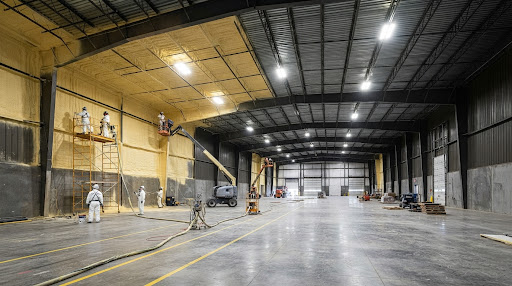
Madera building owners often don't realize they have two spray foam paths to an insulated building. Interior application — foam sprayed to the underside of the roof deck and to wall panels — is the classic insulation retrofit, right when the roof surface itself is sound. Rooftop application — SPF installed over the existing roof as a roofing system — insulates and waterproofs simultaneously, and it's usually the smarter buy when the roof is within a few years of needing work anyway, since $4–$8 per square foot delivers a new seamless roof and R-6.5 per inch in one project. The rooftop system's longevity story — a renewable topcoat on a 10–20-year recoat cycle instead of tear-off — is laid out in how long spray foam roofing lasts. Our assessment looks at both and gives you both numbers when both make sense; the building's condition, not our preference, picks the winner.
A common Madera hybrid: a processing site where the main warehouse gets rooftop SPF because its roof was due anyway, while the attached cooler and office areas get interior foam because their roofs are newer. Or a winery that foams the barrel building's walls and roof deck this year and schedules the tank room's rooftop system for after next crush. Because one contractor and one material family handle both scopes, the phasing flexes with your budget and calendar instead of forcing an all-at-once decision.
Commercial insulation work in an operating facility is a logistics job as much as a spray job, and twenty-plus years of Valley ag and industrial sites have taught us to plan it that way. We mask and shield equipment, racking, and product zones; we sequence work bay by bay so your operation keeps moving; we ventilate per SPFA practice and keep re-entry timing clear so there's no ambiguity about when spaces are back in service; and on food-grade and winery sites we coordinate with your sanitation and QA requirements before the rig shows up. Where code requires an ignition or thermal barrier over interior foam, we include and apply it — an unprotected-foam shortcut is the kind of thing that surfaces at your next fire inspection, and we don't take it. Most metal-building and warehouse projects run days, not weeks.
Surface preparation is the unglamorous foundation of the whole job, so we're explicit about it. Foam's performance depends on adhesion, and adhesion depends on the substrate: metal panels get cleaned of dust, oils, and loose rust — no small matter in ag buildings that have collected years of harvest-season grime — and problem corrosion gets treated before any foam flies. Existing failed insulation comes down first where present; foaming over hanging blanket is the kind of shortcut that shows up in every bad spray-foam story, and we don't do it. The bid spells out prep scope alongside thickness and coatings, so you're comparing complete jobs, not just prices.
What the work looks like on the ground: the crew arrives with a rig-mounted proportioner and heated hose, masks and shields whatever stays in the work zone, and sprays in controlled passes that build thickness in lifts — foam expands and cures in seconds, so progress is visible in real time and a big open deck moves fast. Fresh foam is trimmed and inspected as the work advances, thickness gets verified against spec, and any code-required ignition or thermal barrier coating follows once the foam has cured. Ventilation runs throughout, re-entry timing is communicated zone by zone, and the site gets left clean — overspray control is planning, not apology, and it's part of every job briefing before the first pass goes on steel.
From our Tulare County shop, Madera is about sixty minutes north on CA-99 — routine territory, along with Chowchilla's dairy-support and processing buildings, the west-side ranch shops off CA-145, and the CA-41 foothill corridor through Coarsegold up to Oakhurst. The foothill towns flip the insulation problem seasonally: gateway-to-Yosemite businesses and shop buildings at elevation see real winter cold along with summer heat, and closed-cell foam serves both directions of that swing. Wherever the building is, the process is the same: free assessment, core data and measurements where needed, and a written bid within 48 hours from a family-owned contractor — license #C-2-1052735, BBB Accredited, SPFA member. Call (559) 739-9519 and tell us what the building does; we'll insulate it for that job. Whether that's a huller fighting condensation, a winery chasing temperature stability, a warehouse chasing Title 24 compliance, or a shop that's simply unbearable by afternoon, the fix starts with the same free visit — and ends with a building that finally works the way its operation needs it to.
Also serving Madera: Spray Foam Roofing in Madera · Silicone Roof Coating in Madera · Foam Roof Repair in Madera. See all Madera services on the Madera service hub, or read our full commercial insulation guide. Nearby: Commercial Insulation in Merced · Commercial Insulation in Hanford.
No — commercial, agricultural, and industrial buildings only. Metal shops, warehouses, wineries, processing plants, and cold storage are our lane. If you call about a house we'll tell you straight and save you the site visit; for a commercial building anywhere in Madera County, the assessment is free.
Yes — this is one of the most common reasons Madera ag buildings call us. Closed-cell foam bonded to the panels keeps the interior surface warm enough that fog-season air can never reach dew point on it, and because the foam is its own air and vapor barrier, humid air can't get behind it to find cold steel. The drip stops.
Climate Zone 13's heat drives the answer, and Title 24 sets minimums when a building is altered or newly conditioned. Closed-cell foam delivers about R-6.5 per inch, so typical roof-deck applications of two to three inches land in the R-13 to R-20 range. We specify exact thickness in your written bid based on the building, its use, and applicable code.
In a metal building, usually yes — and often it's the only option that actually performs. Metal-building blanket compresses to near-zero R-value at every purlin and tears easily, and fiberglass does nothing to stop air from reaching cold panels, so condensation continues. Closed-cell foam conforms to the panel geometry, air-seals, vapor-retards, and stiffens the structure in one application.
In most cases yes. We sequence work zone by zone, mask and protect tanks, barrels, and equipment, ventilate per SPFA practice with clear re-entry timing, and coordinate scheduling around crush, bottling, and sanitation requirements. Madera-area wineries and food facilities are a regular part of our work, and the planning happens before the spray rig arrives.
It depends on the roof's condition. If the roof surface is sound, interior foam under the deck is the straightforward retrofit. If the roof is also near end of life, rooftop SPF at $4–$8 per square foot waterproofs and insulates in one project and is often the better total spend. Our free assessment prices both paths when both apply.
Free assessment — drone survey, core sampling where needed, and a written bid within 48 hours, anywhere in Madera County.
Or Call Directly
(559) 739-9519