100% silicone restoration for flat, foam, and metal roofs across Madera County — a seamless, reflective, ponding-proof surface at a fraction of replacement cost.
Silicone roof coating gives Madera building owners a way to renew an aging flat, foam, or metal roof for $2–$4 per square foot instead of paying replacement money for a tear-off. A high-solids 100% silicone system is applied as a fluid over your existing roof, cures into a seamless white membrane, and resets the roof's weathering surface for another decade or two. For the wineries along the 99 corridor, the processors and warehouses in the Madera Industrial Park, the metal buildings out the county avenues, and the commercial stock up CA-41 in Oakhurst, coating is very often the smartest roof money available — provided the roof underneath still qualifies, which is exactly what our free drone survey and core sampling determine before we quote anything.
Allstate Spray Foam Roofing has been coating and restoring Valley roofs for more than twenty years. We're family-owned, California-licensed (#C-2-1052735), BBB Accredited, and SPFA members, and our crews reach Madera in about an hour up Highway 99 from our Tulare County shop.
The owners who call us about coatings usually arrive by one of three roads. Some have a roof that's leaking at the details — seams, flashings, fasteners — but is fundamentally sound, and they've just received a tear-off bid that made their eyes water. Some have a spray foam roof approaching the end of its topcoat cycle and know (or are about to learn) that a recoat is normal scheduled maintenance, not a failure. And some are simply fighting summer heat: a dark roof over a warehouse, shop, or wine-storage building that's driving cooling costs they can see on every bill. Silicone restoration answers all three, and the free assessment sorts out which story your roof is telling — along with the occasional fourth story, the roof that genuinely is past saving, which we'll tell you straight rather than coat and hope.
Not all roof coatings behave alike, and the difference matters enormously on Valley flat roofs. Silicone is moisture-cure and hydrophobic: it can sit under standing water indefinitely without softening, re-emulsifying, or losing adhesion. Acrylic coatings — the cheaper alternative you'll see quoted — are water-based, and ponded water does to them roughly what it does to latex paint. On a dead-flat Madera warehouse roof where water lingers for days after a winter storm or sits under weeks of tule fog, that distinction decides whether the coating lasts twenty years or fails in three.
Silicone also holds its properties under UV better than any competing chemistry. Madera's solar exposure is severe — the same sun that ripens the AVA's grapes chalks and embrittles lesser coatings. Silicone weathers by very slowly chalking at the surface while staying flexible and adhered, which is why the recoat cycle runs 10–20 years rather than 5–10. The tradeoff is that once a roof is siliconed, future recoats must also be silicone — nothing else sticks to it reliably — which is a one-time decision, not a real drawback, since silicone-over-silicone recoats are the simplest job in roofing.
Formulation quality separates good silicone jobs from cheap ones. We install high-solids silicone — the percentage of the bucket that stays on the roof as cured membrane rather than evaporating as solvent — and we build the system to a specified dry-mil thickness, verified during application, not to a vague "two coats" promise. Thickness is the coating's fuel tank: a system applied at proper mils has reserve to weather sacrificially for 15–20 years, while a thin, fast-cheap application can chalk through in five. When you compare bids in Madera, ask every contractor two questions — what solids content, and what finished dry-mil thickness — and watch how quickly the low bid explains itself.
Coating restores a roof; it doesn't resurrect one. The existing roof must be fundamentally sound, dry, and well-adhered. Good candidates across Madera County include: spray foam roofs due for their scheduled recoat; metal roofs with sound panels but leaking fasteners and laps; single-ply (TPO/EPDM) that's aged but not saturated; and built-up or mod-bit roofs with weathered surfaces but dry insulation. Poor candidates: roofs with widespread saturated insulation (coating traps the moisture), membranes that have lost adhesion, or decks with structural problems. This is why we core-sample before quoting — a coating over wet insulation is money thrown away, and we won't sell it. When cores show saturation, the honest fix is targeted removal and repair first, or a move to a full spray polyurethane foam roofing system where the roof warrants it.
Each substrate gets its own preparation logic. Aged TPO and other single-ply membranes need adhesion-critical cleaning and the right primer, plus reinforcement of every seam with coating and fabric before the field coat — seams are where single-ply failed, so seams get the extra layer. Built-up and modified-bitumen roofs need bleed-blocking primer so asphalt oils don't stain and undercut the silicone, with alligatored areas addressed first. Metal gets rust conversion and fastener-by-fastener detail work. Existing foam roofs are the simplest case: clean, repair, recoat. None of this is exotic — it's just the unglamorous majority of the job, and it's where corner-cutting contractors save the money that later costs you the roof.
We also verify moisture before we commit. Drone imagery flags suspect areas — discoloration, sagging, chronic ponds — and core samples confirm what's actually inside the assembly. On larger Madera roofs where the stakes justify it, that survey work is the difference between restoring a roof for $2–$4 per square foot and unknowingly sealing a wet sponge under a beautiful white membrane. No coating contractor who skips this step is doing you a favor with their lower bid.
The timing question — coat now or wait — has a consistent answer: earlier is cheaper. A roof coated while it's merely weathered needs cleaning, detail work, and silicone. The same roof three years later needs all of that plus wet-material removal, more repairs, and sometimes it has slipped out of coating candidacy entirely, turning a $2–$4 per square foot restoration into a $4–$8 replacement. Madera's climate compresses that window because the UV load is relentless and the winter wet season stress-tests every weakness annually. If your roof is fifteen-plus years old, chalking heavily, or collecting more maintenance calls each winter than the last, the assessment is worth doing this season — it's free either way, and knowing where the roof sits in its life is worth something even if you budget the work for next year.
We'd rather you hear the tradeoffs from us than discover them later. The honest ledger:
Weighing that ledger for a typical Madera building: the cons are manageable with competent installation — granulated walkways solve the slip issue, disciplined prep solves adhesion, and the silicone-only recoat commitment is a feature once you understand the renewal cycle. The one con that genuinely disqualifies buildings is the last one: if your building's real problem is missing insulation — a metal shop that's an oven in July, a barrel room that can't hold temperature — a coating will brighten the roof and stop the leaks but won't move the thermometer much. That building wants spray foam, either on the roof or under the deck, and we'll tell you so during the assessment rather than sell you the wrong fix. The right tool for the right roof is the entire discipline here.
Silicone restoration in the Madera area typically prices at $2–$4 per square foot installed. The drivers: how much cleaning and prep the existing surface needs, how much repair work (wet-area removal, seam reinforcement, fastener treatment) comes first, specified coating thickness in dry mils, roof access, and detail density — a winery roof crowded with vents, curbs, and piping takes more labor per square than an open warehouse. Compare that against $4–$8 per square foot for a new SPF system or the still-higher cost of tear-off and single-ply replacement, and the appeal is obvious wherever the existing roof qualifies. Our cost guide breaks down how coating economics compare with full roof systems over a 20-year horizon.
| Coating Chemistry | Ponding Water | UV Durability | Typical Recoat Cycle | Best Use in Madera |
|---|---|---|---|---|
| 100% Silicone | Immune — hydrophobic | Excellent | 10–20 years | Flat/low-slope, foam roofs, ponding-prone, metal |
| Acrylic | Poor — re-emulsifies | Good, chalks faster | 5–10 years | Sloped metal with positive drainage only |
| Urethane | Fair | Good; often needs topcoat | 8–12 years | High-traffic/impact areas, base coat duty |
If your building already has an SPF roof, silicone recoating is not an option — it's the maintenance the system is designed around. The foam itself doesn't weather; the topcoat does, sacrificially, under the Valley sun. On the standard cycle you recoat every 10–20 years: we clean the surface, repair any foam damage or blisters found in inspection, and spray fresh silicone to specification. The roof's clock resets, and the foam underneath — with its full R-6.5 per inch still working — never needs replacement. Madera-area foam roofs that have kept this schedule are running strong after three and four decades; the lifecycle evidence is laid out in how long does spray foam roofing last. If your foam roof's coating is chalking heavily, showing exposed yellow-brown foam, or pinholing, don't wait — coating a weathered-but-intact foam roof costs $2–$4 per square foot, while letting UV eat into the foam itself adds repair scope.
What a recoat visit actually includes: a full inspection of the foam surface with any blisters, gouges, or bird-pecked spots repaired to sound foam; cleaning to bare, sound coating; then fresh silicone sprayed to specification across the field and worked by hand into every penetration detail. Most Madera-sized foam roofs recoat in a few days. The building never opens to the sky, nothing gets torn off, and the finished roof carries the same industry-leading leak-proof guarantees as a new system. If you inherited a foam roof with an unknown history — common when buildings change hands along the 99 corridor — start with the free assessment and we'll tell you where it sits in its lifecycle and what the honest next step is.
Madera County's metal buildings — equipment shops, barns, hullers, tank rooms, commodity sheds from Chowchilla to the foothills — are prime coating candidates once fastener leaks start. A silicone metal-roof system starts with prep: wash-down, rust treatment, then detail work where the leaks actually originate: every fastener head gets brushed sealant or a purpose-made cap, every panel lap and ridge gets reinforced, penetrations get flashed with coating and fabric. Then the full-field silicone coat goes on, tying the details into one membrane. The white surface also drops summer panel temperatures sharply — on an uninsulated shop that's an immediate comfort difference, and on a winery tank room it trims the load on process cooling. One honest caveat: coating does not insulate. If your metal building also drips condensation during fog season or bakes in summer, the better answer is often foam over the panels — see our spray foam vs TPO comparison for how the full-system options stack up on metal buildings.
Chowchilla deserves a specific mention here, because its building stock is so heavily metal: processing and dairy-support structures, equipment barns, and highway-commercial buildings along the 99 and CA-233 where fastener leaks are less an exception than a schedule. Edge details matter as much as the field on these buildings — gutters, eave trim, ridge caps, and translucent skylight panels are chronic leak sources that a drive-by bid ignores and a proper scope addresses. Our metal-roof coating scope itemizes those details line by line, so you can see exactly what's being sealed and compare bids on substance instead of on a single mystery number.
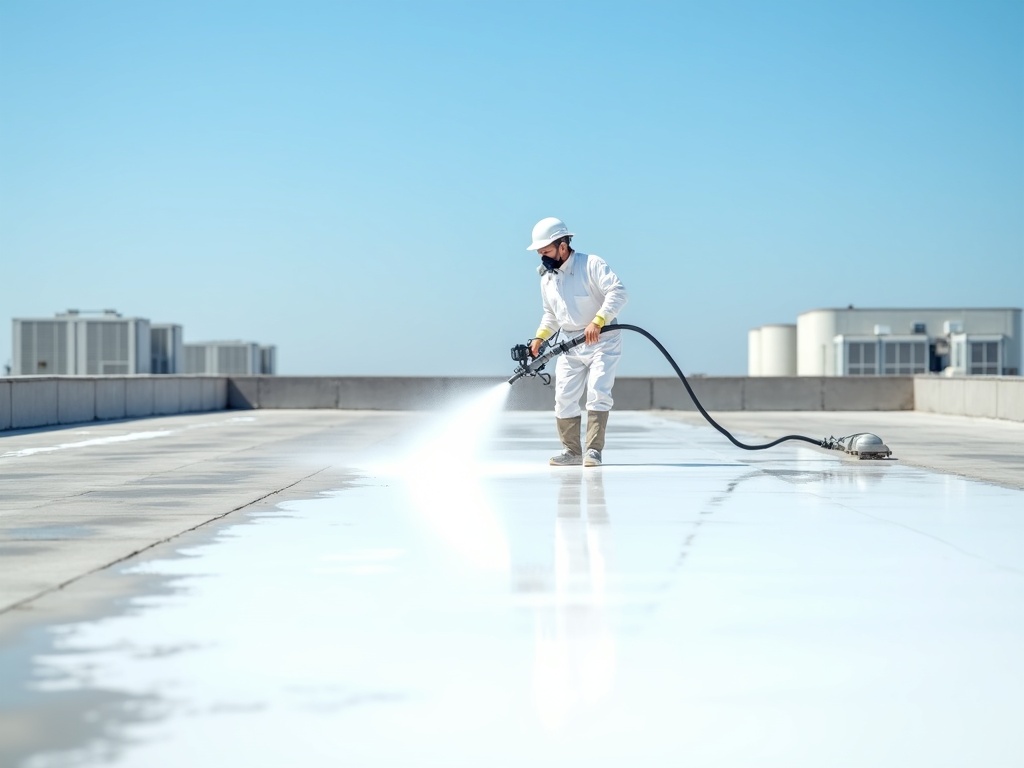
Much of Madera's commercial stock was built dead-flat or near it, and decades of settling, added equipment, and clogged drains leave shallow ponds standing on many roofs after every storm. Winter makes it worse: rain arrives in Pacific systems, then tule fog keeps evaporation near zero for days, so water that would flash off a summer roof in hours sits for a week in January. Ponded water accelerates every failure mode a roof has — it magnifies UV, breeds algae and debris dams, overloads structure, and probes relentlessly at seams. Silicone is the only coating chemistry rated to sit under that water indefinitely. During our assessment we map ponding zones from drone imagery, and where practical we correct the worst of them — building drainage crickets from foam, clearing and adding drains — before coating, so the restoration fixes causes as well as symptoms.
Madera's winter weather pattern makes drainage discipline doubly important: Pacific storms arrive in clusters, and between them the fog keeps roofs wet and drains working. A drain that's marginal in October is a rooftop pond by January. Part of every coating project — and every maintenance program we run afterward — is simple drain hygiene: bowls cleared, strainers replaced, overflow paths verified. It's unglamorous work that prevents a remarkable share of the "sudden" winter leaks we get called about across the county.
Every coating project in Madera starts with the free assessment: full drone survey, core samples where the roof's moisture condition is uncertain, and a written bid within 48 hours. The work itself runs: power-wash and cleaning; repairs — saturated material removed and replaced, seams and splits reinforced, fasteners treated; primer where the substrate chemistry requires it; then silicone applied to specified mil thickness, with granules broadcast into walkways and service paths. Coating work is quiet and low-disruption: no tear-off debris, no dumpsters, minimal odor, and your operation keeps running underneath. For working wineries and food facilities we sequence around production schedules and sanitation zones — we've done this around crush season before, and planning beats apology.
Timeline and follow-through: most restoration projects in the Madera area run from a few days to a week or two on the roof depending on size, prep scope, and weather windows — coatings need dry surfaces and workable temperatures, so we schedule honestly around the Valley's fog season rather than spraying into conditions that compromise cure. When the work is done you get documentation of what was installed and at what thickness, the industry-leading leak-proof guarantees we back our systems with, and a straightforward maintenance path: periodic inspections, drain hygiene, and prompt touch-up of any mechanical damage. A coated roof that gets that minimal attention reliably reaches the far end of its 10–20-year cycle; a neglected one gets there slower. Either way, the next step at end of cycle is another recoat — not a tear-off — which is the whole economic point of choosing silicone in the first place. The lifecycle arithmetic is laid out in how long spray foam roofing lasts.
From our Tulare County shop it's about sixty minutes up the 99 to Madera, with Chowchilla a short hop further and the CA-41 foothill towns — Coarsegold and Oakhurst — within routine range. Foothill roofs get the same silicone logic with a twist: elevation brings colder winters and occasional snow on low-slope sections, and silicone's flexibility through freeze-thaw cycling outperforms brittle aged membranes. Gateway-corridor businesses in Oakhurst — lodges, restaurants, retail serving Yosemite traffic — also benefit from restoration's speed: days on the roof, not weeks, matters when your parking lot is your revenue.
On the Valley floor, the 145 corridor west of Madera and the avenues between the city and the river carry the ranch shops, hullers, and packing buildings where metal-roof coating work concentrates, while the Industrial Park and Avenue 12 host the flat commercial and warehouse roofs where silicone-over-membrane restoration dominates. Wherever the building sits, the assessment travels the same: drone up, cores where needed, written bid in 48 hours. Multi-building owners can bundle the survey — one drone day across a portfolio of roofs produces a ranked, budget-ready picture of which buildings need coating money this year, which need it in three, and which just need a drain cleared before the first storm.
The roof-coating market attracts overpromisers, so here's our standard: we tell you whether your roof qualifies based on cores and imagery, we tell you when coating is the wrong answer, and we put the price in writing within 48 hours. Family-owned for 20+ years, license #C-2-1052735, BBB Accredited, SPFA member, and industry-leading leak-proof guarantees on the systems we install. Call (559) 739-9519 for your free drone survey anywhere in Madera County.
Also serving Madera: Spray Foam Roofing in Madera · Foam Roof Repair in Madera · Commercial Insulation in Madera. See all Madera services on the Madera service hub, or read our full silicone roof coating guide. Nearby: Silicone Roof Coating in Merced · Silicone Roof Coating in Hanford.
Restoration with 100% silicone typically runs $2 to $4 per square foot in the Madera area, depending on prep, repairs, specified thickness, and detail complexity. That's roughly half the cost of a new roof system. We confirm your exact number with a written bid within 48 hours of our free drone survey.
Silicone is the only mainstream coating that withstands standing water indefinitely, so it's the right chemistry for Madera's dead-flat roofs and slow winter evaporation under tule fog. Where ponding is severe we also correct drainage — foam crickets, drain work — before coating, so the cause gets addressed, not just the symptom.
Yes. We treat every fastener and panel lap, reinforce ridges and penetrations, then apply the full silicone field coat over the prepped panels. It stops fastener leaks and cuts summer panel temperatures substantially. If the building also has condensation or insulation problems, we may recommend spray foam over the panels instead — the assessment tells us which.
Chalking is the topcoat doing its sacrificial job, but it means the roof is due for its scheduled recoat. Recoating intact foam costs $2–$4 per square foot; waiting until UV exposes and degrades the foam itself adds repair scope and cost. We'll confirm the coating's remaining life with an inspection and get you a bid in 48 hours.
Yes — reflectivity is one of silicone's biggest benefits in Climate Zone 13. A bright white surface reflects most solar load instead of absorbing it, which drops rooftop temperatures dramatically during 100°F+ stretches and reduces the heat driven into the building. On refrigerated and wine-storage buildings that translates directly into reduced cooling runtime.
We cover the full county, including the CA-41 corridor into the foothills. Silicone performs well at elevation — it stays flexible through freeze-thaw cycles and handles occasional snow on low-slope sections. Crews dispatch from our Tulare County shop, about an hour from Madera and a bit more into the hill country.
Free assessment — drone survey, core sampling where needed, and a written bid within 48 hours, anywhere in Madera County.
Or Call Directly
(559) 739-9519