Closed-cell spray foam for metal buildings, warehouses, cold storage, and processing facilities — from the insulation contractor that was founded in Visalia.
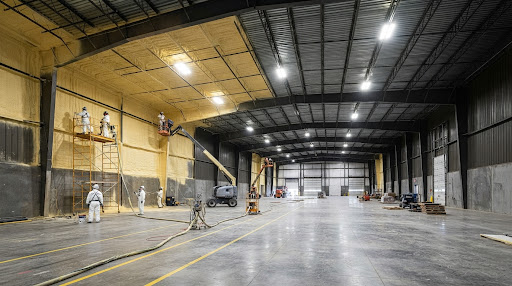
Commercial spray foam insulation in Visalia addresses a problem you can read on any summer utility bill in the Industrial Park: most of this city's working buildings were erected as bare steel boxes, and every July they become ovens that businesses pay dearly to cool. Closed-cell spray polyurethane foam — applied to roof decks, walls, and ceilings at roughly R-6.5 per inch — converts those boxes into insulated envelopes, usually in days, usually without stopping the operation inside. We have been doing this work from our shop minutes away in Tulare County for more than twenty years, and insulation is literally our founding trade: it is in the company name.
One scope note before anything else, because we believe in staying in our lane: our insulation work is commercial and agricultural buildings only — metal buildings, warehouses, cold storage, packing and processing facilities, shops, and similar structures. We do not do residential insulation. If you own a business building in Visalia, this page is for you.
Search for an insulation contractor in Visalia and the results skew two ways: residential outfits geared for attics and crawlspaces, and commercial installers dispatching from Fresno or beyond. We occupy the space between and above both — a commercial spray foam specialist whose founding shop sits minutes from the city, family-owned for twenty-plus years, licensed under CA #C-2-1052735, BBB accredited, and a member of the Spray Polyurethane Foam Alliance.
Locality matters in insulation for the same quiet reasons it matters in roofing. Foam application is weather- and condition-sensitive; substrate temperature and humidity affect adhesion and yield, so a contractor who can catch the right window on short notice delivers better foam than one locked into a route schedule. Mobilization costs on a crew that's already here are near zero, which is why our bids on Visalia work don't carry a travel premium. And when a building expands — a new bay, a mezzanine, a lean-to added over new pack lines — the contractor who insulated phase one is minutes away for phase two, with the records of exactly what was sprayed and at what thickness.
Closed-cell SPF is the densest and most capable of the spray insulation family, and it is what we install in commercial applications. Its cell structure — millions of sealed gas-filled bubbles — delivers roughly R-6.5 per inch, the highest practical R-value per inch of any mainstream insulation. Two inches yields about R-13; three inches about R-19.5, in a continuous, monolithic layer with no seams, no sagging, and no gaps around purlins, girts, or penetrations.
Continuity is the property spec sheets undersell. Fiberglass batts lose a large share of their rated performance to real-world installation — compression at framing, gaps at edges, slumping over years of vibration — and metal buildings amplify the loss because every purlin and girt is a thermal bridge conducting heat straight past the insulation. Sprayed foam bonds to the panel and wraps the framing, so the rated number and the installed number are essentially the same figure. Closed-cell foam is also an air barrier and a vapor retarder at typical thickness, and it adds measurable racking strength to metal panel assemblies — four functions from one application.
In Visalia's climate the payoff concentrates in summer. When it is 104°F outside, an uninsulated metal skin radiates heat into the building like an element; foam breaks that transfer, and interior temperatures in insulated shops routinely drop from brutal to workable even before mechanical cooling enters the picture. For conditioned buildings, cooling loads fall; for unconditioned ones, foam is frequently the difference between a building you can use in August and one you can't.
Owners sometimes ask about open-cell foam, which costs less per inch and shows up in residential bids. For the commercial and agricultural buildings we serve, closed-cell is almost always the right specification: open-cell's lower R-per-inch (~R-3.6) demands roughly double the depth for the same performance, it is not a vapor retarder — a serious liability in fog-season condensation control — and it lacks closed-cell's rigidity and moisture indifference in washdown and dusty environments. We stock the right material for the assembly rather than the cheapest line item, and the bid explains the choice.
The metal building is Tulare County's default commercial structure, and it has two chronic ailments. Summer heat is the loud one. The quiet one is winter condensation: during tule fog season, interior humidity meets steel panels chilled to outdoor temperatures, and the building rains indoors. Condensation drips onto inventory and equipment, corrodes the panels from the inside, soaks any batt insulation into sagging uselessness, and feeds mold on whatever it wets. Vinyl-faced blanket insulation — the white quilting stapled into most metal buildings at construction — is usually torn, compressed, and moisture-stained within a decade.
Closed-cell foam ends both ailments in one pass because it solves them at the physics level: the steel is no longer the cold surface meeting humid air, since the foam's warm-side surface stays near room temperature, and the foam itself is a vapor retarder that closed the air paths anyway. We spray directly to the underside of roof panels and the inside of wall panels, encapsulating purlins and girts, in fresh construction and in occupied retrofits alike. Where old blanket insulation exists, it is stripped first — foam needs the panel, not the quilt.
There is a comfort dividend that never makes the spreadsheet but always makes the testimonial: a foamed metal building is quieter. The foam deadens the rain-on-tin drum, the panel rattle in wind, and the echo that makes bare steel boxes exhausting places to work. Shops and gyms notice it the first week. It costs nothing extra — it is simply what a bonded rigid layer does to a resonant panel — but we mention it because owners consistently rank it among their favorite outcomes.
Visalia's economy runs on agriculture, and agriculture runs on refrigeration. Cold storage, packing houses with pre-cool rooms, and processing plants ringing the city carry the highest energy stakes of any buildings we serve: every BTU that leaks through an under-insulated envelope is compressor run-time, and compressors are among the most expensive machines a facility operates. Closed-cell foam's R-6.5 per inch, air-sealing, and vapor control make it the standard envelope upgrade for these facilities — insulating the box, killing the infiltration that frosts evaporators, and stopping the vapor drive that builds ice inside walls.
We understand the operational realities that come with the work: wash-down environments, food-adjacent spaces where scheduling and containment are non-negotiable, harvest calendars that dictate when a room can be emptied for spraying, and the difference between insulating a pre-cool room to holding-freezer duty versus a dry storage bay. Being minutes away means our crews can work the narrow windows those calendars allow — an off-week between crops, a room-by-room rotation — without the mobilization overhead an out-of-town contractor has to bill or refuse.
The dollars in refrigerated ag are concrete enough to be worth stating carefully: refrigeration is typically the largest single energy line in a packing or cold-storage operation, and envelope losses run it harder in exactly the months — July through September — when demand charges peak and the fruit is moving. Insulation upgrades in these facilities are among the few capital projects that attack the peak itself rather than trimming around it, which is why the payback conversations tend to be short once the walk-through numbers are on paper.
The Visalia Industrial Park is one of the Central Valley's largest industrial districts, and with Goshen's warehouse cluster at the 99/198 interchange it forms a distribution corridor that competes for tenants with Fresno and Bakersfield markets. Insulation quietly moves the economics of these buildings in three ways. Operating cost: conditioned distribution space in a 100°F-summer climate lives or dies on envelope performance, and foam cuts cooling load at the source. Workforce: even unconditioned warehouses become materially more workable when the roof deck stops radiating; summer heat inside an uninsulated steel warehouse is a safety and retention issue every operator here knows. Asset value: an insulated, condensation-free building leases better and holds tenants longer.
For owners upgrading buildings in the park, the highest-leverage combination is usually foam under the roof deck (or a foam roof system on top — see below), foam on west- and south-facing walls, and air-sealing at dock doors and penetrations. The drone survey and walk-through tell us where your specific building bleeds energy, and the written bid prices the layers separately so you can phase the work.
We also insulate the unglamorous middle of the market that big installers route around: the 6,000-square-foot machine shop, the equipment dealer's parts warehouse, the church multipurpose building, the mini-storage rows baking along the frontage roads. Because mobilization from our shop costs minutes, small and mid-size Visalia buildings get real bids instead of minimum-charge brush-offs — and those owners become the roofing and repair customers of the next twenty years, which is precisely the business model that has kept a hometown company independent this long.
Most insulation bids you'll gather for a commercial building compare foam against batts or rigid board, so here is the honest comparison we give owners:
| Factor | Closed-cell spray foam | Fiberglass batt / blanket | Rigid board |
|---|---|---|---|
| R-value per inch | ~R-6.5 | ~R-3 to R-3.7 | ~R-4 to R-6 |
| Air sealing | Yes — monolithic | No | Only with taped joints, rarely durable |
| Vapor control | Built in at thickness | Facing only; fails when torn | Separate detailing required |
| Fit to metal framing | Wraps purlins/girts, no bridging gaps | Compressed at every member | Fights every rib and fastener |
| Durability in ag/industrial use | Rigid, bonded, washable when coated | Sags, tears, holds dust and moisture | Impact-brittle, joints open |
| Installed cost | Highest upfront | Lowest upfront | Middle |
Fiberglass wins exactly one row, and it is the row that stops mattering the first time a batt gets wet in fog season or torn by a forklift mast. Foam's premium buys air sealing, vapor control, and installed-equals-rated performance — which is why the energy modeling on metal buildings so consistently favors it despite the upfront difference.
Vetting an insulation bid is easier than most owners think, and we invite the comparison. Ask each bidder four questions: What R-value target, at what verified thickness? Closed-cell or open-cell, and why for this assembly? What ignition or thermal barrier does the bid include? And who, exactly, holds the license — a local contractor or a broker reselling a traveling crew's work? Our answers are on paper in every bid: closed-cell at stated thickness, barriers specified to code, CA License #C-2-1052735, and a shop address in Tulare County you can drive past on the way to lunch.
Interior commercial foam work is priced per square foot of sprayed surface at a specified thickness, and the honest context for Visalia owners is this: closed-cell foam generally runs in the low single dollars per square foot per inch of thickness, with total cost driven by area, thickness target, prep (stripping old blanket insulation, masking, containment), and access height. A 10,000-square-foot metal roof deck at two inches is a different bid than a cold-storage retrofit with containment requirements — so we do not publish one-size numbers that would be wrong in both directions.
What we publish instead is the process: free on-site assessment, measurements and photos, and a written bid within 48 hours itemizing area, thickness, R-value target, prep, and price. If the smarter spend for your building is roof-side — a foam roof system at $4–$8 per square foot that insulates and waterproofs in one move — the bid will show that comparison rather than sell you the interior job by default. Energy-code paperwork under Title 24, where the project triggers it, is handled as part of the work; continuous insulation is exactly what the code wants to see, and foam is the cleanest way to document it.
Spray foam inside a building carries code obligations that a serious contractor handles as a matter of course and a casual one skips until an inspector or an insurer notices. California building code generally requires foam plastic insulation to be separated from occupied space by a thermal barrier, or protected by an approved ignition barrier or intumescent coating in specific assemblies like attics and crawl-type spaces. Which requirement applies depends on the building's occupancy, the assembly being sprayed, and how the space is used — a warehouse ceiling, a shop wall, and a plenum are three different answers.
We engineer this into the bid, not around it. Where an intumescent coating over the foam is the right path, it is specified, priced, and applied at the documented rate; where the assembly needs a thermal barrier, the bid says so and coordinates with your GC or our scope covers it. Insurance carriers ask about exactly this when they survey commercial buildings, and handing your carrier the installed system's documentation — product, thickness, barrier or coating, applicator license — is the difference between a routine renewal and an awkward one.
This is also a fair vetting question to put to any insulation contractor bidding your Visalia building: ask what ignition or thermal barrier the bid includes and why. A shrug answers the real question. Foam is superb material installed to spec and a liability installed by improvisation, and the spec is not optional in our shop — the same discipline that applies to our roofing millage applies to interior foam and its protective layers.
The question every operating facility asks first: do we shut down? Usually not entirely, and often not at all. Foam application is staged by zone — a bay at a time, a wall at a time, a room at a time — with containment and ventilation set per zone. Occupied-building protocol matters: spray foam has cure-time re-entry intervals for the immediate work area, so we sequence zones against your shifts, spraying pack-line ceilings during the off-season, warehouse bays overnight or across weekends, offices last. The crew being based minutes away makes odd-hours sequencing feasible instead of billable-travel-prohibitive.
Prep is the unglamorous half of quality. Surfaces get cleaned and dried, old blanket insulation comes down, adjacent surfaces and equipment get masked, and substrate temperature gets verified before the first pass — foam sprayed onto a dusty or damp panel is foam that will disappoint everyone in five years. Thickness is verified as the work proceeds, and you receive documentation of what was sprayed where and at what depth: the record that makes the next expansion, appraisal, or energy audit easier.
Scheduling around Visalia's calendar is half the craft of occupied-building work. Summer is when owners feel the pain, but late fall through spring is often the ideal application season for interiors — moderate substrate temperatures, off-season windows at ag facilities, and crews available before the roofing season peaks. Owners who book walk-throughs in September and October routinely have their buildings insulated before the next cooling season starts billing them, which is the right order of operations. The worst order is the common one: suffer through July, call in August, and compete with everyone else who did the same.
Documentation closes every project. You receive the record of products used, thickness sprayed by area, barrier or coating systems applied, and photos of the finished assemblies — the package your insurer, appraiser, energy auditor, or future buyer will eventually ask for. Buildings with documented envelopes are simply worth more and argue better, and producing that package is a habit we brought over from our roofing practice, where millage documentation has been standard on our jobs for years.
The strongest version of the envelope play combines both of our founding trades: closed-cell foam inside the walls and a spray polyurethane foam roof on top. The roof-side system waterproofs and insulates in a single $4–$8-per-square-foot application, adds slope where ponding lives, and renews on a 10–20 year silicone recoat cycle; the wall-side foam finishes the box. One licensed contractor carries the whole envelope, one warranty conversation covers it, and the building performs as a system instead of a set of patches. The combined-scope economics are laid out in our cost guide, and for buildings weighing membrane alternatives, the foam vs. TPO comparison covers the roof half of the decision.
For Visalia's ag facilities specifically, the combination compounds: a packing house that foams its roof and pre-cool room walls typically sees the refrigeration load drop from both directions at once — less solar gain through the deck, less infiltration and vapor drive through the walls — and the roof stops leaking onto the pack line as a bonus.
The satellite towns share Visalia's building stock and get the same service radius — minutes, not a market expansion. Exeter and Woodlake's citrus packing sheds and cold rooms, Farmersville's shops and ag-service buildings, Goshen's warehouse row where 99 meets 198: metal skins, minimal original insulation, fog-season condensation, and summer heat, all within a short dispatch of our shop. Harvest-window scheduling applies to insulation exactly as it does to our roofing work — pack-season buildings get insulated in the off-season, and we plan that with you months ahead when needed.
If your Visalia building is too hot in August, raining condensation in January, or feeding a refrigeration bill that grows every year, the diagnosis costs nothing: a free assessment — walk-through, measurements, drone survey where the roof is part of the conversation — and a written bid within 48 hours, from the commercial insulation contractor that was founded in this city and never left. Family-owned twenty-plus years, CA License #C-2-1052735, BBB accredited, SPFA member. Call (559) 739-9519 and let's make the building work for the business instead of against it.
Also serving Visalia: Spray Foam Roofing in Visalia · Silicone Roof Coating in Visalia · Foam Roof Repair in Visalia. See all Visalia services on the Visalia service hub, or read our full commercial insulation guide. Nearby: Commercial Insulation in Tulare · Commercial Insulation in Clovis.
No — our insulation work is commercial and agricultural buildings only: metal buildings, warehouses, cold storage, packing and processing facilities, shops, and similar structures. Keeping that lane is deliberate; it's the work we've specialized in for twenty-plus years.
Closed-cell foam delivers roughly R-6.5 per inch, so two inches is about R-13 and three inches about R-19.5 — installed as a continuous layer that wraps purlins and girts instead of being compressed by them. Unlike batts, the installed performance essentially matches the rated number.
Yes — that's one of its cleanest wins. Fog-season condensation happens because humid interior air touches steel panels at outdoor temperature. Foam keeps the interior surface warm and acts as an air and vapor barrier at the same time, so the 'indoor rain' stops at the physics level, not with fans and buckets.
That's standard practice for us. Work is staged zone by zone with containment and cure-time re-entry intervals respected, and for ag facilities in Visalia, Exeter, and Woodlake we schedule around harvest windows — off-season for pack lines, room rotations for cold storage. Being based minutes away makes odd-hours sequencing practical.
Closed-cell foam generally runs in the low single dollars per square foot per inch of thickness, with the real number driven by area, thickness target, prep, and access. We put exact figures in a written bid within 48 hours of a free walk-through — and if a roof-side foam system is the smarter spend for your building, the bid shows that comparison too.
Generally yes. California's Title 24 favors continuous insulation and tight envelopes, which is precisely what closed-cell foam provides, and we handle the documentation where a project triggers code requirements. We work under Visalia and Tulare County permitting year-round, so there's no learning curve on your job.
Free assessment — drone survey, core sampling where needed, and a written bid within 48 hours, anywhere in Tulare County.
Or Call Directly
(559) 739-9519